Edifier vs Pioneer DJ Studio Monitors: Which Brand Fits You?
As Amazon Associates, we earn from qualifying purchases. This means we may receive a small commission at no extra cost to you if you click through and make a purchase.
As an Amazon Associate we earn from qualifying purchases. Links on this page are affiliate links.
When you weigh the edifier vs Pioneer DJ studio monitor options, you face a choice between two powered speaker designs. Both units are active monitors requiring no external amplifier. The Edifier R1280Ts emphasizes stereo imaging and bass extension for general listening. The Pioneer DJ DM-40D focuses on compact desktop accuracy for production tasks. You need to decide which form factor and sound profile aligns with your specific workspace needs.
Use
Studio Monitoring
Desktop
Woofer Size
4-inch
4-Inch Woofer
Color
Brown
Black
Features
Subwoofer Output
DSP tuning
Weight
10.8 pounds
1 pounds
Choose the first if
- You want to connect an external subwoofer for deeper bass response
- You prefer physical side-panel knobs for immediate EQ adjustments
- You need dual RCA inputs to keep two devices connected simultaneously
Choose the second if
- You require a lightweight speaker that fits tightly on a desk
- You need DSP tuning for accurate mixing and production monitoring
- You want a speaker voiced by a DJ audio team for punchy low ends
Verdict
Choose the Edifier R1280Ts if you prioritize physical connectivity options and the ability to expand your system with a subwoofer. Pick the Pioneer DJ DM-40D if your priority is a compact, lightweight monitor designed specifically for accurate desktop production work.
Edifier vs Pioneer DJ Monitor Specs
Speaker Type
Edge: Tie
Both options are powered speakers, meaning they have built-in amplification and connect directly to your audio source without needing a separate amp. The Edifier R1280Ts is designed as a stereo active near-field monitor, while the Pioneer DJ DM-40D is an active desktop monitor. This shared active design simplifies your setup for both brands, as you only need one power cable and an audio connection for each speaker.
Woofer Size
Edge: Tie
The Edifier R1280Ts features a 4-inch sub-woofer unit paired with a 13mm silk dome tweeter. The Pioneer DJ DM-40D also specifies a 4-inch woofer in its attributes. While both share the same driver diameter, the Edifier lists specific tweeter details and power output, whereas the Pioneer focuses on DSP tuning for balanced sound. The identical woofer size suggests similar low-frequency potential, though the Edifier highlights its continuous power output.
Connectivity
Edge: Edifier R1280Ts Powered Bookshelf Speakers
The Edifier R1280Ts offers dual RCA inputs, allowing you to connect two devices simultaneously without plugging and unplugging cables. It also includes a subwoofer output with automatic detection for adding an external active subwoofer. The data for the Pioneer DJ DM-40D does not list specific input types or additional output ports. The Edifier provides more explicit connectivity options for multi-device setups and bass extension.
Features
Edge: Edifier R1280Ts Powered Bookshelf Speakers
The Edifier R1280Ts includes a side panel for volume, bass, and treble adjustments, along with an updated remote control for mute and volume from across the room. It also features a Soundfield Spatializer button. The Pioneer DJ DM-40D emphasizes DSP tuning and DJ-tuned sound for punchy low ends, but the provided data does not list physical controls or remote capabilities. The Edifier offers more manual control options.
Use
Edge: Tie
The Edifier R1280Ts is recommended for stereo use and placement on a bookshelf, making it suitable for general listening and studio monitoring. The Pioneer DJ DM-40D is specifically made for desks, fitting home DJ or production setups with room to spare. The Pioneer is tailored for compact desktop environments, while the Edifier is better suited for bookshelf placement with a focus on stereo imaging.
Dimensions
Edge: Tie
The Edifier R1280Ts measures 12.6 inches in width, 7.2 inches in height, and 17 inches in length. The Pioneer DJ DM-40D measures 14.8 inches in width, 13 inches in height, and 11 inches in length. The Edifier is wider and deeper but shorter in height, while the Pioneer is taller and shallower. These differences affect how each speaker fits on your desk or shelf.
Which speaker fits your workflow
DJ needing compact desk monitors
Our pick: Pioneer DJ 4-inch Active Desktop Monitor Speakers
The Pioneer DJ DM-40D is built for desktop use. Its compact size fits production desks with room to spare. DSP tuning provides clear, balanced sound for mixing. The design delivers punchy, defined low end suitable for DJ audio teams. It connects directly to your gear without a separate amp, making it ideal for DDJ controllers.
Listener wanting bass and sub output
Our pick: Edifier R1280Ts Powered Bookshelf Speakers
The Edifier R1280Ts offers 42W of continuous power for strong bass. It includes a subwoofer output port with automatic detection for connecting an external active subwoofer. A built-in crossover activates when the sub is connected. The 4-inch sub-woofer unit and 13mm silk dome tweeter ensure impactful stereo sound, enhancing your listening experience with spatializer controls.
User preferring physical EQ controls
Our pick: Edifier R1280Ts Powered Bookshelf Speakers
The Edifier R1280Ts features side panel knobs for adjusting the EQ to your liking. You can control bass, treble, and volume directly on the speaker. An updated remote allows you to adjust volume and mute from across the room. Dual RCA inputs let you connect two devices simultaneously, eliminating the need to plug and unplug cables frequently.
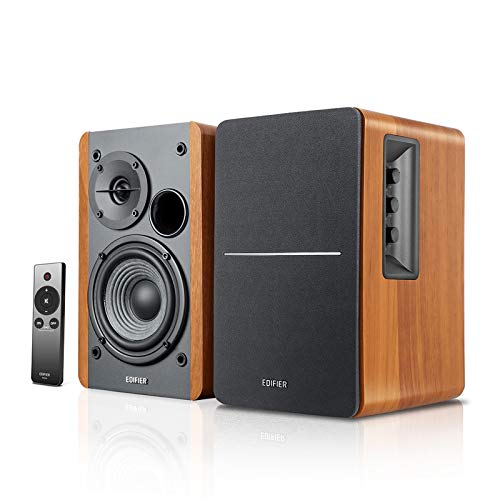
Edifier R1280Ts Powered Bookshelf Speakers
Best for: Wired stereo monitoring with subwoofer expansion
- Woofer Size
- 4-inch
- Total Wattage
- 42 Watts RMS
- Audio Inputs
- Dual RCA
- Acoustic Tuning
- Side panel EQ knobs
- Tweeter Type
- 13mm silk dome
- Speaker Type
- Powered
The Edifier R1280Ts are powered bookshelf speakers designed for stereo studio monitoring. They deliver 42W of continuous power through a 4-inch sub-woofer and a 13mm silk dome tweeter. You get dual RCA inputs for connecting two devices simultaneously and a dedicated sub-out port for expanded bass. The unit weighs 10.8 pounds and measures 17 inches wide. You can adjust EQ settings using side panel knobs or a remote.
- 42W continuous undistorted power output
- Dual RCA inputs for simultaneous device connection
- Extra sub-out port with automatic detection
- Side panel knobs for bass, treble, and volume control
- Remote control for volume and mute adjustments
- Heavier build at 10.8 pounds compared to lighter desktop monitors
- Larger footprint with 17-inch width requiring more shelf space
- Lower 4-inch driver size limits deep bass extension compared to larger studio monitors
- You need a subwoofer output for expanded low-frequency response
- You want to connect two devices via RCA without swapping cables
- You prefer physical knobs for quick EQ adjustments on the speaker
- You require Bluetooth wireless connectivity for streaming
- You need a compact speaker under 12 inches in width
- You want a lighter monitor under 8 pounds for easy relocation
Verdict: Edifier R1280Ts Brown Bookshelf Speakers fit listeners who need a wired stereo setup with a subwoofer output and physical EQ controls. You should choose this model if you have shelf space for a 17-inch unit and do not require wireless features.

Pioneer DJ 4-inch Active Desktop Monitor Speakers
Best for: small desk DJ setups
- Woofer Size
- 4-inch
- Acoustic Tuning
- DSP
- Speaker Type
- Powered
- Use
- Desktop
- Color
- Black
- Dimensions
- 11 × 14.8 × 13 inches
The Pioneer DJ DM-40D is a pair of powered 4-inch desktop monitors designed for production desks. These active speakers include built-in amplification, so you connect them directly to your gear without a separate amp. DSP tuning provides balanced sound with a punchy low end. They measure 11 by 14.6 by 13 inches and weigh 1 pound. This compact size fits well in tight spaces while delivering clear audio for mixing and monitoring.
- 4-inch woofer delivers punchy, defined low end
- Built-in amplification for simple direct connection
- DSP tuning ensures clear, balanced sound
- Compact 11 x 14.6 x 13 inch footprint
- 4-inch woofer size is smaller than larger studio monitors
- 1-pound weight per speaker limits bass depth compared to larger cabinets
- You need compact speakers for a small home DJ desk
- You want direct connectivity without buying a separate amplifier
- You prioritize defined low end in a small form factor
- You require larger woofers for deep bass response
- You need a passive speaker design requiring external amplification
- You want a larger footprint for maximum sound dispersion
Verdict: Pioneer DJ DM-40D 4-inch Desktop Monitor is a compact, active solution for DJs who need balanced sound in a small space. It fits users with limited desk room who want direct connectivity without extra gear.
Specifications side by side
| Spec | Edifier R1280Ts Powered Bookshelf Speakers | Pioneer DJ 4-inch Active Desktop Monitor Speakers |
|---|---|---|
| Woofer Size | 4-inch | 4-inch |
| Total Wattage | 42 Watts RMS | – |
| Audio Inputs | Dual RCA | – |
| Acoustic Tuning | Side panel EQ knobs | DSP |
| Tweeter Type | 13mm silk dome | – |
| Speaker Type | Powered | Powered |
| Use | Studio Monitoring | Desktop |
| Features | Subwoofer Output | – |
| Color | Brown | Black |
| Recommended Use | Stereo | – |
| Placement | Bookshelf | – |
| Dimensions | 17 × 12.6 × 7.2 inches | 11 × 14.8 × 13 inches |
| Weight | 10.8 pounds | 1 pounds |
| Model | R1280TS | DM-40D |
| Size | – | 14.60 x 13.80 x 11.10 in" |
Frequently asked questions
Which brand offers better stereo imaging for general music listening?
Edifier is the better choice for stereo imaging. The R1280Ts is designed as a stereo active near-field monitor. It emphasizes wide sound staging and detailed separation. This makes it suitable for critical listening and general music enjoyment rather than just DJ cueing.
Can I connect a subwoofer to the Pioneer DJ DM-40D?
No, the Pioneer DJ DM-40D does not include a subwoofer output. Its design focuses on compact desktop use with a 4-inch woofer. If you need bass extension, the Edifier R1280Ts is the correct option. It features a dedicated subwoofer output for expanding your low-frequency response.
Are these monitors suitable for small desk setups?
The Pioneer DJ DM-40D is ideal for small desks. Its compact dimensions allow it to fit easily on tight workspaces. The Edifier R1280Ts is larger and heavier. It requires more shelf space and is better suited for larger rooms or dedicated listening positions rather than cramped desks.
Do I need an external amplifier for these speakers?
You do not need an external amplifier for either brand. Both the Edifier R1280Ts and Pioneer DJ DM-40D are powered speakers. They contain built-in amplification and connect directly to your audio source. This simplifies your setup by removing the need for additional gear.
Which speaker is better for DJ cueing and mixing?
The Pioneer DJ DM-40D is better for DJ workflows. It provides balanced, punchy sound focused on clarity. This helps in mixing and cueing tracks accurately. The Edifier R1280Ts prioritizes stereo imaging and bass, which is less critical for precise DJ monitoring than the focused response of the Pioneer unit.
What color options are available for these monitors?
The Edifier R1280Ts comes in a brown finish. The Pioneer DJ DM-40D is available in black. These colors help the speakers blend into different studio or home environments. Choose the color that best matches your existing equipment and decor preferences.
Which model weighs less for easier transport?
The Pioneer DJ DM-40D weighs significantly less. It is lighter and more portable due to its compact design. The Edifier R1280Ts is heavier at 10.8 pounds. If you need to move your monitors frequently, the lighter Pioneer unit offers better portability.


