JBL vs ADAM Audio: Studio Monitors Compared by Specs
As Amazon Associates, we earn from qualifying purchases. This means we may receive a small commission at no extra cost to you if you click through and make a purchase.
As an Amazon Associate we earn from qualifying purchases. Links on this page are affiliate links.
This JBL vs ADAM Audio studio monitor comparison looks at two active speakers for different workflows. Both units are powered monitors designed for accurate sound reproduction in studio or desktop environments. The main difference lies in their driver sizes and connectivity options. The JBL 305P MkII features a larger 5-inch woofer and traditional balanced inputs, while the ADAM Audio D3V uses a smaller 3.5-inch driver with USB-C direct connection. You should choose based on your room size and device setup.
Woofer Size
5 inches
3.5 inches
Tweeter Type
Image Control Waveguide
D-ART Ribbon
Connectivity
XLR/TRS
USB-C, TRS
Low Frequency Extension
Not listed
45 Hz
Included Stands
Not listed
Yes, detachable 15° stands
Weight
10.4 pounds
7.89 pounds
Choose the first if
- You need deeper bass response for larger rooms or cinematic sound design.
- You prefer standard XLR or TRS connections for your audio interface.
- You want a larger driver size for more dynamic range.
Choose the second if
- You want direct USB-C connection to your computer without extra cables.
- You have limited desk space and need lighter, compact monitors.
- You want included angled stands for immediate setup.
Verdict
The JBL 305P MkII is better for producers who need more bass and traditional studio connectivity. The ADAM Audio D3V suits users with smaller desks who value direct USB-C integration and included stands.
JBL 305P MkII vs ADAM D3V Specs
Woofer Size
Edge: JBL 305P MkII 5" Powered Studio Monitor
The JBL 305P MkII features a 5-inch woofer, providing a larger surface area for moving air compared to the ADAM Audio D3V. The ADAM unit uses a smaller 3.5-inch aluminum woofer. A larger driver generally supports better low-frequency extension and higher output levels. The JBL specification lists a 5-inch cone, while the ADAM D3V relies on its passive radiators to extend bass down to 45 Hz. For critical mixing where bass response is key, the JBL offers a larger physical driver. The ADAM design prioritizes compactness with its smaller cone size.
Amplifier Power
Edge: JBL 305P MkII 5" Powered Studio Monitor
Power handling differs significantly between these two active monitors. The JBL 305P MkII utilizes dual 41-Watt Class-D amplifiers, resulting in a total output of 82 Watts. In contrast, the ADAM Audio D3V is driven by 80-Watt amplifiers. While the numbers are close, the JBL specifies a slightly higher total wattage across its dual amplifier setup. This power difference may influence maximum volume levels and dynamic headroom. The ADAM D3V delivers 80 Watts total. Both units use Class-D technology for efficiency. The JBL holds a slight numerical advantage in total amplifier power.
Connectivity
Edge: ADAM Audio D3V 3.5in Powered Desktop Monitor
Input options vary to suit different workflow needs. The JBL 305P MkII provides XLR and TRS inputs, which are standard professional connections for studio interfaces and mixers. The ADAM Audio D3V offers balanced 1/4-inch inputs and USB-C connectivity. USB-C allows for direct connection to computers and mobile devices, simplifying setup for desktop users. The JBL lacks explicit USB digital input in its listed features, relying on analog connections. The ADAM includes a headphone socket on the front panel for private monitoring. The ADAM D3V offers more versatile digital and analog options for modern desktop setups.
Dimensions
Edge: ADAM Audio D3V 3.5in Powered Desktop Monitor
Physical footprint is a major consideration for desk space. The JBL 305P MkII measures 12.2 inches in width, 13.9 inches in height, and weighs 10.4 pounds. The ADAM Audio D3V is significantly smaller, measuring 4.5 inches in width, 9.5 inches in height, and weighing 7.89 pounds. The JBL requires a larger surface area and is heavier. The ADAM D3V is designed for tight desktop environments where space is limited. Its compact size makes it easier to position on smaller desks. The ADAM D3V is the clear choice for users with limited desk space.
Room Correction
Edge: Tie
Acoustic adjustment features help tailor sound to your room. The JBL 305P MkII includes Boundary EQ and HF Trim controls. These allow you to adjust low and high frequencies to compensate for room boundaries and placement. The ADAM Audio D3V features DSP-powered switches on the backplate to address common acoustical issues. Both units provide tools to fine-tune sound based on your environment. The JBL uses analog-style trim controls, while the ADAM uses DSP switches. Both approaches offer practical solutions for optimizing monitor performance in different rooms. This results in a tie for acoustic flexibility.
Tweeter Type
Edge: ADAM Audio D3V 3.5in Powered Desktop Monitor
High-frequency reproduction relies on different driver technologies. The JBL 305P MkII uses a patented Image Control Waveguide with a standard dome tweeter configuration, though the specific tweeter material is not detailed in the specs. The ADAM Audio D3V features a 1.5-inch D-ART (Desktop Accelerated Ribbon Tweeter). Ribbon tweeters are known for precise and unfatiguing high-frequency reproduction. The ADAM explicitly highlights this technology for its clarity. The JBL focuses on wide imaging through its waveguide design. The ADAM D3V offers a specific tweeter technology that may appeal to users seeking detailed highs.
Which studio monitor fits your workflow
Desktop producers needing compact setup
Our pick: ADAM Audio D3V 3.5in Powered Desktop Monitor
The ADAM Audio D3V offers a smaller footprint with 3.5-inch woofers and passive radiators. Its USB-C connectivity allows direct computer connection. The included stands angle sound toward your ears. This compact design suits tight desks where space is limited and direct digital input is preferred.
Users requiring deep bass response
Our pick: JBL 305P MkII 5" Powered Studio Monitor
The JBL 305P MkII uses a 5-inch woofer and Slip Stream port for deeper low-end extension. Dual 41-Watt amplifiers drive the drivers for dynamic range. This larger driver size moves more air than the smaller ADAM unit, providing stronger bass presence for cinematic sound design and music production.
Those needing room correction controls
Our pick: JBL 305P MkII 5" Powered Studio Monitor
The JBL 305P MkII includes Boundary EQ and HF Trim switches to adjust frequency response. These controls help tailor the sound to your specific room acoustics. This feature ensures accurate mixes by compensating for placement issues, making it a practical choice for variable studio environments.

JBL 305P MkII 5" Powered Studio Monitor
Best for: Producers needing precise imaging and adjustable EQ
- Woofer Size
- 5-inch
- Total Wattage
- Dual 41-Watt
- Audio Inputs
- XLR/TRS
- Acoustic Tuning
- Boundary EQ and HF Trim
- Speaker Type
- Powered
- Color
- Black
The JBL 305P MkII is a pair of 5-inch active studio monitors designed for accurate sound reproduction. It features dual 41-watt Class-D amplifiers and a 5-inch woofer with a Slip Stream port for deep bass. The patented Image Control Waveguide provides a wide sweet spot for mixing. Boundary EQ and HF Trim allow you to adjust frequencies for your room. This setup suits producers and podcasters who need reliable, tailored audio in a compact 10.4-pound enclosure.
- Dual 41-watt Class-D amplifiers for dynamic range
- 5-inch woofer with Slip Stream port for deep bass
- Image Control Waveguide for precise imaging and wide sweet spot
- Boundary EQ and HF Trim for room-specific adjustments
- 5-inch woofer size is smaller than 6.5-inch options
- 10.4-pound weight per speaker is bulkier than lighter alternatives
- You need a wide sweet spot for critical listening
- You want adjustable EQ to match your room acoustics
- You require dual 41-watt amplification for clear imaging
- You need a woofer larger than 5 inches
- You prefer a lighter monitor under 10 pounds
- You do not need room correction adjustments
Verdict: JBL 305P MkII 5-Inch Studio Monitor fits producers who need precise imaging and adjustable EQ in a 5-inch package.
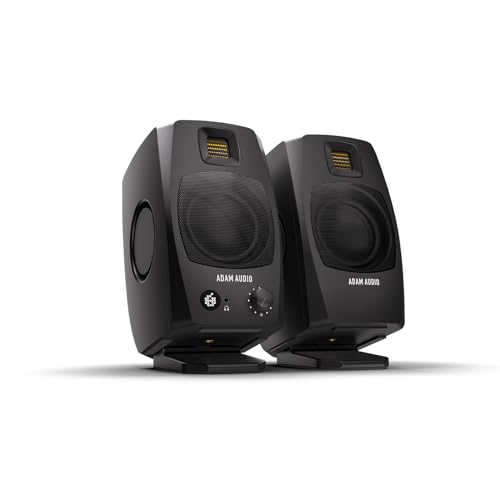
ADAM Audio D3V 3.5in Powered Desktop Monitor
Best for: compact desktop studio monitoring
- Woofer Size
- 3.5"
- Total Wattage
- 240 W
- Audio Inputs
- USB-C, balanced 1/4" TRS
- Frequency Response
- 45 Hz – 23 kHz
- Acoustic Tuning
- DSP-powered switches
- Tweeter Type
- 1.5" D-ART ribbon
The ADAM Audio D3V is a 240W active desktop studio monitor designed for producers and songwriters. It features a 3.5-inch aluminum woofer paired with a 1.5-inch D-ART ribbon tweeter. The system extends low-frequency response down to 45 Hz. You can connect directly via USB-C or use balanced 1/4-inch inputs. DSP switches on the backplate help manage room acoustics. The package includes detachable stands angled at 15 degrees for optimal listening.
- 240W total power output drives the woofer and tweeter
- D-ART ribbon tweeter provides precise high-frequency reproduction
- Dual-sided passive radiators extend bass response to 45 Hz
- USB-C connectivity allows direct connection to computers
- Includes detachable stands with 15-degree upward angle
- 3.5-inch woofer size is smaller than the 5-inch driver in the JBL 305P MkII
- 7.89-pound weight per unit is heavier than typical compact monitors
- Maximum frequency response is not listed in the data
- You need a compact monitor that fits on a small desk
- You want ribbon tweeter technology for detailed high frequencies
- You require USB-C connectivity for direct computer connection
- You need a larger 5-inch woofer for deeper bass extension
- You prefer a lighter monitor for easy portability
- You require a wider range of listed frequency specifications
Verdict: ADAM Audio D3V 3.5in Desktop Monitor suits users who prioritize ribbon tweeter clarity and USB-C convenience in a compact form factor. It is ideal for desktop setups where space is limited but precise monitoring is required.
Specifications side by side
| Spec | JBL 305P MkII 5" Powered Studio Monitor | ADAM Audio D3V 3.5in Powered Desktop Monitor |
|---|---|---|
| Woofer Size | 5-inch | 3.5" |
| Total Wattage | Dual 41-Watt | 240 W |
| Audio Inputs | XLR/TRS | USB-C, balanced 1/4" TRS |
| Frequency Response | – | 45 Hz – 23 kHz |
| Acoustic Tuning | Boundary EQ and HF Trim | DSP-powered switches |
| Tweeter Type | – | 1.5" D-ART ribbon |
| Speaker Type | Powered | Powered |
| Connectivity | – | TRS |
| Use | – | Studio Monitoring, Desktop |
| Features | – | USB Recording, USB-C |
| Color | Black | Black |
| Design | 2-Way | – |
| Dimensions | 14 × 12.2 × 13.9 inches | 7.88 × 4.5 × 9.5 inches |
| Weight | 10.4 pounds | 12 pounds |
| Size | 5-inch Speaker | 8.50 |
| Model | 305PMKIISET | AMS-D3V-Black |
Frequently asked questions
Which studio monitor is better for small desktop spaces?
The ADAM Audio D3V is the better choice for tight desks. Its physical dimensions are 4.5 inches wide, 9.5 inches high, and 7.88 inches deep. It weighs only 7.89 pounds. This compact form factor fits easily on crowded workspaces. The JBL 305P MkII is significantly larger and heavier, making it less suitable for limited areas.
Does the ADAM D3V connect directly to a computer?
Yes, the ADAM Audio D3V includes USB-C connectivity. This allows for direct connection to a computer for both audio and control. The JBL 305P MkII relies on traditional analog inputs like TRS. You will need an audio interface or mixer to connect the JBL unit to your digital workstation.
Which speaker has a larger woofer for deeper bass?
The JBL 305P MkII features a 5-inch woofer, which is larger than the ADAM Audio D3V. The ADAM unit uses a smaller 3.5-inch aluminum woofer. A larger driver generally moves more air, providing a wider low-frequency response. The JBL design is better for producers needing precise imaging in the lower mids and bass.
Are these monitors active or passive?
Both the JBL 305P MkII and the ADAM Audio D3V are powered, or active, monitors. They contain built-in amplifiers, so you do not need an external amplifier. You simply connect them to power and your audio source. This design simplifies setup for both studio and desktop environments.
What is the weight difference between these two monitors?
The JBL 305P MkII weighs 10.4 pounds. The ADAM Audio D3V is lighter at 7.89 pounds. The JBL unit is also taller and wider. The ADAM model is more portable and easier to reposition on a desk. The weight difference reflects the size of the drivers and internal components in each cabinet.
Which monitor is designed for precise imaging and EQ adjustment?
The JBL 305P MkII is best for producers needing precise imaging and adjustable EQ. Its 5-inch driver and 2-way design support detailed sound reproduction. The ADAM Audio D3V focuses on compact monitoring with USB-C convenience. If you require extensive tonal control in a 5-inch package, the JBL is the stronger option.
Can I use the ADAM D3V for professional studio monitoring?
Yes, the ADAM Audio D3V is designed for studio monitoring and desktop use. It features a ribbon tweeter for clarity and a compact form factor. While it has a smaller 3.5-inch woofer, it delivers accurate sound for close-field listening. It suits users who prioritize clarity and space-saving in a professional or home studio setting.


