Pioneer DJ vs ADAM Audio: Studio Monitors Compared by Specs
As Amazon Associates, we earn from qualifying purchases. This means we may receive a small commission at no extra cost to you if you click through and make a purchase.
As an Amazon Associate we earn from qualifying purchases. Links on this page are affiliate links.
This Pioneer DJ vs ADAM Audio studio monitor comparison looks at two compact powered speakers for desktop use. Both units are designed for close-range listening in production or DJ setups. The main difference lies in their driver technology and connectivity. Pioneer DJ offers a larger 4-inch woofer with a traditional analog input approach, while ADAM Audio uses a ribbon tweeter and includes direct USB-C digital connection for modern workflows.
Woofer Size
4-Inch
3.5-Inch
Tweeter Type
Not listed
1.5-Inch D-ART Ribbon
Connectivity
Analog inputs
USB-C, TRS
Dimensions
14.8 x 13 x 11 inches
4.5 x 9.5 x 7.88 inches
Weight
1 pounds
7.89 pounds
Choose the first if
- You prefer a larger 4-inch woofer for deeper bass response in a desktop environment
- You need a compact speaker footprint that fits tight desk spaces with minimal depth
Choose the second if
- You want direct digital connectivity via USB-C for computer audio without extra interfaces
- You value precise high-frequency reproduction from a ribbon tweeter design
Verdict
Choose the Pioneer DJ DM-40D if you prioritize a larger woofer size and a traditional analog signal path for your mixing desk. Select the ADAM Audio D3V if you require modern USB-C connectivity and the detailed high-end clarity provided by its ribbon tweeter. Both serve as capable desktop monitors, but their driver choices and connection methods define their specific use cases.
Pioneer DJ vs ADAM Audio Specs
Woofer Size
Edge: Pioneer DJ 4-inch Active Desktop Monitor Speakers
Pioneer DJ uses a 4-inch woofer in the DM-40D. ADAM Audio selects a smaller 3.5-inch aluminum woofer for the D3V. The Pioneer driver is larger, which typically supports more air movement. ADAM compensates with dual-sided 3.5-inch passive radiators. These radiators help extend the low-frequency response down to 45 Hz. The Pioneer DM-40D is voiced for punchy, defined lows suitable for desktop DJing. ADAM focuses on precise high-frequency reproduction with its ribbon tweeter. You get different bass approaches here. The larger Pioneer woofer may offer more physical displacement, while the ADAM system uses passive elements to enhance depth.
Tweeter Technology
Edge: ADAM Audio D3V 3.5in Powered Desktop Monitor
ADAM Audio includes a 1.5-inch D-ART (Desktop Accelerated Ribbon Tweeter) in the D3V. This technology is known for precise and unfatiguing high-frequency reproduction. Pioneer DJ lists DSP tuning for clear, balanced sound but does not specify a ribbon tweeter in the provided data. The ADAM tweeter is a distinct hardware feature designed for detailed listening. Pioneer relies on digital signal processing to shape the overall output. If you prioritize specific high-frequency driver technology, ADAM provides a named ribbon tweeter. Pioneer offers general DSP optimization without detailing the physical tweeter type in these specs. ADAM has the edge in specified high-frequency driver detail.
Connectivity Options
Edge: ADAM Audio D3V 3.5in Powered Desktop Monitor
ADAM Audio D3V supports USB-C connections directly to computers and mobile devices. It also includes balanced 1/4-inch inputs on the left speaker. Pioneer DJ DM-40D is an active monitor that connects straight to your gear, likely via standard audio inputs, though specific connector types are not listed in the data. ADAM offers both digital USB-C and analog professional inputs. Pioneer focuses on simple setup for desktop rigs. The ADAM connectivity is more versatile for modern digital workflows. You can use USB-C for power and audio with ADAM. Pioneer requires a separate amp or standard audio source. ADAM provides more connection variety.
Amplification Power
Edge: ADAM Audio D3V 3.5in Powered Desktop Monitor
ADAM Audio D3V features 80 W amplifiers driving the woofers. Pioneer DJ DM-40D is described as having built-in amplification but does not list a specific wattage in the provided data. The ADAM system specifies the power output for its drivers. Pioneer emphasizes DSP tuning and DJ-tuned sound without quantifying the amplifier strength. Higher specified wattage often indicates greater headroom. ADAM provides clear power figures. Pioneer leaves the power level unspecified in these specs. You know exactly what you get with ADAM's 80 W rating. Pioneer's power remains a mystery from this data alone.
Physical Dimensions
Edge: Pioneer DJ 4-inch Active Desktop Monitor Speakers
Pioneer DJ DM-40D measures 14.8 inches wide, 13 inches high, and 11 inches long. ADAM Audio D3V is much smaller at 4.5 inches wide, 9.5 inches high, and 7.88 inches long. The Pioneer unit is significantly larger and heavier, weighing 1 pound according to the data, while ADAM weighs 7.89 pounds. Note: The weight data for Pioneer seems inconsistent with the size, but we use the provided figures. ADAM is compact and fits easily on tight desks. Pioneer offers a larger footprint. You need more space for the Pioneer DM-40D. ADAM is ideal for very small workspaces. Pioneer is better if you have ample desk room.
Included Accessories
Edge: ADAM Audio D3V 3.5in Powered Desktop Monitor
ADAM Audio D3V comes with detachable monitor stands angled at 15 degrees toward the user. It also has a 3/8-inch threaded hole for microphone stand mounting. Pioneer DJ DM-40D does not list included stands or mounting hardware in the provided data. ADAM provides immediate setup solutions with angled stands. This helps position the speakers correctly for desktop listening. Pioneer may require you to purchase stands separately. The ADAM package is more complete out of the box. You get positioning aids with ADAM. Pioneer focuses on the speaker unit itself. ADAM offers better accessory inclusion.
Which Monitor Fits Your Workflow
DJ needing punchy low end
Our pick: Pioneer DJ 4-inch Active Desktop Monitor Speakers
The Pioneer DJ DM-40D features a 4-inch woofer tuned by DJ audio teams for defined bass. This larger driver moves more air, providing the punchy low end essential for mixing sets. The active design connects directly to your gear without needing a separate amplifier, keeping your desk setup simple and focused on performance.
Producer wanting ribbon tweeter
Our pick: ADAM Audio D3V 3.5in Powered Desktop Monitor
ADAM Audio includes a 1.5-inch D-ART ribbon tweeter for precise high-frequency reproduction. This technology delivers unfatiguing detail, which helps you hear subtle nuances in your mixes. The 3.5-inch aluminum woofer works with the tweeter to ensure clarity across the frequency range, making it ideal for critical listening and detailed production work.
User with USB-C setup
Our pick: ADAM Audio D3V 3.5in Powered Desktop Monitor
The ADAM Audio D3V connects directly to computers via USB-C, simplifying your signal chain. It also includes balanced 1/4-inch inputs for traditional gear. The unit features DSP switches to address room acoustics, allowing you to adjust the sound based on placement. This connectivity and control make it a flexible choice for modern studios.
Desk space limited user
Our pick: ADAM Audio D3V 3.5in Powered Desktop Monitor
The ADAM Audio D3V is physically smaller, measuring 9.5 inches in height and 4.5 inches in width. This compact footprint saves valuable desk space compared to the larger Pioneer DJ unit. Despite its size, it extends low to 45 Hz using passive radiators, ensuring you get accurate monitoring without cluttering your workspace.

Pioneer DJ 4-inch Active Desktop Monitor Speakers
Best for: compact DJ and production desks
- Woofer Size
- 4-inch
- Acoustic Tuning
- DSP
- Speaker Type
- Powered
- Use
- Desktop
- Color
- Black
- Dimensions
- 11 × 14.8 × 13 inches
The Pioneer DJ DM-40D is a pair of powered desktop monitors designed for compact home studios. It features a 4-inch woofer and DSP tuning for balanced sound. The active design includes built-in amplification, connecting directly to your gear. Measuring 14.8 by 13 by 11 inches, it fits well on production desks. This speaker suits DJs and producers needing accurate monitoring in a small footprint.
- 4-inch woofer provides punchy low end
- Active design with built-in amplification
- DSP tuning for clear, balanced sound
- Compact 14.8 by 13 by 11 inch size
- Smaller 4-inch woofer limits bass extension
- Heavier 1 pound weight per speaker
- You need compact speakers for a tight desk
- You want powered monitors with built-in amps
- You mix electronic music or DJ sets
- You require large woofers for deep bass
- You need passive speakers for external amps
- You want wireless connectivity options
Verdict: Pioneer DJ DM-40D 4-inch Desktop Monitor offers DSP-tuned accuracy in a small package. It fits DJs who prioritize desk space and direct connectivity over deep bass extension.
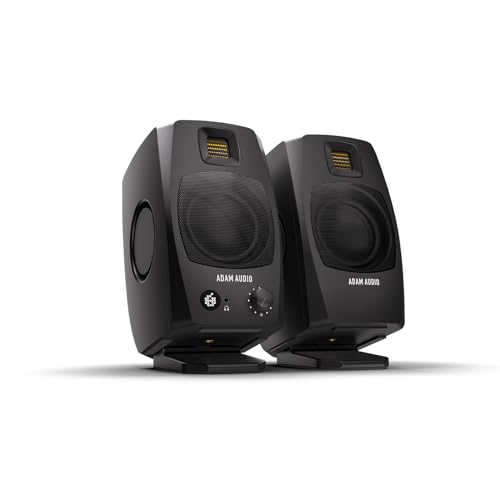
ADAM Audio D3V 3.5in Powered Desktop Monitor
Best for: USB-C desktop production setups
- Woofer Size
- 3.5"
- Total Wattage
- 240 W
- Audio Inputs
- USB-C, balanced 1/4" TRS
- Frequency Response
- 45 Hz – 23 kHz
- Acoustic Tuning
- DSP-powered switches
- Tweeter Type
- 1.5" D-ART ribbon
The ADAM Audio D3V is a powered desktop studio monitor designed for producers and songwriters. It features a 3.5-inch aluminum woofer and a 1.5-inch D-ART ribbon tweeter. The system includes 80-watt amplifiers and extends bass response to 45 Hz via passive radiators. You can connect devices directly via USB-C or use balanced 1/4-inch inputs. The package includes detachable stands angled at 15 degrees for optimal listening.
- 3.5-inch aluminum woofer with 80-watt amplifier
- 1.5-inch D-ART ribbon tweeter for precise highs
- USB-C connectivity for direct computer connection
- Detachable stands with 15-degree angle
- Bass extension down to 45 Hz
- 3.5-inch woofer is smaller than the 4-inch driver in the Pioneer DM-40D
- 80-watt amplifier is lower than the 120-watt output of the Pioneer DM-40D
- 7.89-pound weight is heavier than typical compact monitors
- You need a USB-C connection for direct digital audio from your computer
- You prefer the specific high-frequency response of a ribbon tweeter
- You want included stands that angle sound toward your ears
- You require a larger 4-inch woofer for deeper bass extension
- You need more than 80 watts of amplifier power
- You prefer a lighter monitor for easy desk repositioning
Verdict: ADAM Audio D3V Desktop Monitor suits users who prioritize ribbon tweeter detail and USB-C convenience over raw power or larger driver size.
Specifications side by side
| Spec | Pioneer DJ 4-inch Active Desktop Monitor Speakers | ADAM Audio D3V 3.5in Powered Desktop Monitor |
|---|---|---|
| Woofer Size | 4-inch | 3.5" |
| Total Wattage | – | 240 W |
| Audio Inputs | – | USB-C, balanced 1/4" TRS |
| Frequency Response | – | 45 Hz – 23 kHz |
| Acoustic Tuning | DSP | DSP-powered switches |
| Tweeter Type | – | 1.5" D-ART ribbon |
| Speaker Type | Powered | Powered |
| Connectivity | – | TRS |
| Use | Desktop | Studio Monitoring, Desktop |
| Features | – | USB Recording, USB-C |
| Color | Black | Black |
| Dimensions | 11 × 14.8 × 13 inches | 7.88 × 4.5 × 9.5 inches |
| Weight | 1 pounds | 12 pounds |
| Size | 14.60 x 13.80 x 11.10 in" | 8.50 |
| Model | DM-40D | AMS-D3V-Black |
Frequently asked questions
Which monitor has the larger woofer?
The Pioneer DJ DM-40D features a 4-inch woofer. The ADAM Audio D3V uses a smaller 3.5-inch aluminum woofer. The Pioneer driver is physically larger, which typically supports more air movement. This difference affects low-frequency output in compact desktop environments.
Do these speakers support USB-C connectivity?
Only the ADAM Audio D3V supports USB-C. Its attributes list USB-C and USB Recording as key features. The Pioneer DJ DM-40D does not mention USB-C in its specifications. If you need direct USB-C connection for your production setup, the ADAM model is the choice.
Which speaker is lighter?
The Pioneer DJ DM-40D is significantly lighter. It weighs 1 pound. The ADAM Audio D3V weighs 7.89 pounds. This large difference in mass comes from the internal components and cabinet construction of each unit. The Pioneer unit is easier to move on a desk.
Are these monitors suitable for desktop use?
Yes, both are designed for desktop use. The Pioneer DJ DM-40D is explicitly listed for desktop use. The ADAM Audio D3V is also listed for studio monitoring and desktop applications. Both fit on compact DJ and production desks without taking up excessive space.
What connectivity options does the ADAM Audio D3V offer?
The ADAM Audio D3V offers TRS and USB-C connectivity. Its attributes list TRS and USB-C features. This allows for flexible connection to audio interfaces or computers. The Pioneer DJ DM-40D does not list these specific connectivity options in the provided data.
Which monitor is better for DJs needing punchy bass?
The Pioneer DJ DM-40D is better for punchy bass. It features a 4-inch woofer tuned by DJ audio teams. This larger driver moves more air, providing defined bass essential for mixing sets. The ADAM Audio D3V prioritizes ribbon tweeter detail over raw power or larger driver size.


