What Is Subwoofer? A Guide for Soundbars Buyers (2026)
As Amazon Associates, we earn from qualifying purchases. This means we may receive a small commission at no extra cost to you if you click through and make a purchase.
As an Amazon Associate we earn from qualifying purchases. Links on this page are affiliate links.
What Is a Wireless Subwoofer?
A wireless subwoofer is a dedicated speaker component designed to reproduce low-frequency sounds. In a soundbar system, it handles the deep bass that smaller drivers cannot produce effectively. This separation allows the main soundbar to focus on mid-range and high-frequency audio, resulting in clearer dialogue and sharper instrument details. The subwoofer itself is responsible for the rumble of explosions, the thump of drums, and the low notes of bass guitars.
The term "wireless" refers to the connection method between the subwoofer and the main soundbar unit. It does not mean the subwoofer has no power cord. You still need to plug the subwoofer into a wall outlet for electricity. The wireless aspect describes how it communicates with the soundbar. Most systems use a proprietary radio frequency or Bluetooth link. This eliminates the need for a long, visible audio cable running across your room. This setup keeps your living space tidy and allows flexible placement.
When shopping, you will see this spec listed as "Wireless Subwoofer" or sometimes just "Subwoofer." It is important to distinguish this from a built-in subwoofer. A built-in unit is enclosed within the soundbar chassis. A separate wireless subwoofer is a standalone box. You can place it on the floor, in a corner, or behind a sofa. This flexibility helps you find the best spot for bass response in your specific room layout.
Buyers care about this spec because it defines the low-end performance of your audio setup. Without a dedicated subwoofer, bass can sound thin or muddy. With one, you get physical impact and depth. The wireless feature adds convenience. It simplifies installation and reduces cable clutter. You get the benefits of a full-range audio experience without the hassle of complex wiring. This makes it a key consideration for anyone looking to upgrade their home theater sound.
Understanding what a subwoofer explained means helps you set realistic expectations. It is not a magic fix for poor room acoustics. However, it is the primary driver for deep, resonant sound. It completes the audio spectrum, providing the foundation for a cinematic listening experience. If you value immersive audio, this component is essential.
Wireless Subwoofer Options Compared
Wireless Subwoofer
A wireless subwoofer connects to the main soundbar without a dedicated audio cable. This removes the need to run a thick bass cable across your room, allowing you to place the sub in any corner for optimal bass response. You gain flexibility in room layout and furniture placement. The trade-off is reliance on a wireless signal, which can occasionally drop if obstacles interfere. For example, the TCL Q65H uses this setup to deliver immersive 5.1 audio without rear speaker clutter. The Samsung HW-B750D offers a compact wireless sub for clear dialogue and bass. The LG S60T and JBL Bar 1300XMK2 also use wireless subs for reliable low-frequency performance. This configuration suits buyers who prioritize clean aesthetics and easy installation over wired connections.
Wireless Subwoofer
This spec indicates the bass unit operates independently of the main bar's physical wiring. It simplifies setup by eliminating cable management for the low-end driver. You can position the subwoofer away from the TV stand to find the best acoustic spot in your living space. The JBL Bar 1300XMK2 leverages this for its 11.1.4 system, ensuring deep bass does not clutter the main unit. The Samsung Q600F also uses a wireless sub to maintain a compact footprint while delivering strong bass. This approach is ideal for those who want a tidy look without sacrificing low-frequency impact. It works well in rooms where running cables is difficult or undesirable. You get consistent bass performance without the visual distraction of wires connecting the sub to the bar.
Who Needs a Wireless Subwoofer
Who needs it
You should prioritize a system with a wireless subwoofer if you value deep, impactful bass in your home audio setup. This component is essential for movie enthusiasts who want to feel explosions and rumbling soundtracks as intended by filmmakers. The wireless connection offers significant placement flexibility, allowing you to position the sub in a corner or away from the main viewing area without running unsightly cables across your living space. This separation also helps reduce vibration transmission to your soundbar, potentially improving overall clarity. If you frequently watch action films or play immersive games, the dedicated low-frequency reproduction provided by a separate unit will enhance your engagement. It is particularly useful in larger rooms where a single soundbar cannot fill the space with sufficient low-end energy. You will appreciate the clean aesthetic and the powerful, controlled bass that defines a complete cinematic experience.
Who can skip it
You can skip the wireless subwoofer if you primarily listen to music, podcasts, or news programs where deep bass is less critical. Listeners who prefer clear dialogue and mid-range frequencies may find a dedicated sub unnecessary and potentially overwhelming. If you live in a small apartment or have thin walls, the low-frequency vibrations from a subwoofer might disturb neighbors or cause structural resonance issues. In such cases, focusing on a soundbar with strong built-in bass drivers or a compact satellite speaker system is more practical. You should also consider skipping this feature if you have limited space, as the additional footprint of a separate sub unit may clutter your entertainment center. Prioritizing a sleek, all-in-one soundbar with good directivity will serve your needs better. Your attention should remain on dialogue clarity and room-filling stereo imaging rather than earth-shaking low frequencies.
Subwoofer Glossary Terms
Speaker Type
The category of audio component. A subwoofer is a dedicated speaker designed specifically to reproduce low-frequency sounds that main speakers cannot handle effectively.
Connectivity
How the device links to your system. Wireless subwoofers use radio signals to pair with the soundbar, eliminating the need for long audio cables across your room.
Woofer Size
The diameter of the main driver, usually measured in inches. Larger sizes like 6.5 or 8 inches typically move more air to produce deeper, more powerful bass.
Use
The intended application for the audio gear. Subwoofers are essential for home theater setups to deliver the rumbling effects and deep bass found in movies and music.
Features
Additional capabilities beyond basic sound. Common features include adjustable bass levels, phase controls, and wireless pairing protocols that help integrate the subwoofer seamlessly into your audio system.
Channels
The number of audio paths in a system. A standard setup often includes a soundbar for center and surround channels, plus a separate subwoofer channel for low frequencies.
Audio Format
The method used to encode sound data. Subwoofers handle the Low-Frequency Effects (LFE) channel, which carries specific bass information encoded in formats like Dolby Digital.
Color
The physical finish of the enclosure. Common options include black or white to help the subwoofer blend discreetly into your living room decor or match other audio gear.
| # | Product | Best for | Price |
|---|---|---|---|
| 1 | TCL Q65H 5.1ch Soundbar | Immersive 5.1 sound without rear speakers | |
| 2 | Polk Audio Signa S3 Slim Soundbar | small spaces and clear dialogue | |
| 3 | Samsung HW-B750D 5.1ch Soundbar | dialogue clarity and compact wireless bass | |
| 4 | LG S60T 3.1ch Soundbar with Wireless Sub | LG TV owners seeking clear dialogue | |
| 5 | JBL Bar 1300XMK2 11.1.4 System | Immersive 11.1.4 channel home theater setups | |
| 6 | Samsung Q600F 3.1.2ch Soundbar | Samsung TV owners wanting height audio |

TCL Q65H 5.1ch Soundbar
Best for: Immersive 5.1 sound without rear speakers
- Subwoofer
- Wireless Subwoofer
- Channels
- 5.1
- Audio Format
- Dolby Atmos, DTS Virtual:X
- Connectivity
- HDMI eARC/ARC, optical, Bluetooth
- Total Power
- 580W
- Use
- Home Theater
The TCL Q65H delivers 5.1 surround sound with a wireless subwoofer and 580W output. It uses side-firing drivers for immersive audio without rear speakers. Dolby Atmos and DTS:X support enhance the experience. AI Sonic optimization adjusts sound based on your seating position. This system fits well in rooms where you want powerful, clear audio without complex wiring or extra hardware.
- 580W power output for room-filling sound
- Wireless subwoofer included for deep bass
- Dolby Atmos and DTS:X audio formats
- AI Sonic optimization for seating position
- Side-firing drivers create surround effects
- 580W power is lower than the JBL Bar 1300XMK2's higher output
- 3.1 channel main bar relies on virtualization rather than dedicated rear speakers like the Samsung HW-B750D
- 4.86 inch height is bulkier than the Polk Audio Signa S3's low-profile design
- You want 5.1 surround sound without installing rear speakers
- You need a wireless subwoofer for deep bass
- You sit in various positions and want AI-optimized audio
- You prefer a low-profile soundbar under 3 inches tall
- You want dedicated physical rear speakers for true 5.1 separation
- You need more than 580W of total power
Verdict: TCL Q65H 5.1 Soundbar with Wireless Sub suits buyers who want immersive 5.1 audio without the clutter of rear speakers. Its AI optimization and wireless sub make it ideal for flexible seating arrangements.
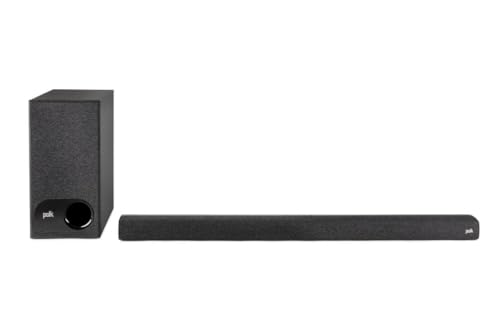
Polk Audio Signa S3 Slim Soundbar
Best for: small spaces and clear dialogue
- Subwoofer
- Wireless Subwoofer
- Channels
- 2.1
- Audio Format
- Dolby Digital 5.1
- Connectivity
- HDMI ARC, optical, Bluetooth, Wi-Fi
- Features
- Dialogue Enhancement
- Color
- Black
The Polk Audio Signa S3 is a 2.1 channel soundbar with a wireless subwoofer. It measures 2.15 inches tall and 35.4 inches wide. This low-profile design fits most spaces without blocking your TV. It includes Voice Adjust technology for clearer dialogue. You get HDMI ARC, optical, and Bluetooth connectivity. It suits buyers who need a compact audio upgrade for smaller rooms.
- Ultra-slim 2.15-inch height fits most spaces
- Wireless 5.25-inch subwoofer delivers deep bass
- Voice Adjust technology maximizes dialogue clarity
- Multiple inputs including HDMI ARC and optical
- 2.1 channel configuration has fewer speakers than 5.1 competitors
- 35.4-inch width is shorter than many soundbars
- You need a soundbar that fits under your TV
- You want clear dialogue without complex setup
- You have limited space for audio equipment
- You require immersive surround sound channels
- You need a wider soundbar for large rooms
- You prefer a system with dedicated rear speakers
Verdict: Polk Audio Signa S3 Slim Soundbar is a practical choice for viewers with limited space who prioritize dialogue clarity over immersive channel counts.

Samsung HW-B750D 5.1ch Soundbar
Best for: dialogue clarity and compact wireless bass
- Subwoofer
- Wireless Subwoofer
- Channels
- 5.1 ch
- Audio Format
- Dolby Audio, DTS Virtual:X
- Connectivity
- Bluetooth
- Color
- Black
- Dimensions
- 4.1 × 40.5 × 2.3 inches
This Samsung soundbar delivers 5.1-channel audio with a built-in center speaker and a wireless subwoofer. It features Dolby Audio and DTS Virtual:X for expanded surround effects without extra speakers. The 40.5-inch unit weighs 18.1 pounds. Adaptive Sound and Voice Enhanced modes optimize dialogue clarity. It supports Bluetooth multi-connection for two devices and includes Game Mode for synced directional audio.
- 5.1-channel configuration with wireless subwoofer
- Built-in center speaker for clear dialogue
- Dolby Audio and DTS Virtual:X support
- Bluetooth multi-connection for two devices
- Adaptive Sound and Voice Enhanced modes
- 18.1-pound weight is heavier than lighter competitors
- 40.5-inch width is shorter than larger 7.1 or 11.1 channel systems
- You want dedicated center speaker dialogue clarity
- You need Bluetooth multi-connection for two devices
- You prefer a wireless subwoofer setup
- You require more than 5.1 channels
- You need detachable surround speakers
- You want a 3.1.2ch height channel configuration
Verdict: Samsung HW-B750D 5.1ch Soundbar fits buyers who want clear dialogue and a compact wireless sub setup. It suits those who do not need height channels or detachable rear speakers.

LG S60T 3.1ch Soundbar with Wireless Sub
Best for: LG TV owners seeking clear dialogue
- Subwoofer
- Wireless Subwoofer
- Channels
- 3.1 ch
- Audio Format
- Dolby Audio
- Recommended Use
- TV
- Dimensions
- 3.5 × 33.5 × 2.5 inches
- Weight
- 18.2 pounds
The LG S60T is a 3.1-channel soundbar with a wireless subwoofer. It features Dolby Audio for clear detail and AI Sound Pro for dynamic audio. The unit measures 33.5 inches wide and 2.5 inches high. It weighs 18.2 pounds. You can control it with one remote via WOW Interface. It works best with LG TVs using WOW Orchestra.
- 3.1 channel configuration with dedicated subwoofer
- Dolby Audio support for clear vocals
- AI Sound Pro for dynamic scenes
- WOW Interface for single-remote control
- 3.1 channel setup has fewer speakers than 5.1 or 11.1 systems
- 18.2 pound weight is heavier than slim alternatives
- 33.5 inch width is shorter than wider soundbars
- You own an LG TV for WOW Orchestra
- You want clear dialogue via Dolby Audio
- You prefer single-remote control via WOW Interface
- You need surround channels beyond 3.1
- You want a detachable surround system
- You prefer a lighter soundbar under 15 pounds
Verdict: The LG S60T 3.1ch Soundbar suits LG TV owners who want clear dialogue and single-remote control. It fits smaller spaces but lacks the surround depth of higher-channel systems.

JBL Bar 1300XMK2 11.1.4 System
Best for: Immersive 11.1.4 channel home theater setups
- Subwoofer
- Wireless Subwoofer
- Audio Format
- Dolby Atmos
- Rear Speakers
- Detachable wireless
- Connectivity
- HDMI ARC, Bluetooth
- Woofer Size
- 6.5-Inch Woofer
- Features
- Dolby Atmos, Rear Speakers
This 11.1.4 channel system includes a wireless 6.5-inch subwoofer and detachable rear speakers. It supports 8K video via HDMI ARC and delivers Dolby Atmos. The 55.3-inch bar weighs 13.9 pounds. You get room-filling 3D sound for movies and gaming. It suits those who want a complete, high-channel home theater setup with flexible speaker placement.
- 11.1.4 channel configuration for 3D surround sound
- Wireless 6.5-inch subwoofer for deep bass
- Detachable wireless surround speakers
- HDMI ARC port supporting 8K video
- 55.3-inch width requires significant wall space
- 13.9-pound weight adds bulk to the setup
- You want a complete 11.1.4 channel surround system
- You prefer detachable speakers for flexible placement
- You need HDMI ARC for 8K video signals
- You have limited wall space for a 55.3-inch bar
- You only need basic stereo or 5.1 sound
- You prefer a lighter, more compact soundbar
Verdict: JBL Bar 1300XMK2 Detachable Surround Soundbar fits buyers seeking a high-channel, immersive audio experience with detachable rear speakers and a wireless subwoofer. It is ideal for those prioritizing 3D surround sound and 8K video support over compact size.

Samsung Q600F 3.1.2ch Soundbar
Best for: Samsung TV owners wanting height audio
- Subwoofer
- Wireless Subwoofer
- Channels
- 3.1.2ch
- Audio Format
- Dolby Atmos, DTS Virtual:X
- Connectivity
- Bluetooth
- Color
- Black
- Dimensions
- 11.6 × 40.6 × 13.5 inches
This 3.1.2 channel soundbar delivers multidimensional audio through up-firing speakers and a wireless subwoofer. The 6.5-inch active sub includes an 8-inch passive radiator for deep bass. It supports Dolby Atmos and DTS Virtual:X. The unit measures 40.6 inches wide and weighs 20.1 pounds. It works with compatible Samsung TVs for Q-Symphony and uses TV microphones for room calibration.
- 3.1.2 channel configuration with up-firing drivers
- 6.5-inch active subwoofer with 8-inch passive radiator
- Supports Dolby Atmos and DTS Virtual:X
- Wireless subwoofer connection for flexible placement
- Heavier build at 20.1 pounds compared to lighter competitors
- Fewer channels than the 11.1.4 system on the list
- Limited to 40.6 inches width for smaller setups
- You want immersive height audio from up-firing speakers
- You own a compatible Samsung TV for Q-Symphony
- You prefer a wireless subwoofer for clean setup
- You need a larger 5.1 or 7.1 channel system
- You want a lighter soundbar under 15 pounds
- You require detachable surround speakers for surround sound
Verdict: Samsung HW-Q600F 3.1.2ch Soundbar fits viewers who want height channels and strong bass in a compact footprint. It suits Samsung TV owners seeking integrated audio calibration.
Specifications side by side
| Spec | TCL Q65H 5.1ch Soundbar | Polk Audio Signa S3 Slim Soundbar | Samsung HW-B750D 5.1ch Soundbar | LG S60T 3.1ch Soundbar with Wireless Sub | JBL Bar 1300XMK2 11.1.4 System | Samsung Q600F 3.1.2ch Soundbar |
|---|---|---|---|---|---|---|
| Channels | 5.1 | 2.1 | 5.1 ch | 3.1 ch | – | 3.1.2ch |
| Audio Format | Dolby Atmos, DTS Virtual:X | Dolby Digital 5.1 | Dolby Audio, DTS Virtual:X | Dolby Audio | Dolby Atmos | Dolby Atmos, DTS Virtual:X |
| Subwoofer | Wireless | Wireless | Wireless | Wireless | Wireless | Wireless |
| Rear Speakers | – | – | – | – | Detachable wireless | – |
| Connectivity | HDMI eARC/ARC, optical, Bluetooth | HDMI ARC, optical, Bluetooth, Wi-Fi | Bluetooth | – | HDMI ARC, Bluetooth | Bluetooth |
| Total Power | 580W | – | – | – | – | – |
| Woofer Size | – | – | – | – | 6.5-Inch Woofer | – |
| Use | Home Theater | – | – | – | – | – |
| Features | Dolby Atmos, Remote | Dialogue Enhancement | – | – | Dolby Atmos, Rear Speakers | Dolby Atmos |
| Color | Black | Black | Black | – | Black | Black |
| Video | – | 8K | – | – | 8K | – |
| Driver Size | – | – | – | – | 6.5-Inch | – |
| Recommended Use | TV | TV | – | TV | – | – |
| Dimensions | 2.68 × 41.5 × 4.86 inches | 3.22 × 35.4 × 2.15 inches | 4.1 × 40.5 × 2.3 inches | 3.5 × 33.5 × 2.5 inches | 5.4 × 55.3 × 2.3 inches | 11.6 × 40.6 × 13.5 inches |
| Weight | 9.3 pounds | 19 pounds | 18.1 pounds | 18.2 pounds | 13.9 pounds | 20.1 pounds |
| Model | Q65H | Signa S3 | E1SAMHWB750DRB | S60T.CUSALLK | JBLBAR1300XM2BLKAM | HW-Q600F/ZA |
| Size | – | – | – | 3.5 Inches | – | 2.2" x 40.6" x 4.1" |
Frequently asked questions
How does a wireless subwoofer improve dialogue clarity?
A wireless subwoofer handles low-frequency sounds, freeing the main soundbar to focus on mid and high frequencies. This separation allows the center channel to deliver clearer dialogue. Systems like the Polk Audio Signa S3 prioritize this clarity for viewers in smaller spaces. You get distinct speech without bass muddiness.
Can I place the subwoofer anywhere in the room?
Yes. Since there is no audio cable connecting the sub to the soundbar, you can place it in any corner for optimal bass response. This flexibility helps you find the best spot for deep bass. The TCL Q65H and Samsung HW-B750D use this design for flexible seating arrangements.
What is the difference between 3.1 and 5.1 channel systems?
A 3.1 system has three main channels plus one subwoofer channel, while a 5.1 system adds two rear surround speakers. The LG S60T offers 3.1 channels for clear dialogue, whereas the TCL Q65H provides 5.1 channels for immersive audio. Choose 5.1 if you want surround depth without detachable rear speakers.
Do wireless subwoofers support Dolby Atmos?
Many systems with wireless subs support Dolby Atmos for height audio. The TCL Q65H and Samsung HW-Q600F both include this format. The subwoofer handles the low-frequency effects in these tracks. This allows you to experience immersive 3D sound while maintaining strong bass impact in your home theater setup.
How large is a typical wireless subwoofer soundbar setup?
Soundbars vary in size, but wireless subs add extra footprint. The JBL Bar 1300XMK2 soundbar is 55.3 inches wide, while the LG S60T is 33.5 inches wide. The subwoofers themselves are compact units that sit on the floor. You should measure your space to ensure the sub fits comfortably in your room.
Is a wireless subwoofer better than a wired one?
Wireless subs eliminate the need for thick bass cables across your room. This simplifies installation and allows for cleaner aesthetics. You can position the sub independently for better sound. The Samsung HW-B750D and Polk Audio Signa S3 both use wireless connections for convenience and flexible placement options.
What size woofer do wireless subwoofers typically have?
Woofer sizes vary by system. The JBL Bar 1300XMK2 features a 6.5-inch woofer for powerful bass. Other systems may use different driver sizes to match their enclosure volume. A larger woofer generally moves more air for deeper low-end response. Check the specs to see the driver size for your chosen model.


