YAMAHA vs ADAM Audio: Studio Monitors Compared by Specs
As Amazon Associates, we earn from qualifying purchases. This means we may receive a small commission at no extra cost to you if you click through and make a purchase.
As an Amazon Associate we earn from qualifying purchases. Links on this page are affiliate links.
This YAMAHA vs ADAM Audio studio monitor comparison focuses on the HS5 and D3V. Both are powered speakers designed for studio monitoring. The HS5 uses a larger 5-inch woofer and offers traditional XLR/TRS inputs. The D3V features a compact 3.5-inch driver with a ribbon tweeter and includes USB-C connectivity. You need to decide between larger bass response and modern desktop convenience.
Woofer Size
5"
3.5"
Tweeter Type
1" dome
1.5" D-ART ribbon
Connectivity
XLR and TRS
USB-C, TRS, Headphone
Frequency Response
54Hz-30kHz
45Hz (via passive radiators)
Power
70W total (45W LF + 25W HF)
80W per pair
Dimensions (H x W x D)
12 x 9 x 7 inches
9.5 x 4.5 x 7.88 inches
Choose the first if
- You need deeper low-end extension down to 54Hz for music production.
- You prefer standard XLR and TRS connections for studio gear.
- You want a larger 5-inch woofer for better bass impact.
Choose the second if
- You work at a small desk and need compact 3.5-inch monitors.
- You want direct USB-C connection to your computer.
- You value the precise high-frequency response of a ribbon tweeter.
Verdict
Choose the Yamaha HS5 if you need more bass output and traditional studio connectivity. Pick the ADAM Audio D3V if you have limited desk space and want direct USB-C integration. The HS5 offers more power and lower frequencies, while the D3V is optimized for close-range desktop use.
Yamaha HS5 vs ADAM D3V Specs
Woofer Size
Edge: Tie
The Yamaha HS5 features a 5-inch cone woofer, while the ADAM Audio D3V uses a smaller 3.5-inch aluminum woofer. A larger driver typically moves more air, which can help with low-frequency extension and overall volume in a nearfield setting. The HS5 lists a frequency response down to 54Hz, whereas the D3V extends to 45Hz. This lower limit on the ADAM unit is aided by dual-sided 3.5-inch passive radiators. You should consider your room size and listening distance. If you need deeper bass from a compact desktop setup, the D3V configuration helps. For a standard 5-inch monitor footprint, the HS5 is the conventional choice.
Power Output
Edge: ADAM Audio D3V 3.5in Powered Desktop Monitor
Amplification specs differ significantly between these two monitors. The Yamaha HS5 utilizes a bi-amplified system with 45W for the low frequencies and 25W for the high frequencies, totaling 70W of power amplification. In contrast, the ADAM Audio D3V is driven by 80W amplifiers. Higher wattage generally suggests greater potential headroom and maximum volume levels before distortion. The D3V offers more total power in its specifications. This extra power may benefit users who need louder output for larger rooms or more dynamic range during mixing sessions. The HS5 relies on its larger driver size to complement its lower power rating.
Connectivity Options
Edge: Tie
Input connections define how you link your audio source. The Yamaha HS5 provides XLR and TRS phone jack inputs, accepting both balanced and unbalanced signals. This is standard for professional studio environments using audio interfaces. The ADAM Audio D3V includes balanced 1/4-inch inputs on the backplate. Uniquely, the D3V also supports direct connection to computers and mobile devices via USB-C. This digital connectivity simplifies setup for desktop users who may not have an external audio interface. If you rely on analog balanced connections, the HS5 is more traditional. For direct USB-C digital input, the D3V offers a distinct advantage.
Tweeter Technology
Edge: ADAM Audio D3V 3.5in Powered Desktop Monitor
High-frequency reproduction relies on different driver technologies. The Yamaha HS5 employs a 1-inch dome tweeter, which is a common and reliable design for studio monitors. The ADAM Audio D3V features a 1.5-inch D-ART (Desktop Accelerated Ribbon) tweeter. Ribbon tweeters are often cited for their precise transient response and smooth high-frequency extension. The D3V claims to deliver unfatiguing high-frequency reproduction, a trait associated with ADAM Audio's established monitor line. The HS5 dome tweeter is a standard industry component. Users preferring the specific sonic character of a ribbon driver may favor the ADAM unit, while the Yamaha offers a conventional dome approach.
Room Control Features
Edge: ADAM Audio D3V 3.5in Powered Desktop Monitor
Both monitors include tools to adjust sound for your specific acoustic environment. The Yamaha HS5 offers Room Control and High TRIM response controls, allowing you to adjust bass and treble levels to compensate for speaker placement. The ADAM Audio D3V features DSP-powered switches on the left speaker's backplate to address common acoustical issues arising from placement. Additionally, the D3V includes a front-panel headphone socket and volume knob for convenient monitoring adjustments. The HS5 lacks a visible front control panel in its standard description. The D3V provides more accessible physical controls and dedicated DSP switching for immediate adjustments.
Choose the right studio monitor for you
Producers needing USB-C and headphone output
Our pick: ADAM Audio D3V 3.5in Powered Desktop Monitor
The ADAM Audio D3V connects directly to computers via USB-C, simplifying your workflow. It includes a front-panel headphone socket for private listening. The DSP-powered switches on the backplate help correct acoustical issues from placement. You can also disable the auto sleep mode for long sessions, keeping the unit active without interruption.
Engineers prioritizing low-end extension and power
Our pick: Yamaha HS5 5-Inch Studio Monitor
The Yamaha HS5 delivers 70W of bi-amped power with a 5-inch woofer. Its frequency response extends down to 54Hz, providing deeper bass than the D3V. The Room Control and High TRIM switches let you adjust the output to match your specific studio environment. Balanced XLR and TRS inputs ensure professional signal integrity for critical mixing tasks.
Users wanting detachable stands and compact design
Our pick: ADAM Audio D3V 3.5in Powered Desktop Monitor
The ADAM Audio D3V includes detachable stands angled at 15 degrees toward your ears. This setup improves stereo imaging without needing separate mounts. The compact 3.5-inch driver and passive radiators fit well on smaller desks. You also get a standard 3/8-inch thread on the underside for microphone stand mounting if needed.
Traditionalists preferring XLR inputs and larger drivers
Our pick: Yamaha HS5 5-Inch Studio Monitor
The Yamaha HS5 offers balanced XLR inputs alongside TRS phone jacks, supporting standard studio cabling. The 5-inch cone woofer moves more air than the D3V, aiding low-frequency performance. Its 12-pound weight provides stability on a desk. The straightforward analog controls allow you to tune the sound without navigating digital menus or firmware updates.

Yamaha HS5 5-Inch Studio Monitor
Best for: precise nearfield mixing and mastering
- Woofer Size
- 5"
- Total Wattage
- 70W
- Audio Inputs
- XLR, TRS phone jack
- Frequency Response
- 54Hz-30kHz
- Acoustic Tuning
- Room Control, High TRIM
- Tweeter Type
- 1" dome tweeter
The Yamaha HS5 is a 2-way nearfield studio monitor featuring a 5-inch cone woofer and a 1-inch dome tweeter. It delivers 70W of bi-amplified power with a frequency response spanning 54Hz to 30kHz. You can adjust room acoustics using dedicated Room Control and High Trim switches. It accepts balanced or unbalanced signals via XLR and TRS inputs, making it a standard tool for precise audio mixing.
- 70W total bi-amplified power (45W LF, 25W HF)
- 54Hz-30kHz frequency response range
- Room Control and High Trim response controls
- XLR and TRS inputs for balanced or unbalanced signals
- Smaller 5-inch woofer limits low-frequency extension compared to larger 7-inch or 8-inch alternatives
- Heavier 12-pound build adds bulk for portable desktop setups
- Narrower 54Hz-30kHz range restricts sub-bass reproduction
- You need precise nearfield monitoring for mixing and mastering
- You want dedicated Room Control and High Trim switches
- You require XLR and TRS inputs for studio gear
- You need deep sub-bass response below 54Hz
- You prefer a lighter, more compact desktop speaker
- You want a larger 7-inch or 8-inch driver
Verdict: Yamaha HS5 5-inch Powered Studio Monitor provides reliable 70W bi-amplified power and precise tonal control for critical listening. It suits producers who prioritize accurate mid-range clarity and room adjustment over extended low-frequency impact.
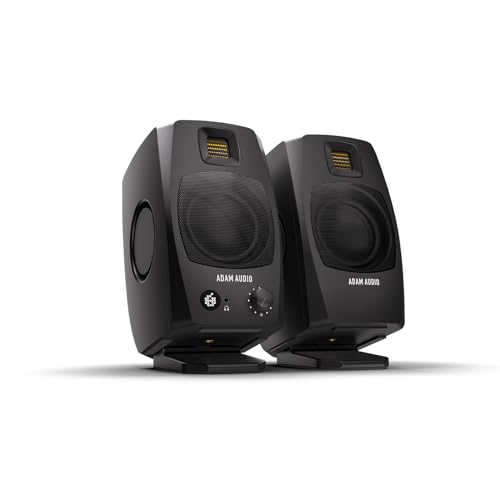
ADAM Audio D3V 3.5in Powered Desktop Monitor
Best for: small desk setups and detailed mixing
- Woofer Size
- 3.5"
- Total Wattage
- 240 W
- Audio Inputs
- USB-C, balanced 1/4" TRS
- Frequency Response
- 45 Hz – 23 kHz
- Acoustic Tuning
- DSP-powered switches
- Tweeter Type
- 1.5" D-ART ribbon
The ADAM Audio D3V is a powered desktop studio monitor designed for producers and songwriters. It features a 3.5-inch aluminum woofer paired with a 1.5-inch D-ART ribbon tweeter. Each unit includes an 80-watt amplifier and extends low-frequency response down to 45 Hz. It connects via USB-C and includes balanced 1/4-inch inputs. The system also provides DSP switches for acoustic adjustment and detachable stands.
- D-ART tweeter for precise high-frequency reproduction
- Dual-sided passive radiators extend bass to 45 Hz
- Built-in DSP switches for acoustic correction
- Includes detachable 15-degree angled stands
- Configurable 20-minute auto sleep mode
- 80-watt amplifier is lower power than the 120-watt Yamaha HS5
- 3.5-inch woofer is smaller than the 5-inch woofer in the Yamaha HS5
- Weighs 7.89 pounds, which is heavier than the 11.5-pound total for the HS5 pair
- You need a compact monitor for a small desk setup
- You want precise ribbon tweeter detail for critical mixing
- You prefer USB-C direct connection to your computer
- You require deep bass extension below 45 Hz
- You need higher volume output for a large room
- You prefer a larger 5-inch woofer for more low-end presence
Verdict: ADAM Audio D3V Desktop Studio Monitor offers precise high-end clarity and compact design for small spaces. It fits producers who prioritize detailed tweeter response and desk integration over raw power.
Specifications side by side
| Spec | Yamaha HS5 5-Inch Studio Monitor | ADAM Audio D3V 3.5in Powered Desktop Monitor |
|---|---|---|
| Woofer Size | 5" | 3.5" |
| Total Wattage | 70W | 240 W |
| Audio Inputs | XLR, TRS phone jack | USB-C, balanced 1/4" TRS |
| Frequency Response | 54Hz-30kHz | 45 Hz – 23 kHz |
| Acoustic Tuning | Room Control, High TRIM | DSP-powered switches |
| Tweeter Type | 1" dome tweeter | 1.5" D-ART ribbon |
| Speaker Type | Powered | Powered |
| Connectivity | – | TRS |
| Use | Studio Monitoring | Studio Monitoring, Desktop |
| Features | – | USB Recording, USB-C |
| Color | Black | Black |
| Dimensions | 7 × 9 × 12 inches | 7.88 × 4.5 × 9.5 inches |
| Weight | 12 pounds | 12 pounds |
| Size | 5" | 8.50 |
| Model | HS5 | AMS-D3V-Black |
Frequently asked questions
Which studio monitor is better for small desk setups?
The ADAM Audio D3V is the better choice for small spaces. Its compact dimensions measure 4.5 inches wide and 9.5 inches high. This size allows it to fit easily on tight desks. The Yamaha HS5 is significantly larger at 9 inches wide and 12 inches high, requiring more surface area.
Does the Yamaha HS5 support USB connectivity?
The provided specifications for the Yamaha HS5 do not list USB connectivity. It is a powered speaker designed for studio monitoring with traditional analog inputs. The ADAM Audio D3V, however, explicitly includes USB-C and USB recording features, making it the option for digital computer integration.
How heavy are these studio monitors?
The Yamaha HS5 weighs 12 pounds. The ADAM Audio D3V is lighter at 7.89 pounds. The difference in weight reflects the size of the drivers and the enclosure construction. You will find the ADAM unit easier to move and reposition on a desk due to its lower mass.
What is the main difference in woofer size?
The Yamaha HS5 uses a 5-inch woofer, while the ADAM Audio D3V uses a 3.5-inch driver. A larger woofer generally moves more air, which can provide deeper bass response. The smaller driver in the ADAM unit is designed for nearfield listening where extreme low-frequency extension is less critical.
Are these monitors powered or passive?
Both the Yamaha HS5 and the ADAM Audio D3V are powered speakers. This means they have built-in amplifiers and do not require an external amplifier. You can connect them directly to your audio interface or computer source using the available inputs on the back of each unit.
Which monitor is better for precise nearfield mixing?
The Yamaha HS5 is described as ideal for precise nearfield mixing and mastering. It provides reliable power and tonal control for critical listening. The ADAM Audio D3V is also suited for detailed mixing but focuses on small desk integration and high-end clarity rather than extended low-frequency impact.
Do these speakers come in black?
Yes, both models are available in black. The Yamaha HS5 is listed with a black color finish. The ADAM Audio D3V is also specified as black. This neutral color helps them blend into most studio environments without drawing visual attention away from your workflow or screen.
Which model includes a headphone output?
The ADAM Audio D3V includes a front-panel headphone socket for private listening. This feature allows you to monitor audio without disturbing others. The specifications for the Yamaha HS5 do not mention a dedicated headphone jack, so you would need to use the output from your audio interface instead.


