Choosing Av Receivers in 2026: The Specs That Matter and 8 Picks
As Amazon Associates, we earn from qualifying purchases. This means we may receive a small commission at no extra cost to you if you click through and make a purchase.
As an Amazon Associate we earn from qualifying purchases. Links on this page are affiliate links.
This av receiver buying guide helps you choose the right component for your audio and video needs. You will learn how to match channel counts, video support, and connectivity options to your specific room size and source devices. We selected each product based strictly on its published specifications, ensuring that your decision relies on factual data rather than marketing claims.
You will see how features like 8K video pass-through, Dolby Atmos decoding, and phono inputs impact your setup. The guide covers compact stereo receivers for vinyl enthusiasts and powerful multi-channel units for large home theaters. By reviewing these eight picks, you can determine whether a 2-channel stereo amp or a 9.4-channel AV processor best fits your space. Each recommendation highlights key dimensions and connectivity standards to help you plan your installation with confidence.
Key Specs for Choosing AV Receivers
Channel Count and Setup
The channel count determines how many speakers you can connect. A 2-channel receiver powers a stereo pair, while 5.2 or 7.2 channels support surround sound with subwoofers and height speakers. The Sony STRDH190 offers 2 channels for simple stereo setups. The Yamaha RX300A provides 5.2 channels for smaller home theaters. Larger rooms may need the Denon AVR-X4800H with 9.4 channels. More channels allow for immersive audio but require more speaker wiring and space. Choose the lowest count that meets your speaker needs to save cost and complexity. Higher channel counts often come with larger footprints and higher power demands.
Look for
- Match channels to your speaker count
- Check for height channel support
Video Resolution Support
Modern receivers pass video signals from sources like Blu-ray players to your TV. Support for 8K resolution ensures future-proofing for high-end displays. The Yamaha RX300A and Denon AVR-X4800H both support 8K video. The Denon AVR-S570BT also includes 8K inputs. If you only use 4K sources, 8K support is not strictly necessary but offers longevity. Lower-end stereo receivers like the Yamaha R-S202 lack video processing entirely. Ensure the receiver has enough HDMI inputs for all your devices. Check if the HDMI ports support HDCP 2.3 for protected content. Video passthrough quality affects picture clarity on compatible displays.
Look for
- Verify 8K or 4K HDMI support
- Count available HDMI inputs
Audio Format Compatibility
Audio formats like Dolby Atmos and DTS:X create immersive 3D soundscapes. These formats require compatible speakers and a receiver that decodes them. The Yamaha RX300A supports Dolby Atmos for height-based audio. The Denon AVR-X4800H supports both Dolby Atmos and DTS:X for broader compatibility. The Onkyo TXNR7100 emphasizes THX certification for reference-level accuracy. If you stream music only, basic stereo decoding is sufficient. For movies, ensure the receiver supports the formats used by your media sources. Decoding capability determines whether you get true surround sound or downmixed stereo.
Look for
- Check for Dolby Atmos support
- Verify DTS:X or THX certification
Connectivity Options
Connectivity determines how you stream audio and link devices. Bluetooth allows wireless music streaming from phones. The Sony STRDH190, Yamaha RX300A, and Yamaha R-S202 all include Bluetooth. HDMI eARC simplifies TV audio return, as seen in the Denon AVR-X4800H. Wireless connectivity enables multi-room audio in some models. The Onkyo TXNR7100 offers smart streaming features. Ensure the receiver has enough analog and digital inputs for your sources. Wi-Fi support often enables higher-quality streaming than Bluetooth. Check for Ethernet ports for stable network connections. Limited connectivity restricts which devices you can use.
Look for
- Confirm Bluetooth and Wi-Fi support
- Check for HDMI eARC ports
Phono Stage and Vinyl Support
If you own a turntable, a built-in phono stage is essential. It amplifies the low-level signal from vinyl records to line level. The Sony STRDH190 and Yamaha R-S202 both include phono inputs and stages. This allows direct connection without an external preamp. Receivers without phono stages require an external converter. This adds cost and clutter to your setup. If you do not use vinyl, this feature is unnecessary. The phono stage quality affects sound fidelity for turntable users. Check if the input is dedicated or shared with other sources. Dedicated inputs prevent signal interference from other connections.
Look for
- Look for a built-in phono stage
- Verify dedicated phono input availability
Physical Dimensions and Weight
AV receivers vary significantly in size and weight. The Denon AVR-X4800H is large and heavy at 34.8 pounds, requiring sturdy shelving. The Yamaha R-S202 is compact at 14.8 pounds, fitting in smaller cabinets. The Denon AVR-S570BT is listed with minimal weight data, suggesting a lighter build. Measure your cabinet space before purchasing. Ensure the receiver has adequate ventilation for heat dissipation. Heavier units often contain larger power supplies and transformers. Consider the depth required for rear panel connections. Weight impacts installation stability and ease of moving the unit.
Look for
- Measure cabinet width and depth
- Check weight for shelf stability
Room Correction and Calibration
Advanced receivers include room correction software to optimize sound for your space. The Onkyo TX-RZ50 features Dirac Live calibration for precise acoustic adjustment. This technology analyzes your room and adjusts speaker levels and timing. THX-certified models like the Onkyo TXNR7100 ensure consistent performance standards. Room correction compensates for speaker placement and room acoustics. It is valuable for critical listening but not essential for casual use. Calibration tools vary in complexity and effectiveness. Check if the feature is included or requires a subscription. Proper calibration improves clarity and balance across all frequencies.
Look for
- Check for Dirac Live or Audyssey
- Verify THX certification status
Types of AV Receivers
Stereo Receivers
Stereo receivers focus on two-channel audio for music and vinyl. They often include phono stages for turntables, like the Sony STRDH190 and Yamaha R-S202. These units are compact and ideal for dedicated listening rooms. You lose surround sound capabilities, so they do not fit home theater needs. The trade-off is simpler setup and better focus on high-fidelity music playback without video processing overhead.
Compact Home Theater Receivers
Compact home theater receivers balance channel count with smaller footprints. The Yamaha RX300A and Denon AVR-S570BT offer 5.2 channels with 8K video support. They suit smaller rooms where extensive speaker arrays are unnecessary. You get essential surround formats like Dolby Atmos without the bulk of larger units. The main trade-off is lower power output and fewer connectivity options compared to flagship models, making them less suitable for large spaces.
High-Channel Home Theater Receivers
High-channel receivers support complex multi-room and immersive audio setups. Models like the Denon AVR-X4800H and Onkyo TX-RZ50 offer 9.2 channels or more. They include advanced room correction and THX certification for precise calibration. These units handle many sources and future-proof your system with 8K and Dolby Atmos. The trade-off is significant size, weight, and higher cost, requiring ample space and ventilation for proper operation in your home theater.
Common AV Receiver Mistakes
Ignoring HDMI version for 4K 120Hz
You need HDMI 2.1 to support 4K at 120Hz and 8K signals. Older HDMI 2.0 ports cap out at 60Hz. Check the spec sheet for supported resolutions and refresh rates to ensure your console or media player works correctly.
Assuming all channels drive speakers equally
Some receivers use a 5+2 or 7+2 architecture where extra channels share power with main ones. This reduces output when you add height or rear speakers. Look for true multi-channel designs if you plan to use all positions simultaneously.
Overlooking room correction microphone inclusion
Automatic room calibration balances speaker levels and frequency response. If the unit does not include a microphone, you must buy one separately. Verify this in the box contents list to avoid unexpected costs and ensure proper acoustic tuning for your space.
Mismatching speaker impedance ratings
Connecting 4-ohm speakers to a receiver rated for 8 ohms may cause overheating. Check the minimum impedance the amplifier can handle. Most modern units support 4 to 16 ohms, but verifying this prevents damage and ensures stable performance during loud passages.
| # | Product | Best for | Price |
|---|---|---|---|
| 1 | Sony 2-Channel Receiver with Phono and Bluetooth | Stereo setups with turntables and limited space | |
| 2 | Yamaha RX300A 5.2-Channel 8K AV Receiver | smaller home theater setups with 5.2 channels | |
| 3 | Yamaha Bluetooth Stereo Receiver | dedicated stereo music listening and vinyl playback | |
| 4 | Denon 9.4-Channel 8K AV Receiver | large home theaters with many sources | |
| 5 | Denon 5.2-Channel 8K AV Receiver | 8K video inputs and Bluetooth streaming | |
| 6 | Onkyo 9.2-Channel THX Certified AV Receiver | Home theater setups requiring THX certification | |
| 7 | Onkyo 7.2-Channel 8K AV Receiver | home theaters needing Zone 2 and 8K | |
| 8 | Onkyo 9.2-Channel THX Certified AV Receiver | Home theaters needing precise room correction |

Sony 2-Channel Receiver with Phono and Bluetooth
Best for: Stereo setups with turntables and limited space
- Channels
- 2-ch
- Power Output
- 100 watts x 2 (8 ohms, 1 Kilo Hertz)
- Wireless Connectivity
- Bluetooth
- Features
- Phono Stage, Phono Input
- Color
- Black
- Recommended Use
- Stereo
The Sony STRDH190 is a 2-channel stereo receiver designed for two-speaker setups. It delivers 100 watts per channel into 8 ohms and supports speaker impedances between 6 and 16 ohms. You get a built-in phono stage for turntables, four RCA inputs, and Bluetooth streaming. Its low profile fits standard cabinets. It suits listeners who want simple, wired stereo audio with vinyl support.
- 100 watts per channel output power
- Built-in phono stage for turntables
- Bluetooth wireless streaming capability
- Low profile 5.2-inch height design
- Only 2 channels for stereo setups
- 100 watts is lower than multichannel rivals
- 17.1-pound weight adds bulk
- You need a dedicated phono input for a turntable
- You want a low-profile receiver for a cabinet
- You prefer simple stereo over home theater
- You require surround sound channels
- You need HDMI video switching
- You want a compact 2.1-inch height
Verdict: Sony STRDH190 2-Channel Stereo Receiver fits listeners who prioritize vinyl playback and simple stereo audio over home theater features. It is a practical option for two-speaker setups with limited cabinet space.

Yamaha RX300A 5.2-Channel 8K AV Receiver
Best for: smaller home theater setups with 5.2 channels
- Channels
- 5.2
- Video Pass-Through
- 8K60, 4K120
- Audio Decoding
- Dolby Atmos, DTS:X virtualization
- HDMI Ports
- HDMI 2.1
- Wireless Connectivity
- Wi-Fi, Bluetooth, AirPlay
- Room Calibration
- YPAO
The Yamaha RX300A is a 5.2-channel AV receiver designed for home theater setups. It supports 8K60 and 4K120 video with HDMI 2.1 features. You get Dolby Atmos and DTS:X virtualization for immersive surround sound. Built-in Wi-Fi, Bluetooth, and AirPlay allow for smart streaming. The bundle includes a 3m AudioQuest Sky HDMI cable for reliable 48Gbps connectivity.
- 5.2-channel surround sound configuration
- 8K60 and 4K120 video support
- Dolby Atmos and DTS:X virtualization
- Built-in Wi-Fi and Bluetooth connectivity
- Includes 3m AudioQuest Sky HDMI cable
- Limited to 5.2 channels compared to 7.2 or 9.2-channel models on this list
- Single subwoofer output limits multi-subwoofer room correction options
- You want a complete setup with a high-speed HDMI cable included
- You need 8K video support for future-proofing your home theater
- You prefer a compact 5.2-channel system for smaller rooms
- You require more than five main channels for a larger surround sound setup
- You need THX certification for strict performance standards
- You are looking for a receiver with more than one subwoofer output
Verdict: The Yamaha RX300A 5.2-Ch 8K AV Receiver fits buyers who want a streamlined 5.2-channel setup with modern 8K video support and an included high-quality HDMI cable. It is a solid choice for smaller rooms where seven or more channels are unnecessary.
Yamaha Bluetooth Stereo Receiver
Best for: dedicated stereo music listening and vinyl playback
- Wireless Connectivity
- Bluetooth
- Features
- Phono Stage, Phono Input
- Channels
- 2 Channel
- Color
- Black
- Recommended Use
- Stereo
- Dimensions
- 12.6 × 17.1 × 5.5 inches
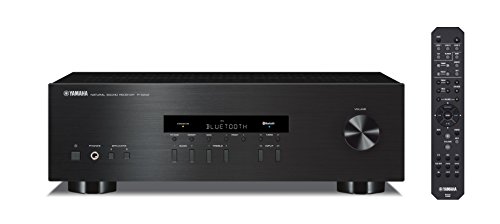
The Yamaha R-S202 is a 2-channel stereo receiver designed for dedicated music listening. It features a built-in phono stage for turntables and Bluetooth connectivity for wireless streaming. The unit includes an AM/FM tuner with 40 preset stations and a headphone terminal. With a frequency response of 10Hz to 100kHz, it offers broad audio range. This receiver suits listeners who prioritize analog sources and simple stereo setups over multi-channel home theater systems.
- Built-in phono input for direct turntable connection
- Bluetooth connectivity for wireless music streaming
- Speaker selector allows connection to two separate speaker systems
- Wide frequency response of 10Hz to 100kHz
- Includes AM/FM tuner with 40 preset stations
- Limited to 2 channels, unlike the 5.2 to 9.4 channel options on this list
- Heavier build at 14.8 pounds compared to lighter entry-level stereos
- No HDMI or video switching capabilities for home theater sources
- You want to connect a vinyl turntable directly without an external preamp
- You need to drive speakers in two different rooms using the selector
- You prefer a dedicated stereo setup for music rather than a home theater system
- You need HDMI inputs for 4K or 8K video sources
- You want to create a surround sound home theater setup
- You require multi-room audio distribution beyond the speaker selector
Verdict: Yamaha R-S202 Stereo Receiver fits listeners who want a dedicated, high-fidelity stereo experience with turntable support. It is ideal for music-focused rooms where video processing is unnecessary.

Denon 9.4-Channel 8K AV Receiver
Best for: large home theaters with many sources
- Channels
- 9.4
- Power Output
- 125W X 9
- Video Pass-Through
- 8K/60Hz, 4K/120
- Audio Decoding
- Dolby Atmos, DTS:X Pro, Auro 3D
- HDMI Ports
- 7 In / 3 Out
- Wireless Connectivity
- Bluetooth, Wi-Fi, HEOS
The Denon AVR-X4800H is a 9.4-channel home theater receiver delivering 125 watts per channel. It supports 8K video pass-through and includes HEOS Wi-Fi for multi-room audio streaming. With ten HDMI ports and support for Dolby Atmos and DTS:X, it suits buyers needing extensive connectivity and powerful amplification for large spaces.
- 9.4-channel architecture with 125W per channel output
- 10 HDMI ports including 7 inputs and 3 outputs
- Built-in HEOS Wi-Fi for multi-room music streaming
- Supports 8K/60Hz and 4K/120Hz video pass-through
- Heavier build at 34.8 pounds compared to lighter stereo receivers
- Larger footprint measuring 17.1 inches wide and 14.9 inches deep
- Higher channel count may exceed needs for small rooms
- You want a high-channel-count receiver for large rooms
- You need multiple HDMI connections for various sources
- You prefer integrated Wi-Fi music streaming over Bluetooth
- You only need basic stereo sound for a small space
- You prefer a compact receiver under 15 inches wide
- You do not need 8K video pass-through capabilities
Verdict: Denon AVR-X4800H 9.4ch 125W AV Receiver fits buyers building a large home theater with many sources and multi-room audio needs.

Denon 5.2-Channel 8K AV Receiver
Best for: 8K video inputs and Bluetooth streaming
- Channels
- 5.2
- Power Output
- 70W x 5
- HDMI Ports
- 4 In / 1 Out, HDMI 2.1
- Wireless Connectivity
- Bluetooth
- Color
- Black
- Video
- 8K
The Denon AVR-S570BT is a 5.2 channel AV receiver designed for home theater setups. It delivers 70 watts per channel and features four HDMI 2.1 inputs supporting 8K video. You get built-in Bluetooth for wireless music streaming and support for Dolby Vision and HDR10+. The unit includes an on-screen setup assistant and app control for iOS and Android. It suits users seeking 8K connectivity and basic multi-room audio without complex installation.
- 70 watts per channel output across 5 channels
- Four HDMI 2.1 inputs with 8K Ultra HD support
- Built-in Bluetooth for wireless streaming from Spotify and TIDAL
- Supports Dolby Vision, HDR10+, and VRR for gaming
- 5.2 channel configuration offers fewer dedicated amplifier channels than the 9.4 or 9.2 channel models on this list
- 70 watts per channel is lower power than the 100 or 125 watts per channel found in other receivers here
- 13 inches wide and 17.1 inches long is a compact footprint compared to larger home theater units
- You want 8K HDMI inputs for future-proof video connections
- You need built-in Bluetooth for wireless music playback
- You prefer a compact receiver for a smaller entertainment center
- You require more than 5.2 channels for a full surround sound system
- You need higher power output than 70 watts per channel
- You want THX certification for strict audio performance standards
Verdict: The Denon AVR-S570BT 5.2 Channel AV Receiver fits buyers who prioritize 8K video inputs and Bluetooth streaming in a compact form factor. It is a practical option for those who do not need the extensive channel count or higher wattage of the larger receivers in this guide.

Onkyo 9.2-Channel THX Certified AV Receiver
Best for: Home theater setups requiring THX certification
- Channels
- 9.2
- Power Output
- 100 Watts Per Channel
- Wireless Connectivity
- Bluetooth, AirPlay 2, Chromecast
- Room Calibration
- Dirac Live
- Color
- Black
- Wattage
- 100W
This Onkyo AV receiver delivers 100 watts per channel across its 9.2 channels. It carries THX certification, ensuring consistent performance across cinema, gaming, music, and surround EX modes. The unit supports IMAX Enhanced for high-quality audio and video. You can stream via Bluetooth, AirPlay 2, or Chromecast. Its dimensions are 17.1 by 14.9 by 6.8 inches, and it weighs 27.5 pounds. This model suits users seeking certified surround sound with smart streaming capabilities.
- 9.2 channels with 100 watts per channel
- THX certified with four distinct listening modes
- Supports IMAX Enhanced mode
- Bi-directional Bluetooth for streaming and headphone transmission
- Compatible with AirPlay 2, Chromecast, and Spotify
- Weighs 27.5 pounds, which is heavier than the Sony STRDH190
- Provides 100 watts per channel, less than the Denon AVR-X4800H's 125 watts
- Has 9.2 channels, fewer than the Onkyo TX-RZ50's 9.2-channel configuration
- You want THX certified surround sound for movies and games
- You need bi-directional Bluetooth for wireless headphones
- You prefer streaming via AirPlay 2 or Chromecast
- You need more than 100 watts per channel
- You want a lighter unit for easy mounting
- You require more than 9.2 channels
Verdict: Onkyo 9.2-Ch THX Certified AV Receiver offers solid power and certified audio for home theater enthusiasts who value THX standards and smart streaming features. It fits buyers who prioritize immersive sound formats like IMAX Enhanced over raw wattage increases.

Onkyo 7.2-Channel 8K AV Receiver
Best for: home theaters needing Zone 2 and 8K
- Channels
- 7.2
- Power Output
- 210 W/Ch
- Audio Decoding
- Dolby Atmos, DTS:X
- HDMI Ports
- 3 in, HDMI 2.1
- Color
- Black
- Dimensions
- 21 × 18.6 × 10.6 inches
The Onkyo TX-NR6100 is a 7.2 channel AV receiver designed for home theater setups. It delivers 210 watts per channel with THX Select certification. You get support for Dolby Atmos and DTS:X, along with three HDMI 2.1 ports for 8K video. This unit handles discrete Zone 2 audio and video. It suits buyers who want certified power and multi-room capability in a single chassis.
- 210 W/Ch THX Certified Select Dynamic Audio Amplification
- 5.2.2-channel Dolby Atmos and DTS:X playback
- Three HDMI 2.1 inputs supporting 8K video
- Discrete Zone 2 Audio and Video support
- 7.2 channel configuration is fewer than the 9.2 channel options on this list
- 22.9 pound weight is heavier than the 5.2 channel models listed
- 210 watts per channel is lower than the 100-125 watts per channel of some competitors, though total output is higher
- You want THX Select certification for calibrated audio performance
- You need discrete Zone 2 audio and video for a second room
- You require 8K HDMI 2.1 connectivity for future-proofing
- You only need stereo sound for music listening
- You prefer a lighter unit under 15 pounds
- You want a 9.2 channel receiver for a larger theater
Verdict: Onkyo TX-NR6100 7.2 THX Receiver fits buyers who need certified power and multi-room audio. It is a solid choice for home theaters that require Zone 2 capability and 8K video support.

Onkyo 9.2-Channel THX Certified AV Receiver
Best for: Home theaters needing precise room correction
- Channels
- 9.2
- Room Calibration
- Dirac Live
- Use
- Home Theater
- Color
- Black
- Video
- 8K
- Dimensions
- 15.7 × 17.1 × 7.94 inches
The Onkyo TX-RZ50 is a 9.2-channel AV receiver designed for home theater setups. It supports 8K video output and includes THX certification for audio accuracy. A key feature is Dirac Live room correction, which optimizes sound based on your space. This unit measures 17.1 inches wide and weighs 36.1 pounds. It suits users who want advanced acoustic calibration and high-resolution video support in a single chassis.
- 9.2-channel configuration for expansive surround sound
- 8K HDMI video support for future-proofing
- Dirac Live room correction for precise audio tuning
- THX certification ensures standard audio performance
- Heavier build at 36.1 pounds compared to lighter competitors
- Smaller physical footprint with a 15.7-inch depth than larger 9.4-channel models
- Lower channel count than the 9.4-channel option on this list
- You want Dirac Live room correction for accurate sound
- You need 8K video passthrough for modern displays
- You prefer a THX-certified audio experience
- You need more than 9.2 channels for your speakers
- You require a lighter unit for easy shelf mounting
- You are satisfied with fewer than 9 channels of amplification
Verdict: The Onkyo TX-RZ50 9.2-Channel AV Receiver fits buyers who prioritize precise room correction and high-resolution video. It is a solid choice for home theaters that benefit from THX standards and Dirac Live calibration.
Specifications side by side
| Spec | Sony 2-Channel Receiver with Phono and Bluetooth | Yamaha RX300A 5.2-Channel 8K AV Receiver | Yamaha Bluetooth Stereo Receiver | Denon 9.4-Channel 8K AV Receiver | Denon 5.2-Channel 8K AV Receiver | Onkyo 9.2-Channel THX Certified AV Receiver | Onkyo 7.2-Channel 8K AV Receiver | Onkyo 9.2-Channel THX Certified AV Receiver |
|---|---|---|---|---|---|---|---|---|
| Channels | 2-ch | 5.2 | – | 9.4 | 5.2 | 9.2 | 7.2 | 9.2 |
| Power Output | 100 watts x 2 (8 ohms, 1 Kilo Hertz) | – | – | 125W X 9 | 70W x 5 | 100 Watts Per Channel | 210 W/Ch | – |
| Video Pass-Through | – | 8K60, 4K120 | – | 8K/60Hz, 4K/120 | – | – | – | – |
| Audio Decoding | – | Dolby Atmos, DTS:X virtualization | – | Dolby Atmos, DTS:X Pro, Auro 3D | – | – | Dolby Atmos, DTS:X | – |
| HDMI Ports | – | HDMI 2.1 | – | 7 In / 3 Out | 4 In / 1 Out, HDMI 2.1 | – | 3 in, HDMI 2.1 | – |
| Wireless Connectivity | Bluetooth | Wi-Fi, Bluetooth, AirPlay | Bluetooth | Bluetooth, Wi-Fi, HEOS | Bluetooth | Bluetooth, AirPlay 2, Chromecast | – | – |
| Room Calibration | – | YPAO | – | – | – | Dirac Live | – | Dirac Live |
| Connectivity | Bluetooth | Bluetooth | Bluetooth | Wireless, HDMI eARC | Bluetooth, Wireless, HDMI eARC | – | – | – |
| Use | – | Home Theater | – | Home Theater | – | – | – | Home Theater |
| Features | Phono Stage, Phono Input | Dolby Atmos | Phono Stage, Phono Input | Dolby Atmos | – | – | – | – |
| Audio Format | – | – | – | DTS:X | – | – | – | – |
| Color | Black | Black | Black | Black | Black | Black | Black | Black |
| Video | – | 8K | – | 8K | 8K | – | – | 8K |
| Recommended Use | Stereo | – | Stereo | Music | – | – | – | – |
| Wattage | – | – | – | – | – | 100W | – | – |
| Dimensions | 11 × 17 × 5.2 inches | – | 12.6 × 17.1 × 5.5 inches | 14.9 × 17.1 × 6.6 inches | 17.1 × 13 × 6 inches | 14.9 × 17.1 × 6.8 inches | 21 × 18.6 × 10.6 inches | 15.7 × 17.1 × 7.94 inches |
| Weight | 17.1 pounds | – | 14.8 pounds | 34.8 pounds | 0.39 ounces | 27.5 pounds | 22.9 pounds | 36.1 pounds |
| Model | STRDH190 | RX300ABL+SKY3M | R-S202BL | AVRX4800H | AVRS570BT | TXNR7100 | TXNR6100M2BMMP | TXRZ50 |
| Size | – | – | 8.25 | – | – | 10.10 | – | 13.20 |
If you need broader hardware options, you can use the receiver buying guide to evaluate alternative channel configurations.
Frequently asked questions
What is the difference between a stereo receiver and an AV receiver?
A stereo receiver powers two speakers for music, while an AV receiver handles surround sound for home theater. The Sony STRDH190 and Yamaha R-S202 are stereo models with phono inputs for vinyl. AV receivers like the Yamaha RX300A or Denon AVR-X4800H support multiple channels for immersive audio formats such as Dolby Atmos.
Do I need an 8K AV receiver for my current TV?
You only need 8K support if your display or sources output 8K video. The Yamaha RX300A, Denon AVR-X4800H, and Onkyo TX-NR6100 all feature 8K video inputs. If you currently use 4K content, older HDMI versions may suffice, but future-proofing with 8K ensures compatibility with next-generation devices.
Which receiver is best for connecting a turntable?
You need a receiver with a built-in phono stage and phono input. The Sony STRDH190 and Yamaha R-S202 both include these features for direct turntable connection. These 2-channel models prioritize high-fidelity stereo music playback over home theater video processing, making them ideal for dedicated listening setups.
How many channels do I need for a home theater?
Channel count determines how many speakers you can connect. A 5.2 setup, like the Yamaha RX300A or Denon AVR-S570BT, supports basic surround sound with a subwoofer and height channels. Larger rooms may require 7.2 or 9.4 channels, such as the Onkyo TX-RZ50 or Denon AVR-X4800H, for more immersive audio.
What is THX certification on an AV receiver?
THX certification indicates that the receiver meets strict standards for audio accuracy and power delivery. The Onkyo TXNR7100 and TX-NR6100 are THX certified, offering reliable performance for home theater enthusiasts. This certification ensures consistent sound quality and immersive experiences, particularly for formats like IMAX Enhanced.
Can I use an AV receiver for multi-room audio?
Many AV receivers support Zone 2 or multi-room audio to play music in other areas. The Onkyo TX-NR6100 explicitly supports Zone 2 capability. The Denon AVR-X4800H also caters to multi-room audio needs. Check the attributes for zone support to ensure the model fits your spatial audio requirements.
Is Bluetooth connectivity standard on AV receivers?
Bluetooth is common for wireless music streaming from phones or tablets. The Sony STRDH190, Yamaha RX300A, and Denon AVR-S570BT all feature Bluetooth connectivity. This allows you to stream audio without cables, though wired connections via HDMI or optical inputs typically offer higher fidelity for video and music sources.
What is the purpose of HDMI eARC?
HDMI eARC improves audio return from your TV to the receiver, supporting high-bandwidth formats. The Denon AVR-X4800H and AVR-S570BT include HDMI eARC. This feature ensures that complex audio signals, such as Dolby Atmos or DTS:X, pass through from your TV apps without quality loss.


