Edifier vs ADAM Audio: Studio Monitors Compared by Specs
As Amazon Associates, we earn from qualifying purchases. This means we may receive a small commission at no extra cost to you if you click through and make a purchase.
As an Amazon Associate we earn from qualifying purchases. Links on this page are affiliate links.
When comparing edifier vs ADAM Audio studio monitor options, you face a choice between entry-level power and pro-grade precision. Both are powered speakers designed for studio monitoring and stereo use. The Edifier R1280Ts offers higher continuous wattage and a subwoofer output for extended bass. The ADAM Audio D3V focuses on compact desktop accuracy with a ribbon tweeter and direct USB-C connectivity. This guide breaks down their specs to help you decide.
Woofer Size
4-inch
3.5-inch
Tweeter Type
13mm silk dome
1.5-inch D-ART ribbon
Amplifier Power
42W continuous
80W per speaker
Connectivity
Dual RCA inputs
USB-C and TRS balanced inputs
Color
Brown
Black
Choose the first if
- You want a subwoofer output for deeper bass extension.
- You prefer physical side-panel knobs for immediate EQ adjustments.
- You need dual RCA inputs to switch between two devices easily.
Choose the second if
- You need direct USB-C connection for computer audio.
- You prioritize precise high-frequency reproduction with a ribbon tweeter.
- You want detachable stands for proper 15-degree ear-level placement.
Verdict
The Edifier R1280Ts suits users who need more raw power and bass flexibility via a sub-out. The ADAM Audio D3V is better for small desks requiring direct digital connection and accurate near-field monitoring. Choose the Edifier for versatility and the ADAM for precision.
Edifier vs ADAM Audio Specs
Amplifier power
Edge: ADAM Audio D3V 3.5in Powered Desktop Monitor
The Edifier R1280Ts delivers 42W of continuous undistorted power. This steady output ensures strong bass and impactful sound for your studio monitoring needs. In contrast, the ADAM Audio D3V uses 80W amplifiers to drive its woofers. This higher wattage rating suggests greater potential for volume and dynamic range in a desktop environment. While both are powered speakers, the ADAM Audio unit offers more than double the amplifier power compared to the Edifier model. You should consider which power level suits your room size and listening habits.
Driver configuration
Edge: ADAM Audio D3V 3.5in Powered Desktop Monitor
The Edifier R1280Ts features a 4-inch sub-woofer unit paired with a 13mm silk dome tweeter. This traditional two-way design focuses on broad frequency coverage. The ADAM Audio D3V takes a different approach with 3.5-inch aluminum woofers and dual-sided 3.5-inch passive radiators. It also uses a 1.5-inch D-ART ribbon tweeter for high-frequency reproduction. The passive radiators on the ADAM Audio model help extend bass response down to 45Hz without requiring a larger cabinet. This configuration offers a distinct sonic character compared to the Edifier's standard driver setup.
Connectivity options
Edge: Tie
The Edifier R1280Ts provides dual RCA inputs, allowing you to connect two devices simultaneously without constant plugging and unplugging. It also includes a subwoofer output port for adding an external active subwoofer. The ADAM Audio D3V offers balanced 1/4-inch inputs on the backplate and a USB-C connection for direct computer linking. It also features a front-panel headphone socket. While the Edifier excels in simple RCA versatility and sub out, the ADAM Audio provides professional balanced connections and modern USB-C digital input for direct digital audio transfer.
Physical dimensions
Edge: ADAM Audio D3V 3.5in Powered Desktop Monitor
The Edifier R1280Ts is a bookshelf speaker measuring 17 inches in length, 12.6 inches in width, and 7.2 inches in height. It weighs 10.8 pounds. The ADAM Audio D3V is significantly more compact, measuring 7.88 inches in length, 4.5 inches in width, and 9.5 inches in height. It weighs 7.89 pounds. The ADAM Audio model is designed specifically for desktop use, fitting easily on smaller workspaces. The Edifier R1280Ts requires more surface area and is better suited for larger bookshelves or stands. Consider your available desk or shelf space when choosing between these two form factors.
Control features
Edge: Tie
The Edifier R1280Ts includes a side panel with knobs for volume, bass, and treble adjustments. It also comes with a remote control for volume, mute, and a Soundfield Spatializer button. The ADAM Audio D3V features a front-panel volume knob and headphone socket. Its left speaker includes DSP-powered switches to address acoustical issues based on placement. The D3V also has a firmware-controlled 20-minute auto sleep mode that can be disabled. The Edifier offers tactile EQ controls and remote convenience, while the ADAM Audio provides DSP tuning and energy-saving features for professional workflows.
Which Edifier or ADAM Monitor Suits You
Producers needing direct USB-C and ribbon tweeters
Our pick: ADAM Audio D3V 3.5in Powered Desktop Monitor
The ADAM Audio D3V connects directly to computers via USB-C, simplifying your signal chain. Its 1.5-inch D-ART ribbon tweeter provides precise, unfatiguing high-frequency reproduction. The 80W amplifiers drive 3.5-inch woofers with passive radiators, extending bass down to 45 Hz. This setup offers the pro-grade precision and low-frequency extension ideal for detailed mixing work.
Users wanting subwoofer output and remote control
Our pick: Edifier R1280Ts Powered Bookshelf Speakers
The Edifier R1280Ts includes an extra subwoofer output port with automatic detection, allowing you to connect an external active subwoofer for deeper bass. It also features an updated remote control, letting you adjust volume, mute, and EQ from across the room. The 42W continuous power and 4-inch woofer ensure strong, impactful sound for your stereo setup.
Listeners prioritizing side panel EQ and dual inputs
Our pick: Edifier R1280Ts Powered Bookshelf Speakers
You can adjust the EQ directly using the side panel knobs on the Edifier R1280Ts. It offers dual RCA inputs, enabling you to connect two devices simultaneously without plugging and unplugging cables. The side panel also houses controls for bass, treble, and volume, giving you immediate physical access to sound shaping while you work or listen.
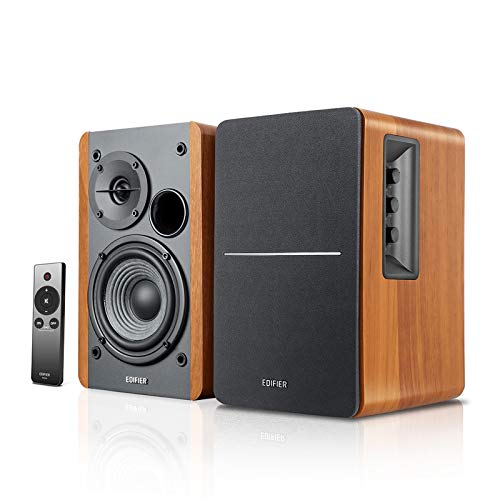
Edifier R1280Ts Powered Bookshelf Speakers
Best for: Wired stereo desktop monitoring setups
- Woofer Size
- 4-inch
- Total Wattage
- 42 Watts RMS
- Audio Inputs
- Dual RCA
- Acoustic Tuning
- Side panel EQ knobs
- Tweeter Type
- 13mm silk dome
- Speaker Type
- Powered
The Edifier R1280Ts are powered bookshelf speakers designed for stereo studio monitoring. They deliver 42W of continuous power through a 4-inch sub-woofer and a 13mm silk dome tweeter. You can connect two devices simultaneously using dual RCA inputs. The unit includes a subwoofer output for expanded bass. Side panel knobs let you adjust bass, treble, and volume directly.
- 42W continuous undistorted power output
- Dual RCA inputs for simultaneous device connection
- Subwoofer output with automatic detection
- Side panel controls for bass, treble, and volume
- Heavier build at 10.8 pounds
- Larger footprint measuring 17 inches in length
- No Bluetooth connectivity listed in specifications
- You need wired stereo monitoring for a desk
- You want to add an external subwoofer later
- You prefer physical knobs for quick EQ adjustments
- You require wireless Bluetooth streaming
- You have limited desk space under 17 inches
- You need a lighter speaker under 10 pounds
Verdict: Edifier R1280Ts Brown Bookshelf Speakers offer solid wired performance for near-field monitoring. They fit users who value physical controls and subwoofer expansion over wireless convenience.
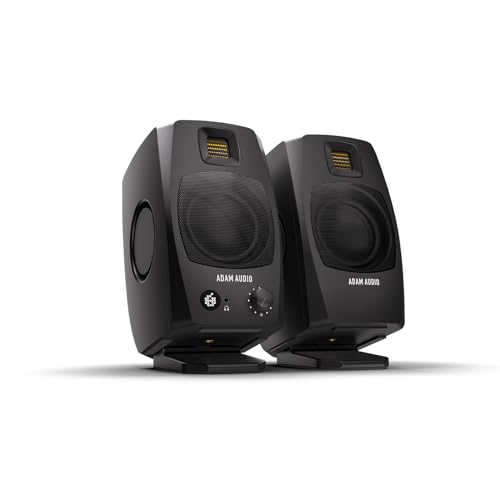
ADAM Audio D3V 3.5in Powered Desktop Monitor
Best for: desktop music production and mixing
- Woofer Size
- 3.5"
- Total Wattage
- 240 W
- Audio Inputs
- USB-C, balanced 1/4" TRS
- Frequency Response
- 45 Hz – 23 kHz
- Acoustic Tuning
- DSP-powered switches
- Tweeter Type
- 1.5" D-ART ribbon
The ADAM Audio D3V is a 2.0 active studio monitor designed for desktop use. It features 80 W amplifiers driving 3.5-inch aluminum woofers and a 1.5-inch D-ART tweeter. The system reaches 45 Hz via passive radiators. You get USB-C connectivity and DSP switches for room correction. Detachable stands angle the sound toward your ears. It suits producers and songwriters needing precise monitoring.
- 80 W amplifier per speaker for strong output
- D-ART tweeter for precise high-frequency reproduction
- USB-C connection for direct device linking
- DSP switches to adjust for room acoustics
- Extends bass response down to 45 Hz
- 80 W power per speaker is lower than typical larger studio monitors
- 3.5-inch woofer size limits low-frequency extension compared to 5-inch or 6.5-inch models
- 7.89-pound weight per unit requires stable desk support
- You need accurate monitoring for songwriting or mixing on a desk
- You want direct USB-C connection to your computer
- You value room correction switches for acoustic adjustment
- You require deep bass extension below 45 Hz
- You need a larger 5-inch or 6.5-inch woofer
- You prefer passive speakers without built-in amplification
Verdict: ADAM Audio D3V Desktop Studio Monitor delivers focused desktop monitoring with DSP room control. It fits producers who need precise highs and direct USB-C connectivity in a compact form.
Specifications side by side
| Spec | Edifier R1280Ts Powered Bookshelf Speakers | ADAM Audio D3V 3.5in Powered Desktop Monitor |
|---|---|---|
| Woofer Size | 4-inch | 3.5" |
| Total Wattage | 42 Watts RMS | 240 W |
| Audio Inputs | Dual RCA | USB-C, balanced 1/4" TRS |
| Frequency Response | – | 45 Hz – 23 kHz |
| Acoustic Tuning | Side panel EQ knobs | DSP-powered switches |
| Tweeter Type | 13mm silk dome | 1.5" D-ART ribbon |
| Speaker Type | Powered | Powered |
| Connectivity | – | TRS |
| Use | Studio Monitoring | Studio Monitoring, Desktop |
| Features | Subwoofer Output | USB Recording, USB-C |
| Color | Brown | Black |
| Recommended Use | Stereo | – |
| Placement | Bookshelf | – |
| Dimensions | 17 × 12.6 × 7.2 inches | 7.88 × 4.5 × 9.5 inches |
| Weight | 10.8 pounds | 12 pounds |
| Model | R1280TS | AMS-D3V-Black |
| Size | – | 8.50 |
Frequently asked questions
Which Edifier or ADAM speaker is better for near-field desktop monitoring?
The Edifier R1280Ts is designed for wired stereo desktop monitoring setups. It features a subwoofer output for bass expansion. The ADAM Audio D3V targets desktop music production with USB-C connectivity. Its compact size fits tight workspaces. Both are powered speakers for studio monitoring.
How do the physical dimensions of these studio monitors compare?
The Edifier R1280Ts measures 12.6 inches wide, 7.2 inches high, and 17 inches long. It weighs 10.8 pounds. The ADAM Audio D3V is smaller at 4.5 inches wide, 9.5 inches high, and 7.88 inches long. It weighs 7.89 pounds. The ADAM unit is more compact for small desks.
What connectivity options does the ADAM Audio D3V offer?
The ADAM Audio D3V provides TRS connectivity and USB-C ports. It supports USB recording functions. This setup allows direct connection to computers. The Edifier R1280Ts focuses on wired stereo performance. It lacks the digital USB features found in the ADAM model.
Can I connect a subwoofer to the ADAM Audio D3V?
The Edifier R1280Ts includes a dedicated subwoofer output. This allows you to add external bass speakers. The ADAM Audio D3V data does not list a subwoofer output. You would need to rely on its internal 80W amplifiers for low-frequency response without external bass support.
Which monitor is lighter and easier to move?
The ADAM Audio D3V weighs 7.89 pounds. The Edifier R1280Ts weighs 10.8 pounds. The ADAM unit is significantly lighter. This makes it easier to reposition on your desk. The Edifier model is heavier due to its larger bookshelf cabinet design.
What color options are available for these powered speakers?
The Edifier R1280Ts is available in brown. The ADAM Audio D3V comes in black. These color choices allow you to match your studio decor. The Edifier offers a warmer wood tone. The ADAM provides a neutral black finish for professional environments.
Are these speakers suitable for stereo playback?
Yes, both models are recommended for stereo use. The Edifier R1280Ts is explicitly rated for stereo monitoring. The ADAM Audio D3V is designed for desktop monitoring. Both are powered speakers intended for accurate stereo imaging in studio environments.


