PECRON Power Station Guide: Which Size Fits Camping or Home Backup?
As Amazon Associates, we earn from qualifying purchases. This means we may receive a small commission at no extra cost to you if you click through and make a purchase.
If you searched for a “pectron power station,” you were almost certainly looking for PECRON, a brand that makes portable power stations: big rechargeable batteries in a box with ordinary wall outlets, USB ports and car-style sockets built in. You charge one from a wall, a car or solar panels, then use it to run lights, phones, a fridge or a CPAP machine when you are camping or when the power goes out. Every PECRON in this guide uses a LiFePO4 battery (lithium iron phosphate), a type of lithium battery known for handling many charge cycles and staying stable under heat, which is why it is popular for home backup.
The six models differ mainly in size: capacity runs from 576Wh on the small E500LFP to 3840Wh on the E3800 LFP, and output from 600W to 4200W, with the larger ones adding expansion batteries, UPS switching and RV outlets.
PECRON Portable Power Stations Compared
Best for: Campers wanting a solar starter kit
Pros
- 1536Wh, 2200W output
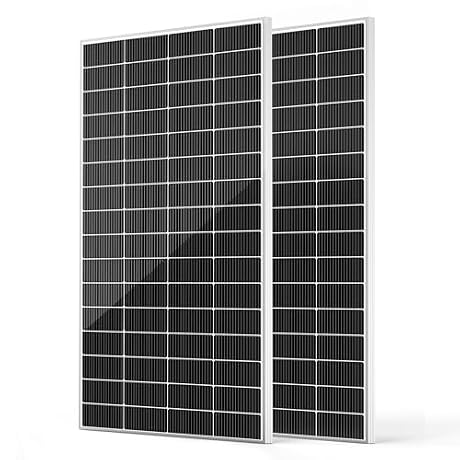
- 200W solar panel included
- Up to 1000W solar input
- Expandable to 9216Wh
Cons
- Panel ships separately
- Some spec fields look mislabeled

Pecron
PECRON Portable Power Station E1000LFP, 1024Wh/1800W LiFePO4 Battery Backup
Price and specifications are read from the Amazon product page and can change.
PECRON Portable Power Station E1000LFP
Best for: Weekend camping and short outages
Pros
- 1024Wh, 1800W output
- Charges in about 1.3 hours
- Expandable to 4096Wh
- Solar, car and AC cables included
Cons
- Solar input not listed

Best for: Home backup with app monitoring
Pros
- 3072Wh, 3600W output
- Expandable to 10752Wh
- App monitoring and UPS mode
- 2 hour AC recharge
Cons
- Extra battery needs separate cable
- Voltage spec reads 220V
Best for: Whole-home essentials and RV living
Pros
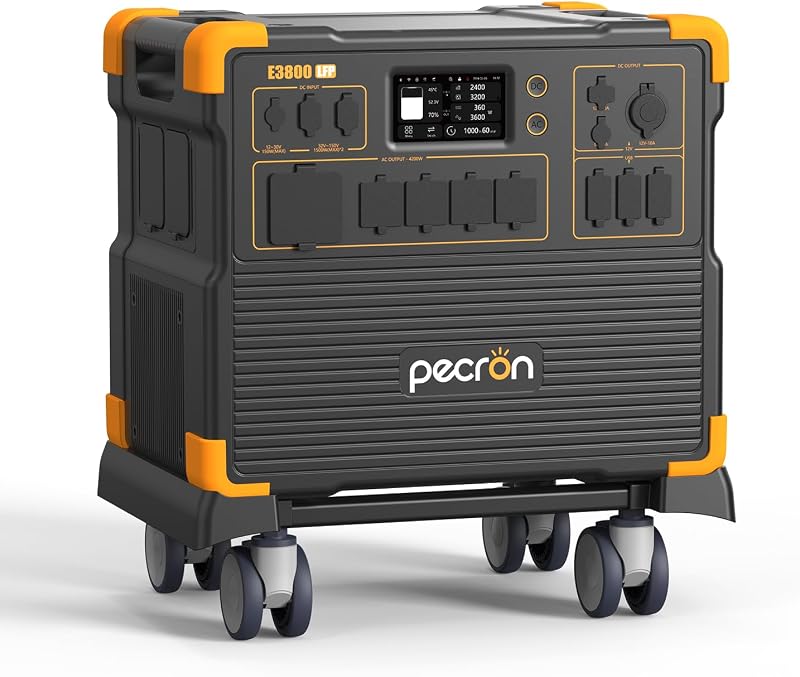
- 3840Wh capacity, 4200W output
- TT30-R RV-ready outlet
- 3200W AC and 3000W solar input
- 8-20ms UPS switching
Cons
- Heavy at 87.3 pounds
| Model | Capacity | Rated output | Max listed expansion | Solar panel included |
|---|---|---|---|---|
| PECRON E3800 LFP | 3840Wh | 4200W | Not listed | No |
| PECRON F3000LFP | 3072Wh | 3600W | 10752Wh | No |
| PECRON E1000LFP | 1024Wh | 1800W | 4096Wh | No |
| PECRON E3600LFP Solar Generator | 3072Wh | 3600W | 18.43kWh | Yes, 2 x 300W |
| PECRON E500LFP | 576Wh | 600W | Not listed | No |
| PECRON E1500LFP | 1536Wh | 2200W | 9216Wh | Yes, 1 x 200W |
Two terms make this table easy to read. Watt-hours (Wh) measure how much energy the battery stores, like the size of a fuel tank. Watts (W) of output measure how much power it can deliver at one moment, like the width of the hose. A 1000W microwave needs a station rated above 1000W output, and the capacity decides how long it can run.
PECRON Portable Power Station E3800 LFP for Big Home Backup and RVs
The PECRON Portable Power Station E3800 LFP is the largest model here, with 3840Wh of capacity and 4200W of pure sine wave output. Pure sine wave means the power is as smooth as a wall outlet, which sensitive electronics and appliances prefer. PECRON says the battery keeps 80% of its capacity after 3500 full cycles and is UL-certified and automotive-grade.
The listing counts 14 output ports, including four AC outlets, a TT30-R outlet for plugging in an RV, three 12V DC outputs and four USB-A ports; the spec table lists 5 power outlets, which likely counts only the AC-style sockets. Charging is flexible: 3200W from the wall with a 30A cable (0 to 100% in 1.4 hours), 1800W with a 15A cable (2.5 hours), up to 3000W of solar input and a car cable. A UPS function (uninterruptible power supply) switches to battery in 8 to 20 milliseconds during an outage so computers do not shut off. An LCD touchscreen shows battery level, power in and out and remaining runtime.
At 87.3 pounds, the E3800 LFP suits RV owners and households that want to run large appliances during outages, not hikers. For smaller jobs, the E1000LFP or E1500LFP will be far easier to move.
PECRON Portable Power Station F3000LFP for Expandable Home Backup
The PECRON Portable Power Station F3000LFP offers 3072Wh and 3600W of pure sine wave output across 13 ports: six AC outlets, two 100W USB-C, two USB-A, a car port and two DC 5525 outputs. PECRON says it can cover two to three days of home essentials and run fridges, air conditioners and power tools.
It recharges from 0 to 100% in about 2 hours at 1800W from the wall, accepts up to 1600W of solar, and can charge from a car. It adds app monitoring for real-time power use and an 8 to 20 millisecond UPS mode. Capacity can grow to 10752Wh with extra EP3800-48V batteries, but the listing notes each connection needs an XT120-M cascade cable sold separately. The spec table lists 220 volts, which conflicts with the rest of the lineup and is not explained, so confirm the outlet voltage with the seller. Warranty is listed as 2+3 years.
The F3000LFP suits homeowners who want app control and room to add batteries later. If you would rather have solar panels in the box, the E3600LFP bundle covers that.
PECRON Portable Power Station E1000LFP for Weekend Camping
The PECRON Portable Power Station E1000LFP sits in the middle with 1024Wh and 1800W of output. The listing mentions 12 outputs: five AC outlets, two USB-C, two USB-A, an XT60 output, a cigar port and a DC 5525 output. It recharges in about 78 minutes (1.3 hours), and capacity can be expanded to 4096Wh.
The box includes AC, solar and car charging cables plus an accessory bag, and the warranty is listed as 2+1 years. The listing does not specify maximum solar input or runtime figures, so check those if solar charging matters to you. For more background on this brand’s range, see our main PECRON portable power station overview.
The E1000LFP suits campers and families who want enough power for a weekend or a short outage without a heavy unit. If you need to run large appliances for days, step up to the F3000LFP or E3800 LFP.
PECRON Solar Generator E3600LFP 3072Wh 3600W for Off-Grid Setups

Pecron
PECRON Solar Generator E3600LFP 3072Wh/3600W with 2x300W Solar Panels
Price and specifications are read from the Amazon product page and can change.
PECRON Solar Generator E3600LFP 3072Wh 3600W
Best for: Off-grid buyers wanting panels included
Pros
- Two 300W solar panels included
- Expandable to 18.43kWh
- 16 outputs incl. TT30-R
- 3 hour charge at 3200W
Cons
- Panels ship separately
- Large system to store
The PECRON Solar Generator E3600LFP 3072Wh 3600W bundle pairs a 3072Wh power station with two 300W solar panels. “Solar generator” simply means a power station sold with panels. Output is rated at 3600W pure sine wave, and with four extra EP3800-48V batteries the system can expand to 18.43kWh, the largest figure in this lineup.
It has 16 output options, including four AC outlets, a TT30-R RV outlet, four USB-A, two 100W USB-C, an XT60-F output, a cigar port and a DC5525 output. Charging takes about 1.3 hours at 3200W AC, 2 hours at 1800W AC, or 1.5 hours with eight 300W panels. The box includes 15A and 30A AC cables, solar cables, a car cable and more, with a 2+3 year warranty. The station and panels ship separately, so do not worry if one box arrives first.
The E3600LFP suits buyers building an off-grid cabin or RV setup who want panels included. For a smaller solar starter kit, the E1500LFP is lighter on space.
Pecron E500LFP Portable Power Station for Day Trips
Best for: Day trips and small gadgets
Pros
- Compact and lightweight
- 600W pure sine wave
- 5 hour AC charge
- Top charger output
Cons
- Capacity listed as 576 or 596Wh
- Only 2 AC outlets
The Pecron E500LFP Portable Power Station is the compact choice. The title lists 576Wh and 600W of pure sine wave output, although one spec line says 596 watt-hours, so treat 576Wh as the headline figure. Outputs include two AC outlets, two USB-A, one USB-C, a cigar port, two DC 5525 outputs and a top charger, which is a charging spot on the top surface.
It fully charges in 1.5 hours with 500W AC charging, or can charge via USB-C (about 6 hours), a 100W solar panel sold separately, or a car. Safety features cover overcharge, over-voltage, overheat, overload and short circuits. The box includes AC and car cables, and warranty is listed as 1+1 year.
The E500LFP suits picnics, tailgates and keeping phones, lights and a laptop running. It cannot power large appliances; for that, move to the E1000LFP or larger.
PECRON Portable Power Station E1500LFP 1536Wh for a Solar Starter Kit
The PECRON Portable Power Station E1500LFP 1536Wh comes with a 200W solar panel and delivers 2200W of output through 12 ports, including four AC outlets, four USB ports up to 100W, an XT60-F output, a cigar port and a DC5525 port. Capacity can be expanded to 9216Wh with two EP3800-48V batteries.
Charging reaches 80% in 0.9 hours and full in 1.8 hours at up to 1400W AC, or about 2.5 hours with up to 1000W of solar. A BMS (battery management system) guards against short circuits, overloads and overheating. Warranty is listed as 2+3 years, and PECRON asks buyers to register within 30 days for the extra 12 months. Some spec fields, such as a “4 Stroke” engine type, look copied from a gas generator template and do not apply to a battery unit. If you plan to add more panels later, our guide to portable solar panels explains the basics.
The E1500LFP suits campers who want a ready-to-go solar kit with room to grow. For a lighter, cheaper-to-carry option without panels, the E1000LFP is simpler.
How to Choose the Right PECRON Portable Power Station
Add up what you want to run. Check the watt label on each device and make sure the total stays under the station’s output: 600W for the E500LFP, 1800W for the E1000LFP, 2200W for the E1500LFP, 3600W for the F3000LFP and E3600LFP, and 4200W for the E3800 LFP.
Then think about how long. A 100W device on a 1024Wh battery runs for roughly 8 to 9 hours once conversion losses are counted. Long outages and fridges point toward the 3000Wh-plus models, and running a fridge is covered in our fridge backup power guide.
Consider weight and portability. The E500LFP is built to carry, while the E3800 LFP weighs 87.3 pounds and belongs at home or in an RV.
Finally, decide on solar and expansion. The E3600LFP and E1500LFP include panels, while the F3000LFP, E3600LFP, E1500LFP and E1000LFP list expansion options.
FAQ
Is “Pectron” the same as PECRON?
Yes, “pectron” is a common misspelling. The brand in this guide is PECRON.
Which PECRON is best for camping?
The E500LFP suits day trips and small gadgets, while the E1000LFP and E1500LFP suit weekends with more devices.
Which PECRON can run a refrigerator during an outage?
The E3800 LFP and F3000LFP listings name refrigerators directly. Larger capacity means longer runtime.
What does UPS mean on a power station?
It stands for uninterruptible power supply. The E3800 LFP and F3000LFP switch to battery in 8 to 20 milliseconds, fast enough to keep a computer running.
Why choose a LiFePO4 battery?
LiFePO4 batteries are known for long cycle life and thermal stability. PECRON rates the E3800 LFP at 80% capacity after 3500 cycles.
Do the solar bundles arrive in one box?
No. The E3600LFP and E1500LFP listings say the power station and solar panel ship separately.