Choosing Subwoofers in 2026: The Specs That Matter and 8 Picks
As Amazon Associates, we earn from qualifying purchases. This means we may receive a small commission at no extra cost to you if you click through and make a purchase.
As an Amazon Associate we earn from qualifying purchases. Links on this page are affiliate links.
This subwoofer buying guide helps you choose the right low-frequency speaker for your home theater. You will learn how to match driver size, wattage, and connectivity to your room and existing audio gear. We focus strictly on published specifications to ensure your decision is based on measurable performance rather than marketing claims.
We selected 8 models from the current market based on their technical data. The list includes options for compact spaces, like the Sonos Sub Mini, and high-output wired units, such as the Klipsch R-120SW. You will see details on channel configurations, amplifier classes, and physical dimensions. This practical approach allows you to compare products directly and pick the subwoofer that fits your specific audio needs.
Key Subwoofer Specs to Check
Speaker Type and Power
You must decide between powered and passive subwoofers. Powered models include a built-in amplifier, which simplifies setup and ensures the driver receives adequate power. The Klipsch R-120SW offers 400W of output for high-volume environments. The Polk Audio Monitor XT12 uses Class AB amplification for robust performance. Passive units require an external receiver. Powered subs provide a complete solution with less wiring complexity. Check the wattage rating to gauge potential volume. Higher wattage generally supports deeper bass extension. Consider your room size when selecting power levels. A 100W sub suits smaller spaces, while larger rooms may need more output.
Look for
- Built-in amplifier class
- Total wattage rating
- Powered or passive design
Driver Size and Depth
The driver diameter determines how much air the subwoofer can move. Larger drivers, such as the 12-inch Polk Audio Monitor XT12, typically produce deeper bass frequencies. The Sony SA-CS9M2 uses a 10-inch driver for a balance of size and performance. The Sonos Sub Mini uses a 6.5-inch driver for compact accuracy. Bigger drivers require more physical space. You must check the cabinet dimensions before purchase. The Polk unit measures 18 inches in length. Ensure your placement area accommodates the physical size. Larger drivers often offer better extension but consume more room. Smaller drivers fit in tight spaces but may lack ultimate depth.
Look for
- Woofer diameter in inches
- Cabinet length and width
- Physical depth constraints
Connectivity Options
Connection type affects installation flexibility. Wireless and Wi-Fi options, like the Sonos Sub 4, eliminate cable clutter. The ULTIMEA Poseidon M80 system includes wireless rear speakers. Wired connections via HDMI eARC or Optical inputs offer stable signal transmission. The Polk Audio Monitor XT12 relies on wired connectivity. Wireless setups require a dedicated transmitter or network. Wired subs connect directly to your receiver. Choose wireless for clean aesthetics and easy placement. Choose wired for maximum reliability and lower latency. Check if your receiver supports the specific input type. HDMI eARC handles high-bandwidth audio formats efficiently.
Look for
- Wireless or wired connection
- HDMI eARC or Optical input
- Network or transmitter needs
Audio Format Support
Modern home theaters use advanced audio formats. Dolby Atmos and DTS:X require compatible subwoofers and receivers. The ULTIMEA Poseidon M80 supports Dolby Atmos. The Polk Audio Monitor XT12 supports DTS:X. These formats enhance immersion by adding height channels. Ensure your subwoofer can handle the signal processing if it is active. Some subs are passive and rely on the receiver. Others have built-in processing. Check the attributes for specific format support. This ensures your bass integrates with the surround sound field. Mismatched formats can limit your system's potential.
Look for
- Dolby Atmos compatibility
- DTS:X support
- Active processing capability
Channel Configuration
Subwoofers often serve as part of a larger channel system. The ULTIMEA Poseidon M80 is a 5.1 channel system. It includes wired rear speakers for complete surround sound. Other subs are standalone units for 2.0 or 7.1.2 setups. The Sonos Sub Mini fits into compact 7.1.2 configurations. Determine if you need a standalone sub or a full system. Standalone subs offer more flexibility in placement. Complete systems simplify pairing but limit speaker choices. Match the channel count to your room's audio needs. A 5.1 system suits most living rooms. Larger spaces may benefit from more channels.
Look for
- Total channel count
- Included rear speakers
- Standalone or system unit
Physical Weight and Build
Subwoofers are heavy and require stable placement. The Polk Audio Monitor XT12 weighs 39 pounds. The Sonos Sub 4 weighs 26.5 pounds. Heavier cabinets reduce vibration and resonance. This improves sound clarity. Lighter units, like the Sonos Sub Mini at 14 pounds, are easier to move. Consider the floor type for placement. Heavy subs may require isolation pads. Ensure your furniture or floor can support the weight. The Klipsch R-120SW weighs 31 pounds. Check the weight specification to plan your setup. Stability is crucial for consistent bass performance.
Look for
- Total unit weight
- Floor support requirements
- Cabinet stability features
Color and Aesthetics
The subwoofer's color should match your existing decor. Most models, like the Sony SA-CS9M2 and Klipsch R-100SW, are black. The Sonos Sub 4 is white. Black units blend better with most electronics. White units suit light-colored furniture. The Sonos Sub Mini is available in black. Consider the visual impact in your room. A mismatched color can be distracting. Check the color specification before ordering. Some brands offer limited color options. Ensure the finish complements your soundbar or receiver. Aesthetic consistency enhances the overall home theater experience.
Look for
- Available color options
- Finish type
- Match with existing gear
Types of Subwoofers to Consider
Wireless Systems
Wireless subwoofers connect to your soundbar or receiver without long cables. This simplifies placement, allowing you to hide the unit under furniture or in corners. The Sonos Sub Mini and Sub 4 use Wi-Fi or proprietary wireless links. The ULTIMEA Poseidon M80 includes a wireless subwoofer but requires wired rear speakers. You get clean aesthetics and flexible positioning. The trade-off is potential latency or connection drops. You must ensure your source device supports the specific wireless protocol. This type suits buyers who prioritize a tidy living room over absolute signal reliability.
Compact Powered Units
Compact powered subwoofers balance size with output. They fit in smaller rooms or apartments where space is limited. The Sony SA-CS9M2 features a 10-inch driver in a small cabinet. The Sonos Sub Mini has a 6.5-inch driver for precise bass. These units often use Class AB or digital amplifiers to drive the driver efficiently. You get accurate low-frequency response without a massive footprint. The trade-off is less raw volume compared to larger models. They are ideal for Beam or Ray soundbar owners. You should check the driver size to ensure it meets your bass expectations for your room size.
High-Output Powered Models
High-output powered subwoofers prioritize raw volume and deep extension. They feature large drivers and high-wattage amplifiers. The Klipsch R-120SW offers 400W and a 12-inch driver. The Polk Audio Monitor XT12 also uses a 12-inch driver with Class AB amplification. These units deliver impactful bass for dedicated home theaters. You get robust performance for movies and music. The trade-off is significant weight and physical size. The Klipsch R-120SW weighs 31 pounds. The Polk model weighs 39 pounds. You need adequate floor space and a power outlet near the placement spot. These are best for users who want maximum bass impact.
Common Subwoofer Buying Mistakes
Ignoring room size when choosing driver diameter
A small driver struggles to move enough air for a large space, resulting in weak bass response. You must match the driver size to your room dimensions. Larger rooms generally require larger drivers, such as 12-inch or 15-inch units, to produce adequate low-frequency output and maintain clarity at higher volumes.
Overlooking amplifier power ratings for your needs
Peak power numbers can be misleading. You should look at continuous RMS wattage to understand real-world performance. Higher continuous power allows the subwoofer to handle dynamic movie explosions without distortion. Ensure the amplifier rating aligns with your listening volume preferences and the acoustic demands of your specific listening environment.
Assuming all wireless connections offer equal quality
Some wireless systems use proprietary links that may introduce latency or compression artifacts. You must verify the connection type and bandwidth capabilities. Wi-Fi based systems often provide higher fidelity and stability than proprietary radio links. Check the specifications to ensure the wireless technology supports the audio quality you expect from your source material.
Neglecting connectivity options for your existing gear
Not all subwoofers support the same input types. You need to check if the unit offers LFE, RCA, or high-level inputs that match your receiver or soundbar. Mismatched connections can force you to use adapters or limit your system's flexibility. Verify compatibility before purchasing to ensure seamless integration with your current audio setup.
Forgetting to check frequency response range limits
A subwoofer that stops at 40Hz may not reproduce deep bass effects in action movies. You should review the specified frequency response range to ensure it covers your desired low end. A wider range down to 20Hz or lower provides more impactful and realistic low-frequency performance for modern home theater content.
| # | Product | Best for | Price |
|---|---|---|---|
| 1 | ULTIMEA 5.1ch Soundbar with Wireless Subwoofer | Complete 5.1 home theater setups | |
| 2 | Sonos Sub Mini Black Wireless | compact wireless 7.1.2 Atmos setups | |
| 3 | Polk Audio Monitor XT12 12" Powered Subwoofer | Home theater setups needing deep, wired bass | |
| 4 | Sony 10-Inch Compact Powered Subwoofer | compact home theater setups needing accurate bass | |
| 5 | Sonos Sub 4 Wireless Subwoofer | Sonos ecosystem users wanting deep bass | |
| 6 | Klipsch 12" 400W Bass-Reflex Subwoofer | High-volume home theater setups needing deep bass | |
| 7 | Klipsch 10-inch Subwoofer with Digital Amplifier | Wired home theater setups needing deep bass | |
| 8 | Sonos Sub Mini Compact Wireless Subwoofer | small rooms with Beam or Ray soundbars |

ULTIMEA 5.1ch Soundbar with Wireless Subwoofer
Best for: Complete 5.1 home theater setups
- Driver Size
- 5.25"
- Peak Power
- 312 W
- Connectivity
- Wireless, Bluetooth 6.0, HDMI eARC
- Use
- Home Theater
- Features
- Dolby Atmos, Rear Speakers
- Channels
- 5.1 Channel
This ULTIMEA Poseidon M80 system delivers 312W peak power with a 5.25-inch wireless subwoofer. It includes two wired rear speakers for true 5.1 surround sound. HDMI eARC handles Dolby Atmos audio, while Bluetooth 6.0 allows for wireless music streaming. The ULTIMEA app lets you adjust bass and surround levels. It suits home theater users who want immersive audio without complex wireless surround setups.
- 312W peak power output for strong bass impact
- Includes two wired rear surround speakers
- HDMI eARC connection for Dolby Atmos decoding
- Bluetooth 6.0 for wireless music streaming
- App control for bass and surround adjustment
- 5.25-inch subwoofer is smaller than the 10-inch or 12-inch drivers in other picks
- Peak power rating of 312W is lower than typical standalone subwoofer ratings
- Wired rear speakers require placement near the listening area
- You want a complete 5.1 system with included rear speakers
- You prefer wired rear speakers for stable connectivity
- You need HDMI eARC for Dolby Atmos playback
- You require a subwoofer with a driver larger than 5.25 inches
- You need a standalone subwoofer without a soundbar
- You want wireless rear surround speakers
Verdict: ULTIMEA Poseidon M80 5.1ch System offers a complete home theater package with included wired rear speakers. It fits buyers who want immersive surround sound without the hassle of wireless rear speaker pairing.

Sonos Sub Mini Black Wireless
Best for: compact wireless 7.1.2 Atmos setups
- Connectivity
- Wireless
- Color
- Black
The Sonos Sub Mini is a compact wireless subwoofer designed for smaller spaces. It features dual 6-inch force-canceling woofers to deliver deep bass without rattling your room. This unit pairs with the Sonos Beam Ultra and Era 100 speakers to create a full 7.1.2 Dolby Atmos surround sound system. You get wireless connectivity and app control for easy setup. It is ideal for those who want immersive audio in a compact footprint.
- Dual 6-inch force-canceling woofers for deep bass
- Compact wireless design fits small spaces
- Supports 7.1.2 Dolby Atmos surround sound
- Controls via Sonos app or TV remote
- Smaller 6-inch woofer size compared to 10-inch or 12-inch competitors
- Sold as part of a bundle rather than as a standalone unit
- You have limited floor space for audio equipment
- You want a complete wireless surround sound system
- You prefer compact subwoofers with force-canceling technology
- You need a standalone subwoofer without other speakers
- You require a larger 10-inch or 12-inch driver for maximum output
- You want to build a system with non-Sonos components
Verdict: Sonos Sub Mini Black offers compact, force-canceling bass for users who prioritize space-saving design and seamless integration with the Sonos ecosystem. It fits buyers seeking a complete, wireless 7.1.2 Atmos setup in a small package.

Polk Audio Monitor XT12 12" Powered Subwoofer
Best for: Home theater setups needing deep, wired bass
- Driver Size
- 12"
- Connectivity
- RCA, LFE, 5-way binding post
- Amplifier Class
- Class A/B
- Speaker Type
- Powered
- Features
- Dolby Atmos, Amplifier
- Audio Format
- DTS:X
The Polk Audio Monitor XT12 is a 12-inch powered subwoofer designed for home theater systems. It features a 100W Class A/B amplifier and delivers bass down to 24Hz. The unit includes a rigid MDF cabinet and versatile connections like RCA and binding posts. You will appreciate its compatibility with Dolby Atmos and DTS:X receivers. This model suits listeners who need deep, distortion-free low frequencies for movies and music.
- 12-inch Dynamically Balanced Woofer
- 100W Class A/B Amplifier
- Frequency response down to 24Hz
- Rigid MDF cabinet minimizes resonance
- Multiple connection options including RCA and binding posts
- 100W amplifier power is lower than some competitors
- 39-pound weight and 16x16x18-inch dimensions require more space
- Crossover range limited to 80-160Hz
- You want a 12-inch driver for deeper bass extension
- You need a wired subwoofer with binding post inputs
- You prefer a rigid MDF cabinet for reduced resonance
- You require a wireless connection for easier placement
- You need a subwoofer under 30 pounds for easy moving
- You want a compact unit smaller than 16 inches in height
Verdict: Polk Audio Monitor XT12 12" Subwoofer offers robust 12-inch bass performance for home theater enthusiasts who prioritize wired connectivity and cabinet rigidity over wireless convenience.
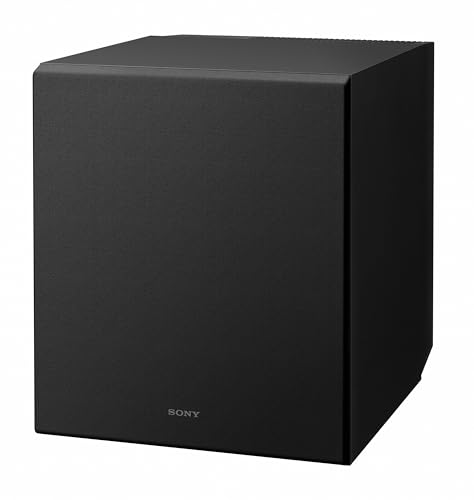
Sony 10-Inch Compact Powered Subwoofer
Best for: compact home theater setups needing accurate bass
- Driver Size
- 10"
- Enclosure Type
- Bass Reflex
- Use
- Home Theater
- Color
- Black
- Dimensions
- 18.7 × 14.8 × 17.4 inches
- Weight
- 20.8 pounds
The Sony SA-CS9M2 is a 10-inch active powered subwoofer designed for home theater use. It features bass reflex ducts to suppress unwanted noise and vibration, delivering tight, accurate bass. Measuring 18.7 inches wide and weighing 20.8 pounds, this compact unit fits easily into tight spots. It is ideal for listeners who want deep bass reproduction from music and movies without a bulky footprint.
- 10-inch active driver for powerful bass output
- Bass reflex ducts improve low frequency sound reproduction
- Compact dimensions fit into tight spaces
- Suppresses unwanted vibration for accurate bass
- Heavier build at 20.8 pounds compared to lighter alternatives
- Single 10-inch driver size limits low-end extension compared to larger subwoofers
- Bass reflex design may produce port noise in high-output scenarios
- You need a subwoofer that fits in tight spaces
- You want deep bass from movies and music
- You prefer a compact home theater setup
- You require wireless connectivity
- You need a subwoofer with multiple driver configurations
- You prefer a lighter, portable subwoofer
Verdict: Sony SA-CS9M2 10-Inch Home Theater Subwoofer is a solid choice for home theater enthusiasts who prioritize compact size and accurate bass. It suits buyers who have limited space but still want powerful low-frequency performance.

Sonos Sub 4 Wireless Subwoofer
Best for: Sonos ecosystem users wanting deep bass
- Connectivity
- WiFi
- Enclosure Type
- Ported
- Color
- White
- Subwoofer
- Wireless Subwoofer
- Dimensions
- 6.22 × 15.3 × 15.8 inches
- Weight
- 26.5 pounds
The Sonos Sub 4 is a white wireless subwoofer designed for deep, dynamic bass. It features dual force-canceling woofers and a ported enclosure to enhance low-frequency output. Measuring 15.8 inches high and weighing 26.5 pounds, it connects via Wi-Fi. This unit suits you if you want a sculptural design that fits under a sofa or stands upright. It pairs reliably with Sonos soundbars like the Arc or Beam for a complete home theater experience.
- Dual force-canceling woofers reduce distortion and rattle
- Ported enclosure improves bass response and low-frequency output
- Connects via Wi-Fi for flexible placement options
- Can stand upright or lay on its side
- Heavier build at 26.5 pounds compared to lighter competitors
- Larger footprint with a height of 15.8 inches
- Requires a Sonos soundbar for full functionality
- You already own a Sonos soundbar system
- You want a subwoofer that can hide under a sofa
- You prefer a matte white finish for your audio setup
- You need a standalone subwoofer without a soundbar
- You prefer a compact wireless subwoofer like the Sub Mini
- You want a black finish instead of white
Verdict: Sonos Sub 4 Wireless Subwoofer is a heavy, tall unit that delivers deep bass through dual force-canceling woofers. It fits you if you have a Sonos soundbar and want a subwoofer that can hide under your sofa.

Klipsch 12" 400W Bass-Reflex Subwoofer
Best for: High-volume home theater setups needing deep bass
- Driver Size
- 12"
- Peak Power
- 400 W
- Continuous Power
- 200 W
- Enclosure Type
- Bass-reflex
- Frequency Response
- 29 Hz – 120 Hz (+/- 3 dB)
- Color
- Black
The Klipsch R-120SW is a single black subwoofer designed for deep bass reproduction. It features a 12-inch high excursion spun-copper Imp woofer and delivers up to 400 watts of peak power. The unit outputs sound between 29 Hz and 120 Hz with a maximum acoustic output of 116 dB. This 31-pound unit measures 19.2 inches in length and includes a bass-reflex rear firing port. It suits listeners who want high-volume, powerful low-end response in a standard home theater setup.
- 12-inch high excursion spun-copper Imp woofer for robust bass
- 400 watts peak amplifier power for high output
- Maximum acoustic output reaches 116 dB for loud environments
- Frequency response extends down to 29 Hz for deep lows
- Bass-reflex design with rear firing port enhances efficiency
- Weighs 31 pounds, making it heavier than many compact wireless competitors
- 12-inch driver size is larger than the 10-inch options available from other brands on this list
- Single unit configuration lacks the dual-driver force-canceling technology found in some rival models
- You need high maximum acoustic output for larger rooms
- You prefer a wired subwoofer with a large driver size
- You want deep bass extension down to 29 Hz
- You require a wireless connection for easy placement
- You need a compact subwoofer under 20 pounds
- You want dual force-canceling woofers to reduce cabinet vibration
Verdict: Klipsch R-120SW 12" Powered Subwoofer fits buyers who prioritize raw output and deep extension over wireless convenience or compact size. Its high wattage and large driver make it ideal for those seeking maximum bass impact in a dedicated audio space.

Klipsch 10-inch Subwoofer with Digital Amplifier
Best for: Wired home theater setups needing deep bass
- Driver Size
- 10"
- Peak Power
- 300 W
- Continuous Power
- 150 W
- Connectivity
- RCA
- Amplifier Class
- All-digital
- Driver Orientation
- Front-firing
The Klipsch R-100SW is a 10-inch powered subwoofer with a 300-watt peak amplifier. It delivers bass from 32Hz to 120Hz. The unit weighs 26 pounds and measures 16.9 by 12.5 by 14.8 inches. You get RCA inputs and phase control. This model suits those who want deep bass in a standard black finish without wireless complexity.
- 10-inch front-firing spun-copper IMG woofer
- 300-watt peak power amplifier
- Frequency response extends down to 32Hz
- Line level LFE RCA inputs for easy receiver connection
- Phase control allows for precise tuning
- Heavier build at 26 pounds compared to lighter competitors
- Larger physical footprint than compact wireless options
- Lower peak power rating than some higher-end models
- You need a wired subwoofer with RCA inputs
- You prefer a traditional black finish
- You want a 10-inch driver for deep bass
- You require a wireless connection
- You need a compact or mini form factor
- You want a subwoofer under 20 pounds
Verdict: Klipsch R-100SW 10-Inch Powered Subwoofer fits users who want a wired, high-output bass solution and do not mind its substantial weight and size. It is a solid choice for standard home theater setups.

Sonos Sub Mini Compact Wireless Subwoofer
Best for: small rooms with Beam or Ray soundbars
- Driver Size
- Dual 6"
- Connectivity
- Wireless, WiFi
- Driver Orientation
- Face inward
- Enclosure Type
- Acoustically sealed
- Color
- Black
- Subwoofer
- Wireless Subwoofer
The Sonos Sub Mini is a compact wireless subwoofer designed for smaller spaces. It features dual 6.5-inch force-canceling woofers housed in an acoustically sealed cabinet. This design neutralizes distortion while delivering deep bass. Trueplay tuning adapts the sound to your room's acoustics. It connects via Wi-Fi and pairs with Beam or Ray soundbars. Weighing 14 pounds, it fits easily into tight areas.
- Dual 6.5-inch force-canceling woofers reduce distortion
- Compact dimensions of 8.98 x 8.98 x 11.9 inches
- Trueplay tuning adapts bass to room acoustics
- Wi-Fi connectivity for seamless integration
- Smaller 6.5-inch driver size compared to 10-inch or 12-inch competitors
- Single subwoofer configuration limits bass output for large rooms
- Requires an iOS device for Trueplay tuning setup
- You have a small living area or bedroom
- You use a Beam or Ray soundbar
- You want a subwoofer that fits in tight spaces
- You need deep bass for a large open-plan room
- You prefer a larger driver for more physical impact
- You do not have an iOS device for tuning
Verdict: Sonos Sub Mini Black Wireless offers precise, distortion-free bass in a tiny footprint. It is the right pick for Beam or Ray owners with limited space who value accuracy over raw volume.
Specifications side by side
| Spec | ULTIMEA 5.1ch Soundbar with Wireless Subwoofer | Sonos Sub Mini Black Wireless | Polk Audio Monitor XT12 12" Powered Subwoofer | Sony 10-Inch Compact Powered Subwoofer | Sonos Sub 4 Wireless Subwoofer | Klipsch 12" 400W Bass-Reflex Subwoofer | Klipsch 10-inch Subwoofer with Digital Amplifier | Sonos Sub Mini Compact Wireless Subwoofer |
|---|---|---|---|---|---|---|---|---|
| Driver Size | 5.25" | – | 12" | 10" | – | 12" | 10" | Dual 6" |
| Peak Power | 312 W | – | – | – | – | 400 W | 300 W | – |
| Continuous Power | – | – | – | – | – | 200 W | 150 W | – |
| Connectivity | Wireless, Bluetooth 6.0, HDMI eARC | Wireless | RCA, LFE, 5-way binding post | – | WiFi | – | RCA | Wireless, WiFi |
| Amplifier Class | – | – | Class A/B | – | – | – | All-digital | – |
| Driver Orientation | – | – | – | – | – | – | Front-firing | Face inward |
| Enclosure Type | – | – | – | Bass Reflex | Ported | Bass-reflex | – | Acoustically sealed |
| Frequency Response | – | – | – | – | – | 29 Hz – 120 Hz (+/- 3 dB) | 32 Hz – 120 Hz (-3 dB) | – |
| Speaker Type | – | – | Powered | – | – | – | – | – |
| Woofer Size | – | – | – | – | – | – | 5" | – |
| Use | Home Theater | – | – | Home Theater | – | – | – | – |
| Features | Dolby Atmos, Rear Speakers | – | Dolby Atmos, Amplifier | – | – | – | Amplifier | – |
| Channels | 5.1 Channel | – | – | – | – | – | – | – |
| Audio Format | – | – | DTS:X | – | – | – | – | – |
| Color | Matte Black | Black | Black | Black | White | Black | Black | Black |
| Subwoofer | Wireless Subwoofer | – | – | – | Wireless Subwoofer | – | – | Wireless Subwoofer |
| Recommended Use | TV | – | – | – | – | – | – | – |
| Wattage | – | – | 100W | – | – | – | – | – |
| Dimensions | 3.54 × 23.6 × 2.76 inches | – | 18 × 16 × 16 inches | 18.7 × 14.8 × 17.4 inches | 6.22 × 15.3 × 15.8 inches | 19.2 × 14 × 16.5 inches | 16.9 × 12.5 × 14.8 inches | 8.98 × 8.98 × 11.9 inches |
| Weight | 12.6 pounds | – | 39 pounds | 20.8 pounds | 26.5 pounds | 31 pounds | 26 pounds | 14 pounds |
| Model | U2524 | – | MXT12 | SACS9M2 | SUBG4US1 | R-120SW | R-100SW | SUBM1US1BLK |
| Size | – | – | 12" | 10" Active Powered Subwoofer | – | Single | 17.00 | Single |
You can use the subwoofer buying guide to compare driver sizes, enclosure types, and frequency response specifications.
Frequently asked questions
What is the difference between a wireless and a wired subwoofer?
Wireless subwoofers connect via Wi-Fi or proprietary radio links, allowing flexible placement away from your receiver. The Sonos Sub Mini and Sub 4 use wireless connections to simplify setup. Wired models, like the Polk Audio Monitor XT12, require physical cables but often provide robust, consistent power delivery for high-volume environments.
How does driver size affect bass performance?
Larger drivers move more air, producing deeper and more powerful low frequencies. The Polk Audio Monitor XT12 features a 12-inch driver for robust bass, while the Sony SA-CS9M2 uses a 10-inch driver for accurate response in compact spaces. Smaller drivers, like the 6.5-inch unit in the Sonos Sub Mini, prioritize precision over raw volume.
Can I use a subwoofer with a soundbar instead of a receiver?
Yes, many soundbars include dedicated subwoofer outputs for wireless or wired connection. The ULTIMEA 5.1ch system comes with a wireless subwoofer and rear speakers for a complete setup. You can also pair standalone subwoofers with compatible soundbars, such as using the Sonos Sub 4 with a Sonos soundbar for deep bass extension.
What does wattage indicate for a powered subwoofer?
Wattage measures the amplifier power driving the driver, indicating potential volume and headroom. The Klipsch R-120SW offers 400W for high-volume home theater use. The Polk Audio Monitor XT12 provides 100W, suitable for standard rooms. Higher wattage generally supports deeper bass without distortion during intense scenes.
Which subwoofers support Dolby Atmos or advanced audio formats?
Some models support immersive audio formats like Dolby Atmos and DTS:X. The ULTIMEA system includes Dolby Atmos support for home theater immersion. The Polk Audio Monitor XT12 handles both Dolby Atmos and DTS:X. These formats enhance spatial audio, placing sound effects around you for a more realistic experience.
How much space does a subwoofer typically require?
Dimensions vary significantly by model. The Sonos Sub Mini is compact at 8.98 inches wide, fitting easily in small rooms. The Klipsch R-120SW is larger at 19.2 inches long. The Polk Audio Monitor XT12 measures 18 inches in length. Check your available floor space or cabinet dimensions before purchasing to ensure a proper fit.
Do I need a separate amplifier for a powered subwoofer?
No, powered subwoofers have built-in amplifiers, so you do not need a separate amp. The Polk Audio Monitor XT12 and Sony SA-CS9M2 are both powered units. This simplifies your setup, as you only need to connect the subwoofer to your source device via HDMI, optical, or wireless link.
What is the weight difference between compact and large subwoofers?
Weight correlates with driver size and cabinet construction. The Sonos Sub Mini weighs 14 pounds, making it easy to move. The Sonos Sub 4 weighs 26.5 pounds. The Klipsch R-120SW is heavier at 31 pounds due to its larger cabinet. The Polk Audio Monitor XT12 is the heaviest at 39 pounds.


