Westinghouse 6500 Watt Generator: Enough for Your Home?
As Amazon Associates, we earn from qualifying purchases. This means we may receive a small commission at no extra cost to you if you click through and make a purchase.
Westinghouse is one of the most familiar names in portable generators for home backup, and its lineup covers everything from mid-size units that keep the essentials running to large machines that can power much of a house. When the power goes out, a portable generator sits outside, runs on fuel and supplies electricity through its outlets or through a transfer switch wired into your home panel. For first-time buyers, the key question is simple: how many watts do you actually need?
The four Westinghouse generators below include two 6,500-class models, one dual fuel and one gas-only, and two larger step-ups at 12,500 and 14,500 peak watts, so the main differences are running wattage, the fuels each can burn, how they start and which outlets they offer.
Westinghouse Portable Generators Compared
| Model | Running / Peak Watts (Gas) | Fuels | Start Type | Listed Runtime |
|---|---|---|---|---|
| Westinghouse 6500 Watt Dual Fuel Home | 5,300 / 6,500 | Gas, propane | Not specified (magneto ignition) | Up to 14.5 hours on 4.7 gal |
| Westinghouse 6600 Peak Watt Home Backup | 5,300 / 6,600 | Gas | Recoil | Up to 14.5 hours on 4.7 gal |
| Westinghouse 12500 Watt Dual Fuel Home | 9,500 / 12,500 | Gas, propane | Remote, electric, recoil | Up to 12 hours on 6.6 gal |
| Westinghouse 14500 Peak Watt Tri-Fuel Home | 11,500 / 14,500 | Gas, propane, natural gas | Remote electric start | Up to 19 hours on 9.5 gal |
Westinghouse 6500 Watt Dual Fuel Home Backup for Essential Circuits

Westinghouse
Westinghouse 6500 Watt Dual Fuel Home Backup Portable Generator, Transfer Switch Ready 30A Outlet, RV Ready 30A Outlet, CO Sensor
Price and specifications are read from the Amazon product page and can change.
Westinghouse 6500 Watt Dual Fuel Home
Best for: Essential home backup with propane option
Pros
- Runs on gas or propane
- Up to 14.5 hours per tank
- L14-30R transfer switch ready
- CO sensor with auto shutdown
Cons
- Start method not specified
- Lower 4,800 running watts on propane
The Westinghouse 6500 Watt Dual Fuel Home backup generator, model WGen5300DFcv, runs on either gasoline or propane. On gas it gives 5,300 running watts and 6,500 peak watts; on propane it gives 4,800 running and 5,800 peak watts. Running watts are what the generator can supply continuously, while peak watts are a short burst for starting motors such as a refrigerator compressor or sump pump. Always size by running watts.
It has a 4.7-gallon fuel tank with a gauge and runs up to 14.5 hours per tank, with a 120/240V selector switch. Outlets include one 5-20R household duplex, one RV-ready TT-30R 30A outlet and one transfer switch ready L14-30R 30A outlet, all with rubber covers. A “transfer switch ready” outlet lets an electrician connect the generator to selected home circuits safely, so you are not running extension cords through a window. The 274cc 4-stroke OHV engine has a cast iron sleeve, automatic low oil shutdown and a CO sensor that shuts it down if carbon monoxide builds up. It comes with oil, a funnel, a propane hose, a tool kit and a wheel kit, and it carries a 3-year limited service, labor and parts coverage. The specs list automatic voltage regulation, an hour meter and overload protection.
One note: the title says 6,500 watts while the wattage field says 6,600, and the feature list gives 6,500 peak on gasoline. This generator suits a household that wants to keep essentials running, such as a refrigerator, a few lights, a sump pump, internet gear and phone chargers, and likes having propane as a backup fuel because it stores well. If you need to run central air or several large appliances at once, the 12,500 and 14,500 watt models give way to it.
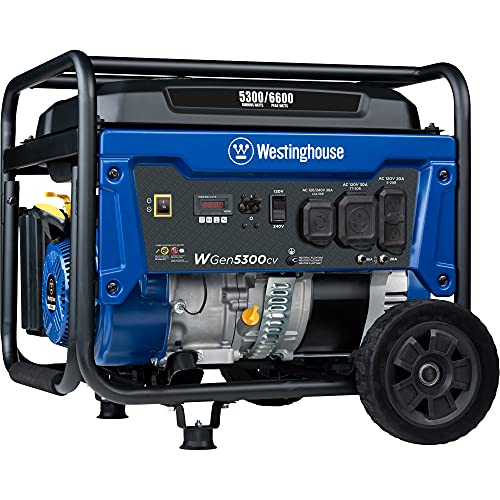
Westinghouse 6600 Peak Watt Home Backup for Gas-Only Simplicity
Westinghouse
Westinghouse 6600 Peak Watt Home Backup Portable Generator, Transfer Switch Ready 30A Outlet, RV Ready 30A Outlet, Gas Powered, CO Sensor
Price and specifications are read from the Amazon product page and can change.
Westinghouse 6600 Peak Watt Home Backup
Best for: Gas-only backup and RV trips
Pros
- 5,300 running watts on gas
- TT-30R RV-ready outlet
- CO shutdown and hour meter
- Up to 14.5 hours per tank
Cons
- Gasoline only
- Recoil start
The Westinghouse 6600 Peak Watt Home Backup generator, model WGen5300cv, is the gas-only sibling. The features list 5,300 running watts and 6,600 peak watts. Its description swaps those two numbers, but the feature list and specs agree on 5,300 running and 6,600 peak, so we go by those.
It uses recoil (pull-cord) start, the same 4.7-gallon tank with a fuel gauge, up to 14.5 hours per tank and a 120/240V selector. The outlet set matches the dual fuel model: a 5-20R household duplex, an RV-ready TT-30R 30A and a transfer switch ready L14-30R 30A, all covered. The 274cc engine has a cast iron sleeve, automatic low oil and CO shutdown, and a digital hour meter. It comes with oil, a funnel, a tool kit and a manual, and the listing does not mention a wheel kit or propane hose. Coverage is the same 3-year limited plan.
The TT-30R outlet makes it RV ready for a 30A travel trailer, so it can double as camping power. This suits a homeowner who is fine using gasoline only. If you want the flexibility of propane, the dual fuel 6,500 watt model is the better choice at the same size.
Westinghouse 12500 Watt Dual Fuel Home Backup for Larger Loads
Westinghouse
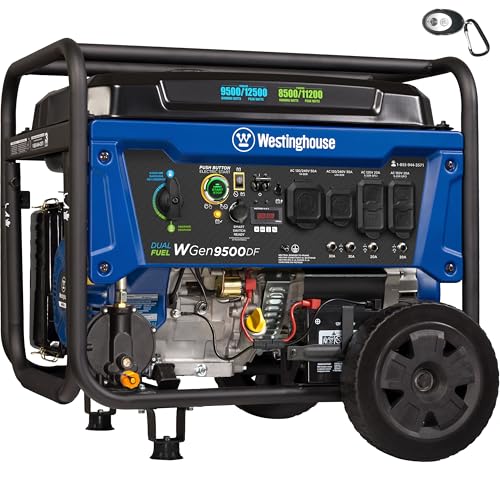
Westinghouse 12500 Watt Dual Fuel Home Backup Portable Generator, Remote Electric Start, Transfer Switch Ready, Gas and Propane Powered
Price and specifications are read from the Amazon product page and can change.
Westinghouse 12500 Watt Dual Fuel Home
Best for: Bigger homes running more appliances
Pros
- 9,500 running watts on gas
- Remote key fob and electric start
- 14-50R 50A RV outlet
- GFCI household outlets
Cons
- CO sensor not listed
- Up to 12 hours runtime
The Westinghouse 12500 Watt Dual Fuel Home backup generator, model WGen9500DF, is a big step up. On gas it provides 9,500 running and 12,500 peak watts; on propane it provides 8,500 running and 11,200 peak watts. That extra capacity lets you run more at once, such as a well pump plus kitchen appliances, or a window AC alongside the essentials.
Starting is easier here: you get a remote start key fob, push-button electric start and a recoil backup. It runs up to 12 hours on a 6.6-gallon tank with a fuel gauge. Outlets include two GFCI 120V 5-20R household receptacles, a transfer switch ready L14-30R 30A, and an RV-ready 120/240V 14-50R 50A outlet, all with rubber covers. The 457cc engine has a cast iron sleeve, low oil shutdown and a VFT display showing voltage, frequency and lifetime hours. It comes with the key fob, a 12V battery charger, oil, a funnel, a tool kit and a manual, with 3-year limited coverage. The listing does not mention a CO sensor, unlike the other three.
This suits larger homes or families who want to run more than the basics during a long outage. For natural gas or longer runtime, the 14,500 watt tri-fuel is the next step.
Westinghouse 14500 Peak Watt Tri-Fuel Home Backup for Whole-House Power

Westinghouse
Westinghouse 14500 Peak Watt Tri-Fuel Home Backup Portable Generator, Remote Electric Start, Transfer Switch Ready, Gas, Propane, and Natural Gas Powered
Price and specifications are read from the Amazon product page and can change.
Westinghouse 14500 Peak Watt Tri-Fuel Home
Best for: Large homes with natural gas hookups
Pros
- Gas, propane and natural gas
- 11,500 running watts on gas
- Up to 19 hours on 9.5 gal
- Under 5% THD for electronics
Cons
- Outlet layout not detailed
- Biggest engine to store and move
The Westinghouse 14500 Peak Watt Tri-Fuel Home backup generator, model WGen11500TFc, runs on three fuels. It gives 11,500 running and 14,500 peak watts on gasoline, 10,500 running and 13,500 peak on propane, and 9,500 running and 12,000 peak on natural gas. If your home has a natural gas line, that option can mean fewer trips for fuel during a long outage.
The 550cc engine with a cast iron sleeve runs up to 19 hours on a 9.5-gallon tank, or up to 7 hours on a 20-pound propane tank. It lists remote electric start, a CO sensor, automatic voltage regulation, overload protection, an hour meter and GFCI outlets. It is engineered with low THD, under 5%. THD, or total harmonic distortion, measures how “clean” the power is; lower THD is safer for sensitive electronics like computers, phones and TVs. Copper windings are listed as helping it run cooler. The listing is thin on outlet details, naming only GFCI outlets and a total of 2 power outlets, and it says transfer switch ready in the title. Coverage is the same 3-year limited plan.
This suits larger homes and anyone who wants the most power and runtime in the lineup. It is more generator than most people need for essentials. For more on this style, see our guide to the Westinghouse tri fuel range.
How to Choose the Right Westinghouse Portable Generator
Add up your running watts. List the appliances you truly need during an outage and check each label. A 5,300 running watt generator usually covers essentials like a refrigerator, lights, a sump pump and electronics, but not a central air conditioner. If your list is long, the 9,500 or 11,500 running watt models make sense.
Choose your fuels. Gasoline is easy to find but does not store well. Propane stores for long periods and is offered on the 6,500 dual fuel, 12,500 and 14,500 models. Natural gas is only on the 14,500 tri-fuel.
Plan the connection. All four are described as transfer switch ready. Hire an electrician to install a transfer switch or inlet so you can safely power home circuits. RV owners should note the TT-30R 30A outlet on the 6,500-class models and the 14-50R 50A outlet on the 12,500.
Think about starting and safety. The larger models offer remote and electric start, which is easier for many people than a pull cord. CO sensors are listed on the 6,500, 6,600 and 14,500 models. Always run any generator outdoors, far from doors and windows. If you only need light camping power, a smaller unit like a 3600 watt inverter generator may be enough.
FAQ
What can a Westinghouse 6500 watt generator run?
With 5,300 running watts on gas, it can typically run home essentials like a refrigerator, lights, a sump pump and electronics at the same time. Check your appliances’ labels to be sure.
What is the difference between running and peak watts?
Running watts are the steady power the generator supplies. Peak watts are a brief burst for starting motors. Size your needs by running watts.
Is the Westinghouse 6500 dual fuel better than the 6600 gas model?
They share the same running watts, tank and outlets. The dual fuel adds propane capability and a wheel kit, while the 6600 model is gas only.
Do these generators have CO sensors?
The 6,500, 6,600 and 14,500 listings mention CO sensors or CO shutdown. The 12,500 listing does not.
Which Westinghouse generator should I buy for a whole house?
For large homes, the 14,500 tri-fuel offers the most running watts and natural gas support. The 12,500 dual fuel is a strong middle option.


