Best Studio Monitors with XLR in 2026: 6 Picks Ranked by Specs
As Amazon Associates, we earn from qualifying purchases. This means we may receive a small commission at no extra cost to you if you click through and make a purchase.
As an Amazon Associate we earn from qualifying purchases. Links on this page are affiliate links.
Choosing the best studio monitors with XLR requires a clear view of connectivity and driver specs. We compared 6 options ranked by their published data. The Edifier MR5 3-Way Studio Monitor leads as the best overall pick due to its 3-way design and 110W RMS power. These picks are based strictly on the specifications listed on the product pages. This guide helps you decide which monitor fits your studio space and signal chain needs. You will see how driver size and input types affect your monitoring workflow. Focus on the data that matters for your specific room and setup.
Match driver size to your room
Your room dimensions should dictate the woofer size, not just your budget. Larger drivers like the 8-inch Yamaha HS8 produce deeper bass but require more space. Smaller options like the 5-inch JBL 305P MkII fit tight desks. Check the physical specs for width and height to ensure the monitor fits your studio layout before buying.
| # | Product | Best for | Price |
|---|---|---|---|
| 1 | Edifier MR5 3-Way Studio Monitor Best overall | Detailed near-field monitoring with XLR inputs | |
| 2 | Edifier MR4.5 4.5" Bi-Amped Monitor Best budget | Small desk setups needing XLR and room EQ | |
| 3 | ADAM Audio T7V 7-Inch Studio Monitor Best premium | Detailed mixing with XLR connectivity | |
| 4 | KALI Audio LP-6 V2 6.5 Powered Monitor Best 6.5-inch woofer | accurate near-field monitoring with XLR inputs | |
| 5 | JBL 305P MkII 5" Powered Studio Monitor Best 5" | Small studio XLR monitoring | |
| 6 | Yamaha HS8 8-Inch Powered Studio Monitor Also great | Studios needing 8-inch drivers and included cables |
The best fit for you
- You want detailed 3-way near-field monitoring – Edifier MR5 3-Way Studio Monitor – The Edifier MR5 features a 3-way speaker design with XLR connectivity for precise reproduction.
- You need room calibration tools for small desks – Edifier MR4.5 4.5" Bi-Amped Monitor – The Edifier MR4.5 offers balanced XLR inputs and room EQ features in a compact form.
- You prefer precise high-frequency detail in a mid-size driver – ADAM Audio T7V 7-Inch Studio Monitor – The ADAM Audio T7V provides XLR connectivity and a 7-inch driver for accurate monitoring.
- You want accurate monitoring with a 6.5-inch woofer – KALI Audio LP-6 V2 6.5 Powered Monitor – The KALI Audio LP-6 V2 includes XLR inputs and a 6.5-inch woofer for producers.
- You prioritize XLR inputs and compact size – JBL 305P MkII 5" Powered Studio Monitor – The JBL 305P MkII features XLR connectivity and a 5-inch driver for tight spaces.

Edifier MR5 3-Way Studio Monitor
Best for: Detailed near-field monitoring with XLR inputs
- Connectivity
- Bluetooth, RCA, XLR, TRS
- Woofer Size
- 5"
- Total Wattage
- 110W RMS
- Audio Inputs
- XLR, TRS, RCA, AUX
- Bluetooth
- Bluetooth 6.0
- Frequency Response
- 46Hz–40kHz
The Edifier MR5 is a 3-way active studio monitor with 110W RMS power and XLR connectivity. It features a 5-inch woofer, 3.75-inch mid driver, and 1-inch tweeter for a 46Hz–40kHz response. This white bookshelf speaker supports Hi-Res Audio and Bluetooth 6.0. It suits professionals needing detailed near-field monitoring with flexible room tuning via physical knobs or an app.
- 110W RMS Class D amplifier provides 101dB peak SPL.
- 3-way active crossover system ensures accurate audio reproduction.
- XLR, TRS, RCA, and AUX inputs offer versatile connectivity.
- Hi-Res Audio support includes 24-bit/96kHz wired and wireless streaming.
- Heavier at 22.9 pounds compared to lighter competitors.
- Smaller 5-inch woofer limits low-frequency extension versus 7-inch or 8-inch models.
- Shorter 10.1-inch height restricts placement options in some setups.
- You need a 3-way driver configuration for detailed midrange clarity.
- You require XLR inputs for balanced studio connections.
- You want app-based room compensation for acoustic tuning.
- You prefer a 2-way design for simpler signal paths.
- You need larger woofers for deeper bass response.
- You prioritize a lighter build for frequent transport.
Verdict: Edifier MR5 3-Way Studio Monitor delivers precise near-field monitoring with 110W RMS power and XLR connectivity. It fits engineers who value detailed 3-way reproduction and flexible room tuning over raw low-end extension.

Edifier MR4.5 4.5" Bi-Amped Monitor
Best for: Small desk setups needing XLR and room EQ
- Connectivity
- Bluetooth, RCA, XLR, TRS
- Woofer Size
- 4.5"
- Total Wattage
- 80W RMS
- Audio Inputs
- Balanced XLR, balanced TRS, RCA, AUX
- Bluetooth
- Bluetooth 6.0
- Frequency Response
- 50Hz–40kHz
The Edifier MR4.5 is a 4.5-inch bookshelf studio monitor designed for nearfield listening and production. It delivers 80W RMS total power with a flat 50Hz–40kHz frequency response. You get balanced XLR inputs alongside TRS, RCA, and Bluetooth 6.0. The unit includes DSP controls and a companion app for room calibration. This compact white speaker suits small desks where space is tight but accuracy matters.
- 80W RMS total power output for clear projection
- Flat 50Hz–40kHz frequency response for accurate monitoring
- Balanced XLR input for professional signal integrity
- Bluetooth 6.0 with LDAC codec for high-res wireless
- Adjustable low cutoff and acoustic space controls
- 4.5-inch woofer is smaller than the 5-inch and 7-inch drivers on other picks
- 80W RMS total power is lower than the 110W RMS and 70W per-channel options elsewhere
- 14.6-pound weight is substantial for the compact footprint
- You need a compact monitor that fits on a small desk
- You require balanced XLR connectivity for your interface
- You want room correction features via an app
- You need larger woofers for deeper bass extension
- You prefer higher power output for larger rooms
- You want a monitor without app dependency for EQ
Verdict: Edifier MR4.5 4.5" White Studio Monitor delivers precise nearfield monitoring with balanced inputs. It fits users with limited desk space who value room calibration tools.

ADAM Audio T7V 7-Inch Studio Monitor
Best for: Detailed mixing with XLR connectivity
- Connectivity
- RCA, XLR
- Woofer Size
- 7"
- Total Wattage
- 70W
- Audio Inputs
- XLR, RCA
- Frequency Response
- 39Hz-25kHz
- Acoustic Tuning
- Low/High Shelf EQ
The ADAM Audio T7V is a 2-way studio monitor featuring a 7-inch woofer and a U-ART tweeter. It delivers 70W of power and reaches 110dB SPL per pair. Connectivity includes XLR and RCA inputs. The beveled cabinet and rear-firing port allow flexible placement. DSP-based high- and low-shelf filters help adapt to your room's acoustics for precise mixing.
- 7-inch woofer for deep low-end response
- U-ART tweeter with HPS waveguide for high resolution
- 110dB SPL per pair for clear playback
- XLR and RCA connectivity options
- DSP filters for room adaptation
- 70W RMS is lower than the 110W Edifier MR5
- 15.7 pounds is heavier than the 5-inch JBL 305P MkII
- 7-inch driver is smaller than the 8-inch Yamaha HS8
- You need XLR connectivity for professional interfaces
- You want detailed high-frequency response from a ribbon tweeter
- You have limited desk space but need a 7-inch woofer
- You require more than 70W of power
- You prefer a lighter monitor under 15 pounds
- You need an 8-inch woofer for deeper bass extension
Verdict: ADAM Audio T7V 7-Inch Studio Monitor offers precise high-frequency detail and flexible room adaptation for mixers who value clarity over raw volume. It suits those who need XLR inputs and a mid-size driver for accurate monitoring.

KALI Audio LP-6 V2 6.5 Powered Monitor
Best for: accurate near-field monitoring with XLR inputs
- Connectivity
- RCA, XLR, TRS
- Woofer Size
- 6.5"
- Total Wattage
- 80 W
- Audio Inputs
- TRS, RCA, XLR
- Frequency Response
- 47Hz-21kHz
- Acoustic Tuning
- DSP, boundary EQ
The KALI Audio LP-6 V2 is a bi-amped powered studio monitor featuring a 6.5-inch woofer and a 1-inch tweeter. It offers 80 watts of total power and connects via XLR, TRS, and RCA inputs. With a frequency range of 47Hz to 21kHz and a maximum SPL of 115dB, it delivers flat frequency response for accurate monitoring. This speaker suits music production and studio environments where precise sound reproduction is essential.
- Bi-amped design with 80 watts total power
- Connects via XLR, TRS, and RCA
- Frequency range of 47Hz to 21kHz
- Maximum SPL of 115dB for high volume
- Updated boundary EQ for flexible placement
- Lower total power output at 80 watts compared to higher-wattage competitors
- Heavier build at 15.5 pounds per speaker
- Smaller 6.5-inch woofer compared to 7-inch or 8-inch options on the list
- You need XLR connectivity for professional studio gear
- You prioritize accurate, flat frequency response for mixing
- You want a 6.5-inch woofer size for near-field monitoring
- You require more than 80 watts of power
- You prefer a larger 7-inch or 8-inch woofer
- You need a lighter speaker under 15 pounds
Verdict: KALI Audio LP-6 V2 6.5-inch Studio Monitor is a solid choice for producers who value precise sound reproduction and XLR connectivity in a compact 6.5-inch format.

JBL 305P MkII 5" Powered Studio Monitor
Best for: Small studio XLR monitoring
- Connectivity
- XLR
- Woofer Size
- 5"
- Speaker Type
- Powered
- Use
- Studio Monitoring
- Features
- Balanced Input
- Dimensions
- 14 × 12.2 × 13.9 inches
The JBL 305P MkII is a powered studio monitor with a 5-inch woofer and XLR balanced input. It measures 12.2 inches wide, 13.9 inches high, and 14 inches deep. This compact design suits small mixing spaces. You get precise monitoring for critical listening tasks. The balanced input ensures clean signal transmission for professional audio setups.
- 5-inch woofer size
- XLR balanced input
- Compact dimensions: 12.2 x 13.9 x 14 inches
- Powered speaker design
- 5-inch woofer is smaller than the 6.5-inch and 7-inch options on this list
- Physical footprint is wider and deeper than typical 4-inch monitors
- You need XLR connectivity for a professional studio
- You have limited desk space for monitors
- You prefer a 5-inch driver size
- You require a woofer larger than 5 inches
- You need Bluetooth wireless connectivity
- You want a monitor with a built-in display
Verdict: JBL 305P MkII 5-Inch Studio Monitor fits engineers who prioritize XLR inputs and compact size over low-end extension. It is a solid choice for near-field monitoring in tight spaces.
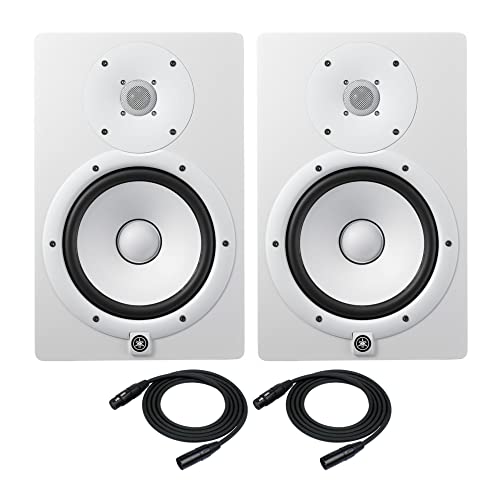
Yamaha HS8 8-Inch Powered Studio Monitor
Best for: Studios needing 8-inch drivers and included cables
- Connectivity
- XLR
- Woofer Size
- 8"
- Total Wattage
- 120W
- Audio Inputs
- XLR, TRS
- Frequency Response
- 38Hz – 30kHz
- Acoustic Tuning
- ROOM CONTROL, HIGH TRIM
The Yamaha HS8 is a pair of 8-inch powered studio monitors designed for professional nearfield monitoring. It features a 38Hz to 30kHz frequency response and a bi-amped system delivering 120W of total power. You get XLR and TRS inputs for balanced or unbalanced signals. This bundle includes 20-foot XLR cables. The speakers offer ROOM CONTROL and HIGH TRIM response controls to adjust the sound to your room.
- 8-inch cone woofer and 1-inch dome tweeter
- 120W bi-amped power system (75W LF, 45W HF)
- 38Hz – 30kHz frequency response
- XLR and TRS inputs for balanced signals
- ROOM CONTROL and HIGH TRIM response controls
- Heavier build at 35 pounds for the pair
- Larger dimensions compared to 5-inch or 6.5-inch monitors on this list
- Higher power output than the 70W ADAM Audio T7V
- You need 8-inch drivers for deeper bass extension
- You want included 20-foot XLR cables
- You require ROOM CONTROL and HIGH TRIM adjustments
- You prefer a smaller footprint than 13x18x22 inches
- You want a lighter monitor under 20 pounds
- You are satisfied with 5-inch or 6.5-inch drivers
Verdict: Yamaha HS8 8" Powered Studio Monitor Pair provides robust 120W power and deep bass response for those needing larger drivers. It suits studios requiring precise room adjustment and included cabling.
Specifications side by side
| Spec | Edifier MR5 3-Way Studio Monitor | Edifier MR4.5 4.5" Bi-Amped Monitor | ADAM Audio T7V 7-Inch Studio Monitor | KALI Audio LP-6 V2 6.5 Powered Monitor | JBL 305P MkII 5" Powered Studio Monitor | Yamaha HS8 8-Inch Powered Studio Monitor |
|---|---|---|---|---|---|---|
| Woofer Size | 5" | 4.5" | 7" | 6.5" | 5" | 8" |
| Total Wattage | 110W RMS | 80W RMS | 70W | 80 W | – | 120W |
| Audio Inputs | XLR, TRS, RCA, AUX | Balanced XLR, balanced TRS, RCA, AUX | XLR, RCA | TRS, RCA, XLR | – | XLR, TRS |
| Bluetooth | Bluetooth 6.0 | Bluetooth 6.0 | – | – | – | – |
| Frequency Response | 46Hz–40kHz | 50Hz–40kHz | 39Hz-25kHz | 47Hz-21kHz | – | 38Hz – 30kHz |
| Acoustic Tuning | Rear knobs, EDIFIER ConneX App | Rear knobs, Edifier ConneX app, DSP | Low/High Shelf EQ | DSP, boundary EQ | – | ROOM CONTROL, HIGH TRIM |
| Tweeter Type | 1" silk dome | 1" silk dome | U-ART | 1" | – | 1" dome |
| Speaker Type | Powered | – | – | Powered | Powered | Powered |
| Connectivity | Bluetooth, RCA, XLR, TRS | Bluetooth, RCA, XLR, TRS | RCA, XLR | RCA, XLR, TRS | XLR | XLR |
| Use | Studio Monitoring | Studio Monitoring | Studio Monitoring | Studio Monitoring | Studio Monitoring | Studio Monitoring |
| Features | Hi-Res Audio, Balanced Input | Hi-Res Audio, Balanced Input | Balanced Input | Balanced Input | Balanced Input | Balanced Input |
| Color | White | White | Black | Black | – | – |
| Driver Size | – | – | – | 6.5-Inch | – | – |
| Recommended Use | Music | Music, Music Production | – | Music, Music Production | – | – |
| Speaker Design | 3-Way | – | – | – | – | – |
| Placement | Bookshelf | Bookshelf | – | – | – | – |
| Design | – | – | 2-Way | – | – | – |
| Dimensions | 6.26 × 10.4 × 10.1 inches | 8.19 × 5.51 × 9.61 inches | 11.5 × 8.3 × 13.7 inches | 10.2 × 8.86 × 14.2 inches | 14 × 12.2 × 13.9 inches | 22 × 13 × 18 inches |
| Weight | 22.9 pounds | 14.6 pounds | 15.7 pounds | 15.5 pounds | – | 35 pounds |
| Model | MR5 | MR4.5 | AMS-T7V | LP-6 V2 Black | 305P MkII | 4334437862 |
| Size | – | – | 7 Inches | – | – | – |
Check XLR and Power Specs
Verify balanced inputs
XLR connections provide balanced audio signals that reduce noise over long cable runs. This is critical for professional studio environments. Look for models listing XLR in their connectivity attributes. The Edifier MR5 includes XLR alongside RCA and TRS options. This flexibility lets you switch between balanced and unbalanced sources easily. Ensure your interface outputs match the monitor inputs for optimal signal integrity and clarity during sessions.
Match woofer to space
Driver size determines low-frequency extension and physical footprint. A 5-inch driver, like the JBL 305P MkII, suits small near-field setups. It fits tight desks without overwhelming the room. Larger drivers, such as the 8-inch Yamaha HS8, offer deeper bass but require more space. Check the width and height specs to ensure the unit fits your desk. Choose the smallest driver that still meets your frequency response needs for accurate monitoring.
Assess total power output
RMS power indicates continuous output capability. Higher wattage generally means greater headroom and volume potential. The Edifier MR5 delivers 110W RMS, supporting detailed monitoring at moderate levels. The Yamaha HS8 pair offers robust power for larger rooms. Check the wattage to ensure the speakers can handle your listening environment. Sufficient power prevents distortion during dynamic passages. It also ensures consistent performance as you adjust volume levels during mixing tasks.
Consider multi-way designs
Speaker design affects frequency separation and detail. A 3-way design, found in the Edifier MR5, uses separate drivers for highs, mids, and lows. This can improve clarity and imaging in the critical midrange. Most other options, like the ADAM T7V, use a 2-way design. Evaluate whether you need the extra detail of a 3-way system. It benefits engineers prioritizing precise reproduction. Simpler 2-way designs often offer better value and compactness for standard near-field use.
Check room calibration tools
Some monitors include features to adjust sound for your room. The Edifier MR4.5 offers room EQ tools for small desk setups. These features help correct acoustic anomalies in untreated spaces. Look for balanced inputs and specific features like room calibration. This ensures accurate monitoring regardless of your studio's acoustics. It allows you to fine-tune the response without external processors. Check the attributes list for these specific capabilities before purchasing.
Review physical dimensions
Monitor size impacts placement and desk space. The Edifier MR4.5 is compact, measuring 5.51 inches wide. It fits well on smaller desks. The Yamaha HS8 is significantly larger at 13 inches wide. Measure your desk width and depth before choosing. Ensure the monitor fits comfortably without blocking controls. Check the height to ensure proper ear-level alignment. Proper placement is essential for accurate stereo imaging and listening experience.
Frequently asked questions
Why do studio monitors need XLR inputs?
XLR connections provide balanced audio signals that significantly reduce electrical noise and interference. This is essential for professional mixing environments where signal clarity is paramount. You get cleaner sound over longer cable runs compared to unbalanced connections. Most monitors in this list, including the JBL 305P MkII and Yamaha HS8, feature these balanced inputs for reliable performance.
Which monitor is best for small desks?
The Edifier MR4.5 is ideal for tight spaces. It features a compact 4.5-inch woofer and includes room EQ tools to adapt to small environments. Its dimensions are 5.51 inches wide and 9.61 inches tall. You also get XLR connectivity for balanced signal transmission. This model balances precise near-field monitoring with a footprint that fits limited desk setups.
What is the difference between 2-way and 3-way monitors?
A 3-way design uses three drivers to handle low, mid, and high frequencies separately. The Edifier MR5 uses this approach for detailed reproduction. A 2-way design, like the ADAM Audio T7V, uses two drivers. This simpler setup is common for mid-size drivers. You choose 3-way for maximum detail or 2-way for a streamlined, compact monitoring solution.
Do these monitors include XLR cables?
The Yamaha HS8 includes included cabling for XLR connections. This simplifies your initial setup process. Other models like the Edifier MR5 and KALI Audio LP-6 V2 list XLR connectivity but do not mention included cables in their specifications. You may need to purchase balanced cables separately for those units. Always check the package contents if cabling is a priority.
How does woofer size affect sound?
Larger woofers produce deeper bass response. The Yamaha HS8 has an 8-inch driver for robust low-end performance. Smaller drivers, like the 5-inch JBL 305P MkII, fit near-field monitoring in tight spaces but offer less low-end extension. You should match the driver size to your room dimensions. A 6.5-inch option, like the KALI Audio LP-6 V2, offers a middle ground.
Can I use Bluetooth with XLR inputs?
Yes, some models support both. The Edifier MR5 and MR4.5 offer Bluetooth alongside XLR and TRS inputs. This allows wireless streaming or wired professional monitoring. The JBL 305P MkII and Yamaha HS8 focus solely on XLR connectivity. You choose Bluetooth-enabled models for flexibility or dedicated XLR models for pure studio signal integrity.


