JBL vs Edifier Studio Monitors: Which Brand Fits You?
As Amazon Associates, we earn from qualifying purchases. This means we may receive a small commission at no extra cost to you if you click through and make a purchase.
As an Amazon Associate we earn from qualifying purchases. Links on this page are affiliate links.
This JBL vs edifier studio monitor comparison looks at two powered options for your workspace. Both units are active speakers designed for near-field monitoring. The JBL 305P MkII features a 5-inch woofer and professional inputs like XLR. The Edifier R1280Ts uses a 4-inch driver and offers dual RCA inputs plus a subwoofer output. You must decide which connectivity and size best fit your room.
Woofer Size
5 inches
4 inches
Connectivity
XLR/TRS inputs
Dual RCA inputs
Features
Image Control Waveguide, Boundary EQ
Subwoofer output, Soundfield Spatializer
Color
Black
Brown
Weight
10.4 pounds
10.8 pounds
Choose the first if
- You need professional XLR/TRS connectivity for audio interfaces.
- You prefer a larger 5-inch woofer for deeper bass response.
- You want precise imaging via a patented waveguide design.
Choose the second if
- You plan to connect an external subwoofer using the dedicated output.
- You primarily use RCA cables for your source devices.
- You value side-panel controls for quick bass and treble adjustments.
Verdict
Choose the JBL 305P MkII if you require professional studio inputs and a larger driver for critical mixing. Select the Edifier R1280Ts if you need flexible subwoofer expansion and convenient RCA connectivity for general listening.
JBL vs Edifier Studio Monitor Specs
woofer size
Edge: JBL 305P MkII 5" Powered Studio Monitor
The JBL 305P MkII uses a 5-inch woofer for low-frequency reproduction. This larger driver generally provides deeper bass extension and more air movement than smaller units. The Edifier R1280Ts features a 4-inch sub-woofer unit. While still effective for near-field monitoring, the smaller cone moves less air. If you require tighter, more authoritative bass response for music production or film scoring, the JBL driver offers a physical advantage. The Edifier relies on its Slip Stream port design and amplifier power to compensate for the smaller driver size. For critical mixing where bass accuracy is paramount, the larger JBL cone provides a clearer low-end foundation.
connectivity
Edge: JBL 305P MkII 5" Powered Studio Monitor
Professional connectivity differs significantly between these two monitors. The JBL 305P MkII includes XLR and TRS inputs, which are standard in studio environments for balanced audio signals. Balanced connections reduce noise over longer cable runs, making them ideal for permanent studio setups. The Edifier R1280Ts relies on dual RCA inputs and a 3.5 mm option. While RCA is common for home audio and computers, it is an unbalanced connection. If you connect these speakers to a professional audio interface or mixing console, the JBL inputs offer superior signal integrity. For direct connection to a laptop or desktop PC, both work, but the JBL provides more versatile professional integration.
room adjustment
Edge: JBL 305P MkII 5" Powered Studio Monitor
Both speakers allow you to tailor the sound to your specific room, but they use different methods. The JBL 305P MkII features Boundary EQ and HF Trim controls. These allow you to adjust low and high frequencies to compensate for room boundaries and reflections, ensuring accurate mixes in varying acoustic environments. The Edifier R1280Ts offers side panel knobs for bass, treble, and volume control. It also includes a Soundfield Spatializer button for adjusting the stereo image. While the Edifier provides manual EQ tweaks, the JBL’s dedicated room correction features are designed specifically for studio accuracy. If your room has challenging acoustics, the JBL controls offer more targeted correction.
subwoofer support
Edge: Edifier R1280Ts Powered Bookshelf Speakers
The Edifier R1280Ts includes a dedicated subwoofer output port with automatic detection. When you connect an external active subwoofer, a built-in crossover activates to route low frequencies appropriately. This feature makes it easy to expand your system for deeper bass without complex manual setup. The JBL 305P MkII data does not list a subwoofer output. While it can produce deep bass via its Slip Stream port, you cannot easily add a dedicated subwoofer to extend the low-end further. If you plan to add a subwoofer later to handle the lowest frequencies, the Edifier offers a straightforward path to expansion that the JBL does not explicitly support in its listed features.
controls
Edge: Edifier R1280Ts Powered Bookshelf Speakers
User interaction with the speakers varies by design. The Edifier R1280Ts comes with an updated remote control, allowing you to adjust volume, mute, and EQ settings from across the room. It also has side panel knobs for manual adjustments. This flexibility is convenient for casual listening or quick tweaks without moving from your desk. The JBL 305P MkII focuses on front-facing or side panel adjustments for EQ and inputs, with no remote listed in the data. For studio monitoring, manual control is often preferred to avoid accidental changes, but the Edifier’s remote adds convenience for general use. If you value remote access, the Edifier is the better choice.
Which studio monitor fits your needs
Podcasters needing wide sweet spot
Our pick: JBL 305P MkII 5" Powered Studio Monitor
The JBL 305P MkII includes a patented Image Control Waveguide. This design delivers precise imaging with a wide sweet spot. You get immersive sound ideal for podcasting. The 5-inch woofer and Slip Stream port ensure dynamic range. Boundary EQ and HF Trim let you tailor the audio to your room. This setup ensures accurate mixes for your content.
Users wanting subwoofer expansion
Our pick: Edifier R1280Ts Powered Bookshelf Speakers
The Edifier R1280Ts features an extra sub-out port. It includes automatic detection for connecting an external active subwoofer. A built-in crossover activates when you connect the sub. You get 42W of continuous undistorted power. The 4-inch sub-woofer unit and 13mm silk dome tweeter provide strong bass. This option is perfect if you plan to expand your low-frequency response later.
Those preferring remote control convenience
Our pick: Edifier R1280Ts Powered Bookshelf Speakers
The Edifier R1280Ts comes with an updated remote control. You can adjust volume and mute from across the room. Side panel knobs allow you to tweak bass and treble. A Soundfield Spatializer button enhances your listening experience. Dual RCA inputs let you connect two devices simultaneously. This flexibility makes it easier to manage your audio setup without moving.

JBL 305P MkII 5" Powered Studio Monitor
Best for: producers needing room tuning
- Woofer Size
- 5-inch
- Total Wattage
- Dual 41-Watt
- Audio Inputs
- XLR/TRS
- Acoustic Tuning
- Boundary EQ and HF Trim
- Speaker Type
- Powered
- Color
- Black
This is a pair of JBL 305P MkII 5-inch active studio monitors. Each speaker uses a 41-Watt Class-D amplifier and a 5-inch woofer. The design includes a Slip Stream port for deep bass. Boundary EQ and HF Trim allow you to adjust frequencies for your room. The MDF enclosure is built for reliability. These monitors suit producers and podcasters needing precise imaging.
- Patented Image Control Waveguide for wide sweet spot
- Dual 41-Watt Class-D amplifiers for dynamic range
- Boundary EQ and HF Trim for room adjustment
- XLR and TRS inputs for versatile connectivity
- 5-inch woofer size is smaller than the 6.5-inch option
- 10.4-pound weight per unit is bulkier than smaller monitors
- You need precise imaging for music production
- You want room-specific frequency adjustments
- You require XLR or TRS inputs
- You need deep bass below 5-inch range
- You prefer a lighter portable setup
- You want a single speaker unit
Verdict: JBL 305P MkII 5" Active Studio Monitor delivers accurate sound for producers. It fits those who need room tuning and balanced imaging.
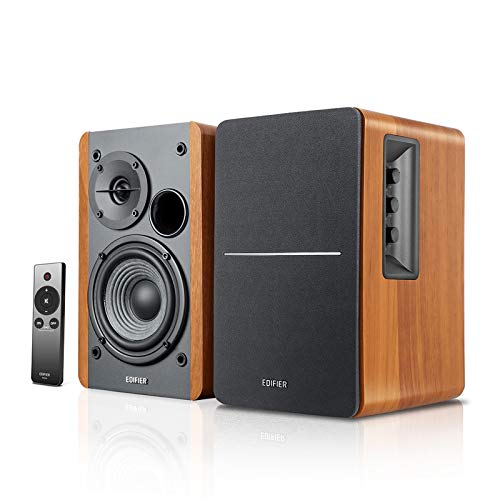
Edifier R1280Ts Powered Bookshelf Speakers
Best for: wired stereo monitoring with sub expansion
- Woofer Size
- 4-inch
- Total Wattage
- 42 Watts RMS
- Audio Inputs
- Dual RCA
- Acoustic Tuning
- Side panel EQ knobs
- Tweeter Type
- 13mm silk dome
- Speaker Type
- Powered
The Edifier R1280Ts is a 2.0 stereo powered bookshelf speaker designed for studio monitoring. It delivers 42W of continuous power through a 4-inch sub-woofer unit and a 13mm silk dome tweeter. This model includes a subwoofer output for expanded bass response and dual RCA inputs for connecting two devices simultaneously. You get precise control via side panel knobs for bass, treble, and volume, plus a remote for convenience.
- 42W continuous undistorted power output
- Subwoofer output with automatic detection
- Dual RCA inputs for two devices
- Side panel EQ and volume controls
- 4-inch driver is smaller than the 5-inch drivers in the JBL 305P MkII
- 10.8-pound weight per speaker
- No Bluetooth connectivity
- You need a wired stereo setup for near-field monitoring
- You want to add an external subwoofer later
- You prefer physical knobs for quick EQ adjustments
- You require wireless Bluetooth streaming
- You need a larger 5-inch driver for deeper bass
- You want a lighter speaker for easy repositioning
Verdict: Edifier R1280Ts 4-inch Studio Monitor offers solid 42W power and flexible inputs for studio work, making it a practical choice for users who prioritize wired connectivity and subwoofer expansion over wireless convenience.
Specifications side by side
| Spec | JBL 305P MkII 5" Powered Studio Monitor | Edifier R1280Ts Powered Bookshelf Speakers |
|---|---|---|
| Woofer Size | 5-inch | 4-inch |
| Total Wattage | Dual 41-Watt | 42 Watts RMS |
| Audio Inputs | XLR/TRS | Dual RCA |
| Acoustic Tuning | Boundary EQ and HF Trim | Side panel EQ knobs |
| Tweeter Type | – | 13mm silk dome |
| Speaker Type | Powered | Powered |
| Use | – | Studio Monitoring |
| Features | – | Subwoofer Output |
| Color | Black | Brown |
| Recommended Use | – | Stereo |
| Placement | – | Bookshelf |
| Design | 2-Way | – |
| Dimensions | 14 × 12.2 × 13.9 inches | 17 × 12.6 × 7.2 inches |
| Weight | 10.4 pounds | 10.8 pounds |
| Size | 5-inch Speaker | – |
| Model | 305PMKIISET | R1280TS |
Frequently asked questions
Which studio monitor is better for small rooms?
The JBL 305P MkII fits smaller spaces better due to its compact dimensions. It measures 12.2 inches wide and weighs 10.4 pounds. This smaller footprint helps reduce room reflections. The Edifier R1280Ts is wider at 17 inches. Its larger size may overwhelm tight desks. Choose the JBL unit if space is limited.
Can I connect a subwoofer to these monitors?
Yes, the Edifier R1280Ts supports subwoofer expansion. It includes a dedicated subwoofer output for adding extra bass. The JBL 305P MkII does not list this feature in its specifications. If you need a wired sub connection, the Edifier model is the practical choice. It offers flexible inputs for studio work.
What is the difference in woofer size?
The JBL 305P MkII uses a 5-inch woofer. The Edifier R1280Ts features a 4-inch driver. The larger 5-inch unit generally moves more air for deeper bass. The 4-inch driver is effective but offers less low-frequency extension. Your choice depends on how much bass you need for your monitoring tasks.
Are these speakers good for stereo mixing?
Both units are designed for stereo monitoring. The Edifier R1280Ts is explicitly recommended for stereo use. It provides solid 42W power for clear separation. The JBL 305P MkII delivers balanced imaging for accurate mixing. Both are powered speakers that plug directly into your audio interface or computer.
Which monitor is lighter to move?
The JBL 305P MkII is slightly lighter. It weighs 10.4 pounds per unit. The Edifier R1280Ts weighs 10.8 pounds. The difference is minimal but noticeable if you rearrange your setup often. Both are bookshelf speakers designed for stable placement. The weight helps reduce vibration from your desk surface.
Do these monitors come in different colors?
The JBL 305P MkII is available in black. The Edifier R1280Ts comes in brown. Your choice may depend on your studio aesthetic. Both colors blend well with typical workspace equipment. The design is functional and professional. Neither model lists additional color options in its published specifications.


