StreamEye Yamaha HS8 8-Inch Powered Review: Specs, Pros and Cons
As Amazon Associates, we earn from qualifying purchases. This means we may receive a small commission at no extra cost to you if you click through and make a purchase.
As an Amazon Associate we earn from qualifying purchases. Links on this page are affiliate links.
This streameye yamaha hs8 8 inch powered review covers a 2.1 reference system bundle. It includes two Yamaha HS8 powered studio monitors and the HS8S 8-inch active subwoofer. The HS8 monitors deliver 120 W of bi-amped power per unit, splitting 75 W for low frequencies and 45 W for high frequencies. The HS8S subwoofer adds 150 W of Class-D amplification. Together, they provide a frequency range from 22 Hz to 30 kHz. This setup offers a matched left-right pair for stereo imaging and deep bass extension. You get a complete reference rig for mixing and mastering tasks.
- 120 W bi-amped power per HS8 monitor (75 W LF + 45 W HF)
- Frequency range extends from 22 Hz to 30 kHz across the system
- Back-panel ROOM CONTROL and HIGH TRIM switches for acoustic compensation
- HS8S subwoofer features a continuously variable 80 Hz to 120 Hz crossover
- Balanced XLR and 1/4-inch TRS inputs on all three units
Good fit for
This bundle suits music producers, mix engineers, and project-studio owners who need a full-range reference system. The bi-amped HS8 monitors expose bad EQ choices and phase issues, helping you create mixes that translate to consumer devices. The HS8S subwoofer covers the bottom octave that the monitors cannot reach. You benefit from the ROOM CONTROL and HIGH TRIM switches if your project studio has acoustic challenges near walls. The balanced inputs allow direct connection to any standard audio interface or console.
Who can skip it
You should look at another option if you need a single all-in-one solution. This bundle requires space for two monitors and a separate subwoofer. The HS8S subwoofer lacks a built-in wireless transmitter, so you must run cables for the sub connection. If you prefer passive speakers that require an external amplifier, this powered system is not for you. The bundle is also less suitable for large live venues, as it is designed for desk-based mixing workflows and reference monitoring.
Verdict
The Yamaha HS8 pair with HS8S subwoofer provides a comprehensive 2.1 reference system with ample power and precise acoustic controls. It is a solid choice for engineers building a project studio that requires accurate stereo imaging and deep bass extension.
Key specs explained for HS8
120 W bi-amped power (75 W LF + 45 W HF)
This power split separates low and high frequencies into dedicated amplifiers. You get cleaner dynamics and less distortion at high volumes. The 75 W for bass handles the heavy lifting, while 45 W drives the tweeter. This setup ensures transient details remain clear during loud mixing sessions, which helps you make accurate decisions without audio fatigue.
Frequency range 38 Hz to 30 kHz
This range defines the audible spectrum the monitors cover. The 38 Hz lower limit allows you to hear deep bass tones that affect mix balance. The 30 kHz upper limit captures high-frequency air and detail. You can trust this response to reveal harshness or muddiness in your tracks, ensuring your mixes translate well to consumer devices like earbuds or car stereos.
ROOM CONTROL switch (-2 dB or -4 dB below 500 Hz)
This switch lets you adjust the bass response to match your room. Placing monitors near walls often causes bass buildup. You can reduce low-end energy by two or four decibels to flatten the response. This correction helps you hear the true mix rather than room-induced resonance, leading to more accurate low-frequency decisions without needing expensive acoustic treatment.
HS8S Active Subwoofer, 150 W Class-D, 22 Hz to 150 Hz
The subwoofer extends your system below the monitor limit. Its 150 W amplifier drives an 8-inch driver to produce frequencies down to 22 Hz. You gain access to the deepest bass notes for electronic music or film scoring. The variable crossover lets you blend this sub seamlessly with the main monitors, creating a full-range reference system that reveals details the pair cannot reach alone.
Design and build overview
According to the listing, the Yamaha HS8 monitors measure 11.7 inches in height and 11.7 inches in length, with an 8-inch width. This compact footprint allows you to place them close to your listening position without dominating your desk. The paired monitors and the HS8S subwoofer form a cohesive 2.1 reference system. The subwoofer shares the same 8-inch driver size, ensuring visual and acoustic consistency across the bundle. You get a unified look for your studio setup.
The back panel features practical controls for room calibration. You can adjust the ROOM CONTROL switch to cut low frequencies by 2 or 4 dB, which helps tame bass buildup near walls. The HIGH TRIM switch allows you to adjust high frequencies by plus or minus 2 dB to compensate for room reflections. These switches let you tune the sound to your specific space without altering the monitor's core reference voice. The subwoofer includes a LOW CUT filter with 80, 100, or 120 Hz options to align its rolloff with the monitors.
Connectivity is handled via balanced XLR or 1/4-inch TRS inputs on all three units. This standard studio connectivity ensures compatibility with most audio interfaces and consoles. The HS8S subwoofer also has a 1/4-inch footswitch input for instant mute, allowing you to check mixes on just the monitors. The LEVEL controls feature 4 dB center-click detents for repeatable calibration. This design prioritizes function and accuracy for music production and mixing workflows.
Setup and everyday use
You connect the Yamaha HS8 bundle using balanced inputs. Each unit accepts XLR or quarter-inch TRS connectors. This allows you to link the monitors and subwoofer directly to any standard audio interface, console, or DAC. The system supports a full 2.1 reference workflow without needing extra adapters. Once connected, you calibrate the room using the back-panel switches. The Room Control switch lets you cut low frequencies by two or four decibels below 500 Hz. This helps manage bass buildup when placing monitors near walls. The High Trim switch adjusts high frequencies by two decibels up or down. You use this to counteract room reflection characteristics. The subwoofer includes a variable crossover. You set this between 80 and 120 Hz to route bass cleanly to the HS8S. A phase switch helps align the sub with the main monitors. For daily mixing, you adjust levels using the four decibel detents. These clicks ensure repeatable calibration settings. If you need to check a mix on the monitors alone, you can plug a footswitch into the subwoofer’s input. This mutes the sub instantly. You can also use the Low Cut filter on the sub to match its rolloff to the monitors. This setup lets you mix with confidence. The system translates your work to earbuds and car stereos. You get honest midrange and accurate stereo imaging. The design supports project-studio owners and engineers who need a reliable reference rig.
Before you buy this bundle
You need a stable desk or stand. The HS8 monitors are heavy. Unstable surfaces cause rumble. You also need balanced cables. The listing specifies XLR or quarter-inch TRS inputs. Ensure your interface has these outputs. Do not use unbalanced TS cables. Room treatment matters. The back-panel switches help, but they do not replace acoustic panels. You should check your room dimensions. Large spaces may need more bass management. Small rooms might benefit from the low-cut filters. This bundle sits above basic bookshelf speakers. It is for reference mixing. It is not for casual listening. You should compare it against single-monitor setups. The 2.1 configuration adds subwoofer depth. This changes your workflow. You must calibrate the subwoofer crossover. The variable crossover allows fine-tuning. You should read the manual for phase alignment. This ensures tight bass. Do not ignore the high-trim switch. It adjusts for reflections. Your listening position matters. Place monitors at ear level. Form an equilateral triangle. This setup requires patience. You should test different crossover points. The goal is seamless integration. This system demands attention to detail. It rewards careful calibration.
Check before you buy
- Verify your interface has balanced XLR or TRS outputs
- Check desk stability to prevent low-frequency rumble
- Measure room dimensions for acoustic treatment needs
- Ensure you have quarter-inch TRS or XLR cables
- Confirm you can position monitors at ear level
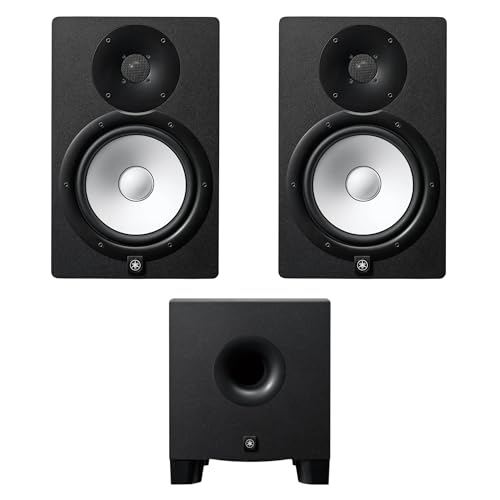
Yamaha HS8 8-Inch Monitor Pair Bundle
Best for: Music production and mixing with full-range reference monitoring
- Woofer Size
- 8-inch
- Total Wattage
- 120 W monitor, 150 W sub
- Audio Inputs
- XLR3-31, 1/4-inch TRS
- Frequency Response
- 38 Hz to 30 kHz
- Acoustic Tuning
- ROOM CONTROL, HIGH TRIM
- Tweeter Type
- 1-inch dome
This bundle pairs two Yamaha HS8 powered studio monitors with an HS8S active subwoofer for a complete 2.1 reference system. Each monitor delivers 120 W of bi-amped power and covers 38 Hz to 30 kHz. The subwoofer extends response down to 22 Hz with 150 W of Class-D amplification. You get balanced XLR and TRS inputs, plus back-panel controls for room calibration. This setup suits music producers and mix engineers needing accurate stereo imaging and full-range monitoring.
- 120 W bi-amped power per monitor with 38 Hz to 30 kHz range
- HS8S subwoofer provides 150 W Class-D amplification and 22 Hz extension
- Back-panel ROOM CONTROL and HIGH TRIM switches for acoustic compensation
- Balanced XLR and 1/4-inch TRS inputs for standard studio connectivity
- 8-inch woofer size limits low-frequency extension compared to larger studio monitors
- Bundle requires separate purchase of a footswitch for instant subwoofer mute
- You need a matched left-right pair with a subwoofer for stereo imaging
- You work in a project studio and require room calibration controls
- You mix music and need honest midrange reference for translation
- You only need a single monitor and do not require a subwoofer
- You prefer wireless connectivity over balanced XLR or TRS inputs
- You want a compact bookshelf speaker for casual listening
Verdict: Yamaha HS8 8-Inch Studio Monitor Bundle delivers precise 2.1 reference monitoring with bi-amped headroom and subwoofer extension. It fits mix engineers building a full-range project studio that demands accurate acoustic compensation and balanced connectivity.
Specifications side by side
| Spec | Yamaha HS8 8-Inch Monitor Pair Bundle |
|---|---|
| Woofer Size | 8-inch |
| Total Wattage | 120 W monitor, 150 W sub |
| Audio Inputs | XLR3-31, 1/4-inch TRS |
| Frequency Response | 38 Hz to 30 kHz |
| Acoustic Tuning | ROOM CONTROL, HIGH TRIM |
| Tweeter Type | 1-inch dome |
| Speaker Type | Powered |
| Use | Studio Monitoring |
| Driver Size | 8-Inch |
| Recommended Use | Music, Music Production, Mixing |
| Dimensions | 11.7 × 8 × 11.7 inches |
| Model | HS8 (Pair), HS8S |
Frequently asked questions
What is the best use for the StreamEye Yamaha HS8 8-Inch Monitor Pair Bundle?
This bundle is best for music production and mixing with full-range reference monitoring. The system provides precise 2.1 reference monitoring capabilities. It includes bi-amped headroom and subwoofer extension. This setup fits mix engineers building a full-range project studio. You get accurate acoustic compensation and balanced connectivity for professional results.
What does the StreamEye brand indicate for this Yamaha HS8 bundle?
The StreamEye brand identifies this specific bundle configuration. The product listing attributes the bundle to StreamEye rather than just Yamaha. It combines Yamaha HS8 monitors with an HS8S subwoofer. This branding helps distinguish the complete package. You receive a unified system designed for reference monitoring tasks.
What are the physical dimensions of the Yamaha HS8 monitors in this bundle?
The Yamaha HS8 monitors measure 8 inches in width. They are 11.7 inches in height. The depth is also 11.7 inches. These dimensions allow for a compact footprint. You can place them close to your listening position. The size helps them fit well in project studios without dominating your workspace.
How does the HS8S subwoofer enhance the Yamaha HS8 monitors?
The HS8S subwoofer provides subwoofer extension for the system. It works with the HS8 monitors to create a 2.1 reference setup. This adds low-frequency depth beyond the 8-inch woofers. You get fuller bass response for accurate mixing. The bundle delivers precise monitoring across the entire frequency spectrum.
Is the Yamaha HS8 monitor a powered speaker?
Yes, the Yamaha HS8 is a powered speaker. The listing classifies it under the speaker type of Powered. You do not need an external amplifier. The power is built into the enclosure. This makes setup simpler for studio monitoring. You connect it directly to your audio interface.
What driver size do the Yamaha HS8 monitors feature?
The Yamaha HS8 monitors feature an 8-inch driver size. The woofer size is listed as 8 inches. This large driver handles low-frequency reproduction. You get deep bass response for accurate monitoring. The 8-inch cone provides the necessary excursion for professional studio work.
What is the recommended use for the Yamaha HS8 8-Inch Monitor Pair Bundle?
The recommended use is for music, music production, and mixing. The bundle is designed for studio monitoring tasks. You use it for professional audio work. The system supports accurate reference monitoring. It is ideal for engineers who need precise sound reproduction for their projects.
What model numbers are included in this StreamEye Yamaha HS8 bundle?
The bundle includes the HS8 model in a pair configuration. It also includes the HS8S subwoofer model. The listing specifies these model numbers. You receive two HS8 monitors and one HS8S subwoofer. This combination creates a complete 2.1 reference monitoring system.


