YAMAHA HS8 Powered Studio Monitors Review: Specs, Pros and Cons
As Amazon Associates, we earn from qualifying purchases. This means we may receive a small commission at no extra cost to you if you click through and make a purchase.
As an Amazon Associate we earn from qualifying purchases. Links on this page are affiliate links.
This yamaha hs8 powered studio monitors review focuses on the Yamaha HS8, a bi-amplified nearfield monitor designed for precise audio reproduction. The system combines an 8-inch cone woofer with a 1-inch dome tweeter in a bass-reflex enclosure. It delivers a frequency response from 38Hz to 30kHz, covering a wide range of audible frequencies. The bi-amp configuration provides 75W for low frequencies and 45W for high frequencies, totaling 120W of power. This setup allows for clear, detailed sound in professional environments.
- 8-inch cone woofer for deep bass response
- 1-inch dome tweeter for crisp highs
- 120W total bi-amplified power output
- ROOM CONTROL and HIGH TRIM adjustments
- XLR and TRS inputs for balanced signals
Good fit for
This monitor suits engineers and producers who need accurate nearfield monitoring. The 120W bi-amp system handles dynamic range well. The ROOM CONTROL and HIGH TRIM features let you adjust the sound for your specific room acoustics. XLR and TRS inputs ensure compatibility with most studio interfaces. The 8-inch woofer provides enough bass extension for critical mixing tasks without being overwhelming.
Who can skip it
If you need a compact desktop speaker, this unit may be too large. At 13 inches wide and 22 inches deep, it requires significant desk space. The weight of 35 pounds per monitor makes frequent moving difficult. If you primarily listen to music casually, the clinical studio sound and extensive adjustment controls might feel unnecessary. You might prefer a smaller, simpler speaker for general listening.
Verdict
The Yamaha HS8 offers powerful, accurate monitoring with flexible input options. It is a solid choice for serious studio work where sound precision matters.
Yamaha HS8 Key Specs Explained
8" cone woofer and 1" dome tweeter
This two-way driver setup handles low and high frequencies separately. The 8-inch woofer manages bass and midrange, while the 1-inch dome tweeter handles treble. This separation reduces distortion and improves clarity. You get accurate sound reproduction for mixing. Compare this to single-driver speakers that may muddy low notes. It suits users who need clear separation between instruments.
120W power amplification
The system uses a bi-amp design with 75W for low frequencies and 45W for high frequencies. This total of 120W provides sufficient headroom for nearfield listening. You avoid clipping during dynamic passages. This power level is typical for studio monitors. It ensures consistent volume without strain. Check if your room size requires more power for larger spaces.
38Hz – 30kHz frequency response
This range indicates the lowest and highest sounds the monitor can produce. The 38Hz lower limit captures deep bass. The 30kHz upper limit covers high frequencies beyond human hearing. This wide range ensures full spectrum accuracy. You can trust the monitor for critical listening. Compare this to consumer speakers that often roll off high frequencies. It is ideal for professional audio work.
ROOM CONTROL and HIGH TRIM controls
These knobs let you adjust the sound based on your room. ROOM CONTROL tweaks bass response to match wall placement. HIGH TRIM adjusts treble to compensate for reflections. You can fine-tune the output for your specific environment. This flexibility improves accuracy in different spaces. Compare this to fixed-response speakers that lack adjustment. It helps you achieve a neutral sound signature.
Yamaha HS8 Design and Build
The Yamaha HS8 is a powered studio monitor built for nearfield use. According to the listing, it features a bass-reflex enclosure that houses an 8-inch cone woofer and a 1-inch dome tweeter. This two-way driver layout separates low and high frequencies to reduce distortion. The cabinet design supports precise audio reproduction in professional environments. You can connect balanced or unbalanced signals via XLR and TRS phone jack inputs. This flexibility allows you to integrate the monitors into various studio setups without needing additional adapters. The inclusion of ROOM CONTROL and HIGH TRIM response controls lets you adjust the sound to match your room acoustics. These physical controls are located on the rear panel for easy access during setup.
In terms of physical dimensions, the monitor measures 13 inches in width, 18 inches in height, and 22 inches in depth. The unit weighs 35 pounds, which provides stability on a desk or stand. The substantial weight helps minimize vibrations from nearby equipment or foot traffic. The white finish offers a clean aesthetic that blends into modern studio spaces. The bundle includes two 20-foot XLR cables, ensuring you have the necessary connections for a dual-monitor setup. The bi-amplified system delivers 75 watts for the low frequency and 45 watts for the high frequency. This power distribution supports clear sound at various volumes. The design prioritizes functionality and durability for daily studio work.
Setup and everyday use guide
The Yamaha HS8 is a powered studio monitor, which means you do not need an external amplifier. You plug it directly into your audio interface or mixer. The listing specifies XLR and TRS phone jack inputs. These connections accept balanced or unbalanced signals. This flexibility allows you to connect various gear without adapters. The bundle includes two 20-foot XLR cables. This length gives you room to position the monitors away from your mixing position while keeping signal integrity high. Balanced connections help reduce noise over these distances. The monitors measure 13 inches wide, 18 inches high, and 22 inches deep. They weigh 35 pounds each. You will need sturdy stands or a solid desk to support this weight. The bass-reflex design requires some space behind the speaker for proper bass extension. You should not place them flush against a wall. The unit features ROOM CONTROL and HIGH TRIM response controls. You can adjust these to match your room’s acoustics. This helps correct frequency imbalances caused by your environment. The 75W LF and 45W HF bi-amp system provides 120W of power. This output is sufficient for nearfield monitoring in a typical home studio. You get precise audio reproduction for mixing and mastering. The white finish is a cosmetic choice that does not affect performance. Setup is straightforward: connect power, attach cables, adjust controls, and start listening. The system is designed for daily studio use.
Check Compatibility And Space First
The Yamaha HS8 bundle includes two 20-foot XLR cables, which simplifies initial connections. You still need an audio interface or mixer with balanced outputs to use these inputs properly. Check your workspace dimensions carefully. Each monitor measures 18 inches in height and weighs 35 pounds. The pair requires significant desk or stand space. You must ensure your room has adequate ventilation, as the bi-amp system generates heat during extended sessions. Keep the bass-reflex ports clear of walls to maintain the specified 38Hz to 30kHz frequency response. This setup suits nearfield monitoring tasks better than casual listening. Unlike consumer home audio speakers, these prioritize flat response over bass enhancement. You should verify that your existing cabling matches the XLR standard. Regular dusting of the tweeter dome preserves clarity. This option fits well if you already have studio gear. It complements other professional monitors by offering consistent tonal accuracy across different mixing stages.
Check before you buy
- Verify your audio interface has balanced XLR outputs
- Measure desk space for 18-inch height monitors
- Ensure 35-pound weight capacity on your stands
- Keep bass-reflex ports clear of walls
- Confirm you have balanced XLR cables
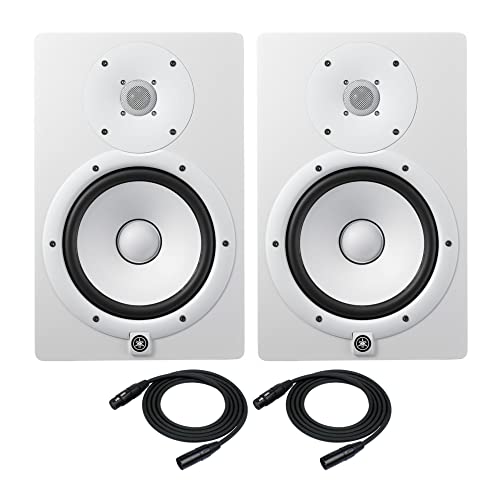
Yamaha HS8 8-Inch Powered Studio Monitor
Best for: professional nearfield studio monitoring
- Woofer Size
- 8"
- Total Wattage
- 120W
- Audio Inputs
- XLR, TRS
- Frequency Response
- 38Hz – 30kHz
- Acoustic Tuning
- ROOM CONTROL, HIGH TRIM
- Tweeter Type
- 1" dome
The Yamaha HS8 is a 2-way bass-reflex bi-amplified nearfield studio monitor. It features an 8-inch cone woofer and a 1-inch dome tweeter. The system delivers 120W of power with 75W for low frequencies and 45W for high frequencies. Frequency response spans from 38Hz to 30kHz. It includes ROOM CONTROL and HIGH TRIM response controls. You can connect via XLR or TRS phone jack inputs.
- 120W bi-amp system with 75W LF and 45W HF power
- 8-inch cone woofer and 1-inch dome tweeter configuration
- 38Hz to 30kHz frequency response range
- ROOM CONTROL and HIGH TRIM response controls for room adjustment
- 35-pound weight per monitor requires sturdy mounting
- 18-inch height and 22-inch depth demand significant desk or stand space
- 38Hz low-frequency limit may not suit deep bass-heavy mixing
- You need accurate nearfield monitoring for studio work
- You want precise room control via physical switches
- You prefer balanced XLR connections for your interface
- You require a compact desktop speaker under 15 inches
- You need wireless connectivity for mobile devices
- You prioritize deep sub-bass response below 38Hz
Verdict: Yamaha HS8 8-inch Powered Studio Monitor offers professional-grade accuracy for mixers who value precise control. It suits studios needing reliable nearfield performance with adjustable room response.
Specifications side by side
| Spec | Yamaha HS8 8-Inch Powered Studio Monitor |
|---|---|
| Woofer Size | 8" |
| Total Wattage | 120W |
| Audio Inputs | XLR, TRS |
| Frequency Response | 38Hz – 30kHz |
| Acoustic Tuning | ROOM CONTROL, HIGH TRIM |
| Tweeter Type | 1" dome |
| Speaker Type | Powered |
| Connectivity | XLR |
| Use | Studio Monitoring |
| Features | Balanced Input |
| Dimensions | 22 × 13 × 18 inches |
| Weight | 35 pounds |
| Model | 4334437862 |
Frequently asked questions
What are the physical dimensions of the Yamaha HS8 studio monitor?
The Yamaha HS8 measures 18 inches in height, 13 inches in width, and 22 inches in length. These dimensions define the footprint it occupies on your studio desk. You should verify your workspace has adequate clearance for these specific measurements before placement.
How much does the Yamaha HS8 weigh?
Each unit weighs 35 pounds. This mass provides stability during operation and reduces unwanted resonance from external vibrations. You need a sturdy desk or stand capable of supporting this weight to ensure safe and stable positioning in your monitoring environment.
What input connections does the Yamaha HS8 support?
The monitor features XLR inputs for balanced audio signals. It also accepts TRS phone jack connections for balanced signals. These options allow you to connect directly to professional audio interfaces or mixers without needing additional adapters for balanced transmission.
Is the Yamaha HS8 a powered speaker?
Yes, the Yamaha HS8 is a powered studio monitor. This means the amplifier is built directly into the enclosure. You do not need to purchase a separate external amplifier, as the unit handles its own power requirements for both the woofer and tweeter drivers.
What is the primary use case for the Yamaha HS8?
This monitor is designed for professional nearfield studio monitoring. It is intended for mixers who require precise audio reproduction in a close listening distance. The design supports reliable performance in studio environments where accurate frequency response is critical for mixing decisions.
Does the Yamaha HS8 have balanced inputs?
Yes, the specifications list balanced input as a key feature. The XLR and TRS connections provide balanced signal paths. This helps reduce noise and interference over longer cable runs, ensuring cleaner audio transmission from your source equipment to the monitor.


