YAMAHA vs Edifier: Studio Monitors Compared by Specs
As Amazon Associates, we earn from qualifying purchases. This means we may receive a small commission at no extra cost to you if you click through and make a purchase.
As an Amazon Associate we earn from qualifying purchases. Links on this page are affiliate links.
This YAMAHA vs edifier studio monitor guide compares the Yamaha HS5 and Edifier R1280Ts. Both are powered speakers designed for studio monitoring and near-field use. They share active amplifier systems. The main difference lies in their driver configuration and connectivity. The Yamaha uses a 5-inch woofer with XLR and TRS inputs. The Edifier features a 4-inch woofer with RCA inputs and a subwoofer output. You can choose based on your connection needs and bass requirements.
Woofer Size
5"
4"
Connectivity
XLR and TRS
Dual RCA
Power
70W total (45W LF + 25W HF)
42W continuous
Subwoofer Output
Not listed
Extra sub-out port
Color
Black
Brown
Choose the first if
- You need professional XLR and TRS inputs for balanced audio connections.
- You prefer a larger 5-inch woofer for deeper low-frequency response.
- You want a higher total power output of 70W for louder monitoring.
Choose the second if
- You want to connect an external active subwoofer via the extra sub-out port.
- You prefer RCA inputs for easy connection to standard consumer audio devices.
- You need side panel controls for adjusting bass, treble, and volume directly.
Verdict
The Yamaha HS5 suits professionals who require balanced XLR/TRS inputs and a larger 5-inch driver for accurate near-field monitoring. The Edifier R1280Ts is better for users who want RCA connectivity and the option to add a subwoofer for enhanced bass. Choose based on your input requirements and bass extension needs.
Yamaha HS5 vs Edifier R1280Ts Specs
Woofer size
Edge: Yamaha HS5 5-Inch Studio Monitor
The Yamaha HS5 features a 5-inch cone woofer. This larger driver size helps produce deeper low frequencies with more authority. The Edifier R1280Ts uses a smaller 4-inch sub-woofer unit. While still effective for near-field listening, the smaller diameter limits the lowest frequencies it can reproduce compared to the Yamaha. For critical bass response in a studio setting, the larger cone on the Yamaha offers a tangible advantage in physical excursion and air movement.
Power output
Edge: Yamaha HS5 5-Inch Studio Monitor
Amplification power differs significantly between these two models. The Yamaha HS5 employs a bi-amp system delivering 45W for low frequencies and 25W for high frequencies, totaling 70W of power amplification. The Edifier R1280Ts provides 42W of continuous undistorted power. The Yamaha’s higher total wattage and dedicated bi-amping allow for greater headroom and cleaner performance at higher volumes. You will notice less distortion potential with the Yamaha when pushing the speakers harder.
Connectivity
Edge: Yamaha HS5 5-Inch Studio Monitor
Input options vary to suit different workflow needs. The Yamaha HS5 accepts both XLR and TRS phone jack inputs. This allows you to connect balanced signals from professional audio interfaces, reducing noise over longer cable runs. The Edifier R1280Ts relies on dual RCA inputs. You can connect two devices simultaneously using RCA to RCA or 3.5 mm-to-RCA cables. If you use balanced outputs from your mixer or interface, the Yamaha provides a more professional connection standard.
Room control
Edge: Yamaha HS5 5-Inch Studio Monitor
Acoustic adjustment capabilities are distinct in each design. The Yamaha HS5 includes dedicated Room Control and High TRIM response controls. These allow you to fine-tune the frequency response to compensate for your specific room acoustics and speaker placement. The Edifier R1280Ts offers side panel knobs for bass, treble, and volume adjustment, along with a Soundfield Spatializer button. While the Edifier provides basic EQ shaping, the Yamaha’s specialized room correction controls offer more precise acoustic tailoring for studio accuracy.
Subwoofer support
Edge: Edifier R1280Ts Powered Bookshelf Speakers
Expandability into a multi-speaker setup is handled differently. The Edifier R1280Ts features an extra sub-out port with automatic detection. When you connect an external active subwoofer, a built-in crossover activates to manage low-frequency distribution. The Yamaha HS5 data does not list a dedicated subwoofer output. If you plan to add a subwoofer later for hybrid monitoring, the Edifier offers a convenient built-in solution without needing external processing gear.
Which Yamaha or Edifier monitor suits you
Producer needing precise near-field accuracy
Our pick: Yamaha HS5 5-Inch Studio Monitor
The Yamaha HS5 offers a 5-inch cone woofer and a 1-inch dome tweeter for detailed high-frequency reproduction. Its 70W bi-amp system delivers clean power. Room Control and High TRIM adjustments let you tune the response to your specific acoustic environment. Balanced XLR inputs ensure professional signal integrity for critical mixing tasks.
Listener wanting easy stereo setup
Our pick: Edifier R1280Ts Powered Bookshelf Speakers
The Edifier R1280Ts includes dual RCA inputs, allowing you to connect two devices simultaneously without swapping cables. A subwoofer output port enables automatic detection for external bass extension. Side panel knobs provide direct control over bass, treble, and volume. This configuration simplifies your desk or shelf arrangement for casual listening.
User seeking spatial sound features
Our pick: Edifier R1280Ts Powered Bookshelf Speakers
This model includes a Soundfield Spatializer button to enhance the listening experience. The 42W continuous power output drives a 4-inch sub-woofer and 13mm silk dome tweeter. These drivers work together to produce strong bass and impactful sound. The included remote control lets you adjust volume and mute settings from across the room.

Yamaha HS5 5-Inch Studio Monitor
Best for: nearfield studio monitoring and mixing
- Woofer Size
- 5"
- Total Wattage
- 70W
- Audio Inputs
- XLR, TRS phone jack
- Frequency Response
- 54Hz-30kHz
- Acoustic Tuning
- Room Control, High TRIM
- Tweeter Type
- 1" dome tweeter
The Yamaha HS5 is a 2-way bass-reflex studio monitor designed for nearfield use. It features a 5-inch cone woofer and a 1-inch dome tweeter. The bi-amplified system delivers 45W for low frequencies and 25W for high frequencies. You get a frequency response range of 54Hz to 30kHz. It includes Room Control and High TRIM response controls for acoustic adjustment. This model suits users needing precise monitoring in a compact footprint.
- 5-inch cone woofer and 1-inch dome tweeter configuration
- 70W total bi-amplified power (45W LF + 25W HF)
- Room Control and High TRIM response controls
- XLR and TRS inputs for balanced or unbalanced signals
- 54Hz low-frequency limit is higher than typical 2-way monitors with larger woofers
- 12-pound weight per unit adds bulk to desk setups
- Single unit configuration requires purchasing pairs for stereo use
- You need accurate nearfield monitoring for mixing
- You require balanced XLR inputs for professional gear
- You want adjustable room response controls
- You need deep sub-bass extension below 54Hz
- You prefer a lightweight portable speaker
- You want a complete stereo pair included
Verdict: Yamaha HS5 5-Inch Powered Studio Monitor provides targeted studio accuracy with its bi-amplified 70W system and adjustable room controls. It fits producers who prioritize precise mid-range clarity and professional connectivity over deep bass impact.
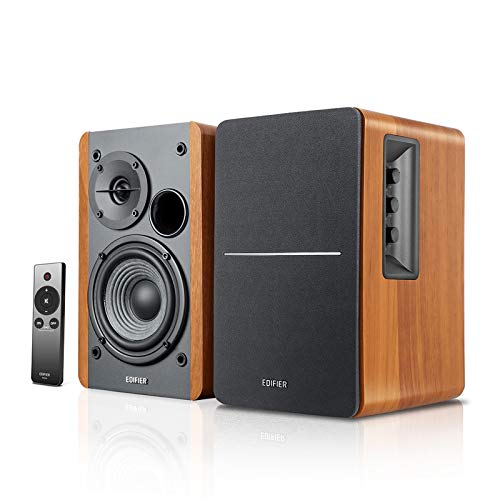
Edifier R1280Ts Powered Bookshelf Speakers
Best for: Stereo monitoring with dual RCA inputs
- Woofer Size
- 4-inch
- Total Wattage
- 42 Watts RMS
- Audio Inputs
- Dual RCA
- Acoustic Tuning
- Side panel EQ knobs
- Tweeter Type
- 13mm silk dome
- Speaker Type
- Powered
The Edifier R1280TS is a powered bookshelf speaker designed for stereo studio monitoring. It delivers 42W of continuous power through a 4-inch sub-woofer and a 13mm silk dome tweeter. You can connect two devices simultaneously via dual RCA inputs. The unit includes a subwoofer output port and side panel controls for bass and treble adjustments. It weighs 10.8 pounds and measures 17 inches in length.
- 42W continuous undistorted power output
- Dual RCA inputs for simultaneous device connection
- Subwoofer output with automatic detection
- Side panel EQ controls for bass and treble
- 42W power is lower than the Yamaha HS5
- 10.8 pounds weight is heavier than the Yamaha HS5
- 17-inch length is larger than the Yamaha HS5
- You need dual RCA inputs for multiple sources
- You want adjustable bass and treble on the side panel
- You plan to connect an external subwoofer
- You require Bluetooth wireless connectivity
- You need a lighter or more compact speaker
- You prefer higher power output than 42W
Verdict: Edifier R1280TS Bookshelf Speaker offers solid 42W power and dual inputs for stereo setups, making it a practical choice for users who value wired connectivity and bass adjustment over compact size.
Specifications side by side
| Spec | Yamaha HS5 5-Inch Studio Monitor | Edifier R1280Ts Powered Bookshelf Speakers |
|---|---|---|
| Woofer Size | 5" | 4-inch |
| Total Wattage | 70W | 42 Watts RMS |
| Audio Inputs | XLR, TRS phone jack | Dual RCA |
| Frequency Response | 54Hz-30kHz | – |
| Acoustic Tuning | Room Control, High TRIM | Side panel EQ knobs |
| Tweeter Type | 1" dome tweeter | 13mm silk dome |
| Speaker Type | Powered | Powered |
| Use | Studio Monitoring | Studio Monitoring |
| Features | – | Subwoofer Output |
| Color | Black | Brown |
| Recommended Use | – | Stereo |
| Placement | – | Bookshelf |
| Dimensions | 7 × 9 × 12 inches | 17 × 12.6 × 7.2 inches |
| Weight | 12 pounds | 10.8 pounds |
| Size | 5" | – |
| Model | HS5 | R1280TS |
Frequently asked questions
Which monitor is better for small mixing rooms?
The Yamaha HS5 is the better choice for tight spaces. Its compact dimensions of 9 by 12 by 7 inches fit easily on small desks. The Edifier R1280Ts is larger at 17 by 12.6 by 7.2 inches. This bulkier size requires more surface area. You should choose the Yamaha if your workspace is limited.
Do these speakers have built-in amplifiers?
Yes, both models are powered speakers. This means they include built-in amplifiers. You do not need an external receiver or amp. The Yamaha HS5 uses a 70W bi-amplified system. The Edifier R1280Ts provides 42W of power. Both are ready to connect directly to your audio source.
Can I add a subwoofer to either speaker?
The Edifier R1280Ts supports subwoofer output. This feature allows you to connect an external sub for deeper bass. The provided data does not mention a subwoofer output for the Yamaha HS5. If you need to expand your low-frequency response with an external unit, the Edifier offers that specific connectivity option.
Which speaker is lighter and easier to move?
The Edifier R1280Ts is lighter. It weighs 10.8 pounds. The Yamaha HS5 weighs 12 pounds. While both are relatively portable, the Edifier has a slight weight advantage. This difference is minor but relevant if you frequently rearrange your studio setup or need to transport the monitors to different locations.
Are these speakers suitable for stereo listening?
Yes, both are designed for stereo monitoring. The Edifier R1280Ts explicitly recommends stereo use. It includes dual RCA inputs for straightforward stereo pairing. The Yamaha HS5 is also a stereo monitor. You will use one unit for the left channel and one for the right. Both deliver accurate left-right separation for mixing.
What color options are available for these monitors?
The Yamaha HS5 comes in black. The Edifier R1280Ts is available in brown. These are the standard finishes for these specific models. The color choice may affect how the speakers blend with your studio decor. You should select the finish that matches your existing equipment or workspace aesthetic.

