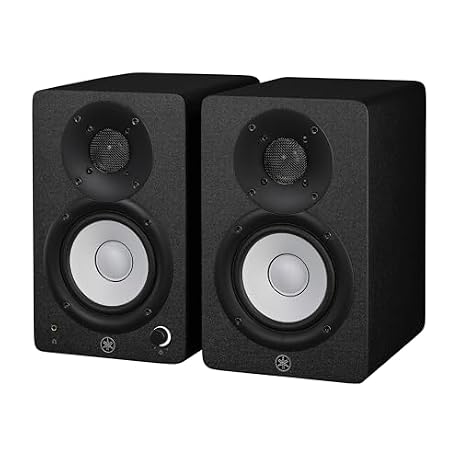
YAMAHA HS8 8-Inch Powered Studio vs YAMAHA HS7 7-Inch Powered Studio: Spec Comparison
As Amazon Associates, we earn from qualifying purchases. This means we may receive a small commission at no extra cost to you if you click through and make a purchase.
As an Amazon Associate we earn from qualifying purchases. Links on this page are affiliate links.
You are comparing the yamaha hs8 8 inch powered studio vs hs7 7 inch powered studio. Both are powered studio monitors designed for professional monitoring tasks. They share a similar goal of accurate sound reproduction. The main difference lies in the driver size and power output. The HS8 features an 8-inch woofer, while the HS7 uses a 7-inch unit. This affects bass response and overall system power. You need to check the specs to see which fits your room.
Woofer Size
8 inches
7 inches
Amplification
not listed
60W LF plus 35W HF
Color
White
Black
Frequency Response
not listed
43Hz – 30kHz
Connectivity
not listed
XLR and TRS phone jack
Choose the first if
- You need an 8-inch driver for deeper bass extension
- You prefer a white cabinet finish for your studio
- You want a larger cabinet for lower resonance
Choose the second if
- You need explicit power ratings for your setup
- You want a black cabinet finish
- You prefer a smaller footprint for your desk
Verdict
Choose the HS8 if you require an 8-inch woofer and a white finish. Choose the HS7 if you need explicit power specs and a black finish. Both are capable studio monitors, so pick based on your aesthetic and size needs.
Yamaha HS8 vs HS7 Spec Comparison
woofer size
Edge: Yamaha HS8 8-Inch White Studio Monitors
The Yamaha HS8 features an 8-inch woofer, while the Yamaha HS7 uses a 7-inch driver. This difference in cone size affects the low-frequency extension and overall bass response. A larger cone generally moves more air, which can provide deeper bass output. The HS8’s 8-inch transducer is designed for a wider bandwidth. The HS7’s 7-inch unit offers a slightly more compact footprint. You should choose based on your room size and bass requirements. The HS8 provides more physical driver surface area for low-end reproduction.
power output
Edge: Yamaha HS7 7-Inch Studio Monitor Pair
The Yamaha HS7 specifies a bi-amp system with 60W for the low-frequency driver and 35W for the high-frequency driver, totaling 95W of amplification. The Yamaha HS8 data does not list specific wattage figures for its amplifiers. This makes a direct power comparison difficult based on the provided specifications. The HS7 clearly states its power distribution between LF and HF units. You get exact numbers for the HS7. The HS8 lacks this specific power detail in the available data.
connectivity
Edge: Yamaha HS7 7-Inch Studio Monitor Pair
The Yamaha HS7 includes both XLR and TRS phone jack inputs, accepting balanced or unbalanced signals. This offers flexibility for various studio setups. The Yamaha HS8 data does not explicitly list its input types or connectivity options. While studio monitors often include these inputs, the HS8 specifications provided do not confirm them. The HS7 clearly supports both balanced and unbalanced connections. You have clear info on the HS7 inputs. The HS8 connectivity remains unspecified in the current data.
frequency response
Edge: Yamaha HS7 7-Inch Studio Monitor Pair
The Yamaha HS7 lists a frequency response range of 43Hz to 30kHz. This indicates its capability to reproduce very low and very high frequencies. The Yamaha HS8 data does not provide specific frequency response numbers. Without these figures, you cannot compare the exact low-end extension or high-frequency roll-off. The HS7 offers a defined range for technical evaluation. The HS8 lacks this specific technical metric in the provided data. You rely on the HS7 for measurable frequency data.
dimensions and weight
Edge: Tie
The Yamaha HS8 measures 15 inches in height and weighs 56 pounds for the pair. The Yamaha HS7 measures 18.1 inches in height and weighs 46.1 pounds for the pair. The HS8 is taller but heavier. The HS7 is shorter but lighter. These differences impact placement and mounting options. You need to consider desk or stand stability. The HS8’s larger woofer contributes to its weight. The HS7’s smaller driver results in less mass. Height differences affect viewing angle and proximity.
color options
Edge: Yamaha HS8 8-Inch White Studio Monitors
The Yamaha HS8 is available in White, Black, and Grey colors. The Yamaha HS7 is listed as Black in the provided data. The HS8 offers more visual variety for your studio environment. You can match the HS8 to lighter or darker decor schemes. The HS7 data only confirms a black finish. If color is a priority, the HS8 provides more choices. The HS7 is limited to black in the current data. You have more aesthetic options with the HS8.
noise reduction features
Edge: Yamaha HS8 8-Inch White Studio Monitors
The Yamaha HS8 highlights advanced noise reduction technology that controls vortex noise in the speaker port. This aims to improve clarity by reducing unwanted air vibrations. The Yamaha HS7 data does not mention specific port noise reduction technologies. The HS8 includes this engineering detail for sound purity. The HS7 lacks this specific feature description in the provided data. You get explicit info on the HS8’s port design benefits. The HS7’s noise management features are not detailed here.
Which Yamaha Studio Monitor Fits You
Mixers needing deep low-end extension
Our pick: Yamaha HS8 8-Inch White Studio Monitors
The HS8 features an 8-inch woofer compared to the HS7's 7-inch driver. This larger cone moves more air, providing stronger bass response and deeper low-frequency extension. If your mix work requires accurate monitoring of sub-bass frequencies, the HS8's larger transducer delivers the necessary physical presence and low-end power for professional studio environments.
Users prioritizing compact footprint and weight
Our pick: Yamaha HS7 7-Inch Studio Monitor Pair
The HS7 pair weighs 46.1 pounds total, significantly lighter than the HS8 bundle at 56 pounds. The HS7 also has a narrower depth of 13 inches versus the HS8's 30 inches. This smaller physical profile makes the HS7 easier to place on tight desks or smaller stands without dominating your workspace or requiring heavy-duty mounting.
Producers valuing detailed power specifications
Our pick: Yamaha HS7 7-Inch Studio Monitor Pair
The HS7 explicitly lists a 60W LF plus 35W HF bi-amp system for 95W total power. It also specifies a 43Hz to 30kHz frequency response. If you prefer transparent technical data regarding amplification and bandwidth limits, the HS7 provides these specific performance metrics, helping you verify its suitability for your specific acoustic requirements.

Yamaha HS8 8-Inch White Studio Monitors
Best for: Professional studio monitoring with accurate sound reproduction
- Acoustic Tuning
- Two response controls
- Speaker Type
- Powered
- Woofer Size
- 8"
- Use
- Studio Monitoring
- Color
- White
- Driver Size
- 8-Inch
The Yamaha HS8 is an 8-inch powered studio monitor designed for accurate sound reproduction. It features a low resonance enclosure and advanced noise reduction technology to minimize unwanted vibrations. The unit includes two response controls to adapt to different room acoustics. This white 2-pack bundle measures 20 by 15 inches and weighs 56 pounds. It suits professionals needing precise monitoring in a studio environment.
- 8-inch woofer driver size for wide bandwidth
- Advanced noise reduction technology reduces port vortex
- Low resonance enclosure design for accuracy
- Two response controls for room adaptation
- Heavier build at 56 pounds compared to lighter alternatives
- Larger physical footprint with 20-inch width
- 8-inch driver size may be excessive for small spaces
- You require high-fidelity monitoring for professional studio work
- You have a dedicated space for larger studio monitors
- You need precise acoustic control with adjustable response settings
- You need a compact monitor for a small desk setup
- You prefer a lighter speaker for easy mobility
- You are looking for a smaller 7-inch driver option
Verdict: Yamaha HS8 8-Inch Powered Studio Monitor is the right choice if you need powerful, accurate monitoring in a dedicated studio space. It fits professionals who prioritize sound precision over compact size.

Yamaha HS7 7-Inch Studio Monitor Pair
Best for: studio monitoring with 7-inch drivers
- Total Wattage
- 95W
- Audio Inputs
- XLR, TRS phone jack
- Frequency Response
- 43Hz – 30kHz
- Speaker Type
- Powered
- Use
- Studio Monitoring
- Color
- Black
The Yamaha HS7 is a pair of black powered studio monitors designed for professional monitoring. It features a 43Hz to 30kHz frequency response and a 95W bi-amp system with 60W for low frequencies and 35W for high frequencies. The unit includes XLR and TRS inputs for balanced or unbalanced signals. This 46.1-pound set suits users needing reliable studio performance with standard connectivity options.
- 95W total bi-amp power output
- 43Hz to 30kHz frequency response
- XLR and TRS input options
- Includes a pair of monitors
- 7-inch driver size is smaller than the HS8's 8-inch option
- Total weight of 46.1 pounds is substantial for placement
- Lower low-frequency extension compared to the 8-inch model
- You need a stereo pair for studio monitoring
- You prefer a 7-inch driver size for your room
- You require both XLR and TRS connectivity
- You need deeper bass extension than 43Hz
- You prefer a single monitor over a pair
- You want a lighter setup than 46.1 pounds
Verdict: Yamaha HS7 7-Inch Studio Monitor Pair offers balanced power and connectivity for studio work. It fits users who prioritize a 7-inch driver and standard balanced inputs over the deeper bass of the larger HS8.
Specifications side by side
| Spec | Yamaha HS8 8-Inch White Studio Monitors | Yamaha HS7 7-Inch Studio Monitor Pair |
|---|---|---|
| Total Wattage | – | 95W |
| Audio Inputs | – | XLR, TRS phone jack |
| Frequency Response | – | 43Hz – 30kHz |
| Acoustic Tuning | Two response controls | – |
| Speaker Type | Powered | Powered |
| Woofer Size | 8" | – |
| Use | Studio Monitoring | Studio Monitoring |
| Color | White | Black |
| Driver Size | 8-Inch | – |
| Dimensions | 30 × 20 × 15 inches | 13 × 21.7 × 18.1 inches |
| Weight | 56 pounds | 46.1 pounds |
| Model | HS8 | CHS5MP |
Frequently asked questions
Which monitor is better for small rooms?
The Yamaha HS7 is often better for smaller spaces. It features a 7-inch driver, which provides balanced power without overwhelming a compact room. Its physical dimensions are 21.7 inches wide and 18.1 inches high. This size makes it easier to position on tight desks compared to the larger HS8.
Do these speakers require an external amplifier?
No, both the Yamaha HS8 and HS7 are powered monitors. They have built-in amplifiers, so you do not need an external amp. You simply connect them to your audio interface or computer. This design simplifies your studio setup by reducing the number of cables and devices required.
What is the weight difference between the HS8 and HS7?
The HS8 is heavier than the HS7. The HS8 weighs 56 pounds, while the HS7 weighs 46.1 pounds. This 9.9-pound difference affects how you mount or move them. The HS8 is built for stability in a fixed studio position, whereas the HS7 is slightly easier to relocate.
Are the HS8 and HS7 bi-amplified?
Yes, both models use bi-amplified designs. Each speaker has separate amplifiers for the woofer and the tweeter. This ensures precise control over each driver. The HS8 uses an 8-inch woofer, and the HS7 uses a 7-inch driver. This separation helps maintain clarity across different frequency ranges.
Can I use these monitors for mixing music?
Yes, both are designed for professional studio monitoring and mixing. The HS8 is ideal if you need powerful, accurate monitoring in a dedicated space. The HS7 offers balanced power for users who prioritize a 7-inch driver. Both provide the sound precision required for critical listening and detailed mix work.
Do these speakers come in different colors?
Yes, the color options differ between the two models. The Yamaha HS8 is available in white. The Yamaha HS7 is typically found in black. This allows you to match the speakers to your studio decor. The visual difference does not affect the audio performance or connectivity options.